

+2 More

Ancient City of Nysa
Location | Sultanhisar Türkiye Aydın | ||||||||
|---|---|---|---|---|---|---|---|---|---|
Foundation | Late 3rd century BC | ||||||||
Significance | City of education and culture | ||||||||
Architectural Structures | Theater, Library, Gymnasion, Gerontikon (Council of Elders), Stadium, Tunnel, Bridges, Plateia (Main Street), Agora | ||||||||
Archaeological Findings | Relief of Sleeping Eros, Roman provincial coins, Tableware and unguentaria from the Hellenistic and Roman periods, Monumental podium friezes | ||||||||
Notable Figures | Strabo (Geographer), Aristodemos (Teacher) | ||||||||
In antiquity, the region of Caria, located in western Anatolia, was one of the centers of social, economic, and cultural development, with numerous important settlements. One of these settlements, the ancient city of Nysa, is located approximately 3 kilometers northwest of the Sultanhisar district in the modern-day province of Aydın. The ancient author Strabo described Nysa as a “double city,” noting that it spread along the foothills of the Mesogis Mountains and was divided into two parts by a stream running through its center.【1】

The foundation of the city dates back to the Hellenistic Period, specifically during the Seleucid Kingdom. According to Strabo, the city's foundation was attributed to three Spartan-origin brothers named Athymbros, Athymbrados, and Hydrelos. However, during Strabo’s time, the people of Nysa recognized only Athymbros as the founder.
Nysa had a twin-city layout, spread across the foothills of the Mesogis Mountains and divided by a stream running through its center. Because of this unique geographical feature, Strabo described the city as a “double city separated by a gorge formed by a torrent.”
During the Roman period, Nysa experienced significant architectural and social development. With the incorporation of the Caria region into the Roman Empire, Nysa became part of the Province of Asia. Inscriptions and architectural remains indicate that a certain aristocratic class had influence in the city, supporting the construction and maintenance of public buildings. The city flourished both architecturally and culturally during the Roman era.
Archaeological evidence shows that Nysa was continuously, though intermittently, inhabited from the Hellenistic Period until the end of the Byzantine era. The limited number of ceramics from the 3rd century AD suggests reduced activity during that time. A sudden decline in the 7th century is believed to be related to Sasanian invasions and earthquakes. Settlement resumed only in the 12th century.
Nysa’s vibrancy during the Roman period is reflected not only in its monumental structures—such as the theater, gymnasium, library, gerontikon, and agora—but also in its intellectual life. The fact that notable figures like Strabo were educated here enhances the city’s historical importance.
Nysa is a city rich in architectural texture, planned in harmony with its topography and home to some of the most striking examples of Roman architecture in Anatolia. Its buildings are notable not only for their aesthetics but also for demonstrating the engineering skills of the period.
Nysa’s theater covers an area of approximately 73 by 99 meters and was constructed in the Late Hellenistic Period (1st century BC). The cavea (seating area) was designed with a curvature exceeding a semicircle by 12 degrees. The scaenae frons (multi-story stage façade) was built between AD 120–140, destroyed by an earthquake in AD 178, and rebuilt between AD 180–200 as a three-story structure. It shares architectural features with the theaters of Perge, Side, and Hierapolis, including a high podium and rich sculptural reliefs. The friezes depict mythological themes such as the life of Dionysus and the marriage of Pluto and Kore (Persephone).
Located northwest of the agora, the Gerontikon is a closed meeting hall with a seating capacity of approximately 700. It features a cavea and a two-story stage façade. Architectural evidence—including a monumental entrance (propylon), forecourt, and interior design—indicates that it was constructed in the 2nd century AD by Sextus Iulius Antoninus Pythodoros. The building likely hosted cultural and political gatherings, signifying its importance in urban civic life.
The gymnasium served as a complex for the physical and intellectual education of young men. It included changing rooms, bathing areas, classrooms, and sports facilities, typical of ancient educational institutions. Adjacent to it, the library is considered one of the best-preserved ancient libraries in Anatolia. Architecturally similar to the Library of Ephesus, it was built with the financial support of a local aristocratic class. The interior walls feature niches designed to hold scrolls.

Nysa’s stadium was planned in connection with the Plateia (main street), which runs in a north-south direction. A tunnel that runs along the eastern side of the stadium and connects to the Plateia via a bridge is a remarkable example of architectural and engineering skill. Designed to facilitate movement between different parts of the city, this tunnel system reflects Roman engineering as applied to urban planning.
In Nysa, especially around the Plateia, three stone bridges were constructed, notable both for their architectural value and functionality. These bridges connect the eastern and western slopes of the city, overcoming the natural division created by the terrain through sophisticated engineering. Excavations around Bridge No. 2 have revealed a dense concentration of architectural remains.
The Plateia, the city’s widest street, is approximately 9 meters wide. Numerous architectural remains have been discovered during excavations around this avenue. The building blocks that run along its north and south porticoes were planned as arcaded commercial and public spaces. Ceramic vessels and unguentaria found along the street provide insight into the daily life of the inhabitants.
The agora served as the social and economic center of Nysa. Located to its north, the Market Basilica was a large public building with both commercial and administrative functions. The structure is distinguished by its colonnaded galleries and multi-story architectural plan.
The agora, as the focal point of Nysa’s social life, also supported the city’s economic and commercial activities. Ceramic tableware and unguentaria found during excavations along the Plateia offer valuable information about the city's daily life. These artifacts, dating to the Hellenistic and Roman periods, are particularly represented by Eastern Sigillata B ware and red-slipped Phocaean ceramics from the Late Antique period.
Among the notable archaeological finds in Nysa is a funerary urn lid featuring a “Sleeping Eros” relief, which documents the presence of cremation traditions in the city. The depiction of a winged Eros resting on a lion skin illustrates how a motif originating in the Hellenistic period was adapted and used during the Roman era.
Documentary of the Ancient City of Nysa – TRT 2
The ancient city of Nysa stood out not only as a center of education and culture but also as a settlement rich in mythological and religious representations. The city’s mythological identity was largely shaped around the cult of Dionysus. Both written sources and archaeological findings reveal how deeply Nysa was intertwined with sacred narratives.
According to mythology, the infant Dionysus was entrusted by the god Hermes to the nymphs of Mount Nysa, where he was raised. This myth linked Dionysus directly to the city and established it as one of his sacred places. The tale of Dionysus being raised in Nysa formed the foundation of the city’s mythological image. The people of Nysa embraced Dionysus as their protective deity and depicted mythological scenes from his life in the reliefs of their theater.
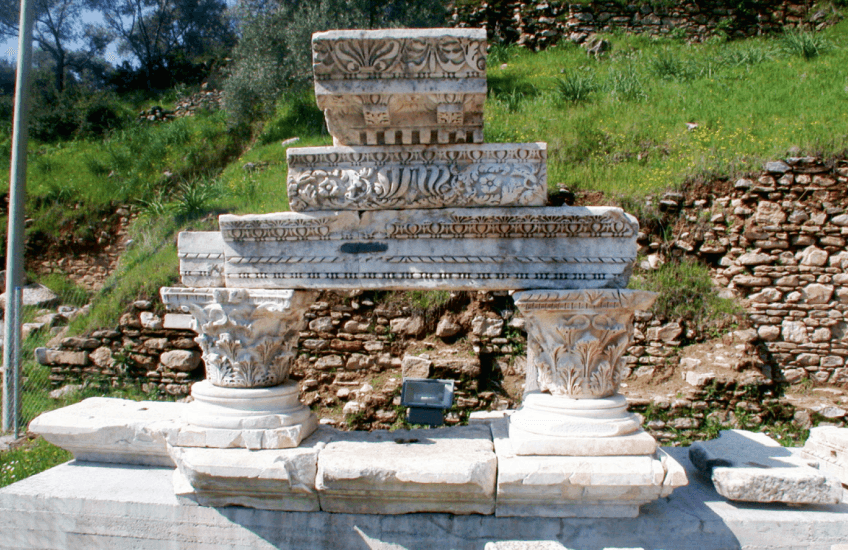
The podium friezes of Nysa’s theater stage building portray scenes from Dionysus’ birth, childhood, and various episodes from his life. Notably, his encounter with Ariadne, and symbolic elements associated with intoxication and nature are illustrated through detailed iconography. The same friezes also include mythological scenes from the underworld, such as the marriage of Pluto and Kore (Persephone), indicating that beliefs in chthonic deities and agricultural cycles were also significant in Nysa.
Although no specific temples have been identified within the city, information about local religious practices can be inferred from necropolis areas and tomb architecture. In the western necropolis of the city, examples of cremation burials have been uncovered. Among these, a funerary urn lid carved with a “Sleeping Eros” relief stands out as a significant religious symbol. This marble artifact, featuring a winged Eros reclining on a lion skin, carries emotional connotations related to child death and also alludes to beliefs in immortality and rebirth. Dated to the Roman Imperial Period, the piece exemplifies the diversity of Nysa’s burial traditions and the artistic expression of its religious symbolism.

A relief from the ancient city of Nysa.
The ancient city of Nysa, located in western Anatolia, was a multifaceted settlement that reflected the level of advancement achieved during the Roman period in education, culture, art, and engineering. As the birthplace of prominent intellectuals such as Strabo, and home to monumental architecture combined with refined aesthetics, Nysa has maintained its historical significance as a major center of education and culture in the Caria region.
Ankara Üniversitesi. "Nysa Antik Kenti." Access Date: 02.04.2025. https://www.ankara.edu.tr/dizin/akademik_kazilar/nysa-antik-kenti
Diler, Muhammed, ve Serdar Hakan Öztaner. “Nysa Antik Kenti Kazıları Konservasyon-Restorasyon Çalışmaları.” ASBİDER Akademi Sosyal Bilimler Dergisi 8, no. 22 (2021): 183–203.
Keskin, Hava. “‘Uyuyan Eros’ Kabartmalı Urne Kapaklarına Nysa Kentinden Bir Örnek.” Nevşehir Hacı Bektaş Veli Üniversitesi Sosyal Bilimler Enstitüsü Dergisi 12, no. 3 (Eylül 2022): 1701–1710.
Köroğlu, Tolga, ve Serdar Hakan Öztaner. “Nysa ad Maeandrum’un Son Dönem Sakinlerine Dair Yeni Antropolojik Bulgular.” Antropoloji 45 (2023): 96–108.
Müze Kart. "Nysa Sultanhisar Örenyeri." Access Date: 02.04.2025. https://muze.gov.tr/muze-detay?DistId=MRK&SectionId=NYS01
Sönmez, Burak. “Nysa Ad Maeandrum Cadde 1–Plateia Hellenistik ve Roma Dönemi Sofra Kapları ve Unguentariumları.” Süleyman Demirel Üniversitesi Fen-Edebiyat Fakültesi Sosyal Bilimler Dergisi, no. 45 (Aralık 2018): 11–42.
Sultanhisar Belediyesi. "Nysa Antik Kenti." Access Date: 02.04.2025. https://www.sultanhisar.bel.tr/nysa-antik-kenti.html
T.C. Kültür ve Turizm Bakanlığı. Aydın İl Kültür ve Turizm Müdürlüğü. "Nysa." Access Date: 02.04.2025. https://aydin.ktb.gov.tr/TR-64434/nysa.html
T.C. Kültür ve Turizm Bakanlığı. Eğitim ve Kültür Kenti Nysa. Brochure. Access Date: 02.04.2025. https://muze.gov.tr/s3/MysFileLibrary/Ayd%C4%B1n%20Nysa%20%C3%96ren%20Yeri-58b03f15-4703-489d-85e3-2c110fa6dcbc.pdf
TRT 2. "Nysa Antik Miras 11. Bölüm." Documentary. Access Date: 02.04.2025. https://www.trt2.com.tr/kultur/antik-miras/nysa-or-antik-miras-or-11-bolum-23082399
Turkish Museums. "Aydın Nysa Örenyeri." Access Date: 02.04.2025. https://www.turkishmuseums.com/museum/detail/1987-aydin-nysa-orenyeri/1987/1
Özbil, Canan. “Nysa ad Maeandrum’da Ele Geçen Roma Eyalet Sikkeleri.” Anadolu / Anatolia 49 (2023): 113–155.
Üreten, Hüseyin. “Bir Antikçağ Okul—Gymnasion-Kütüphanesi: Nysa Kütüphanesi.” Türk Kütüphaneciliği 20, no. 2 (2006): 207–216.
Youtube. "Nysa | Antik Miras | 11. Bölüm" TRT 2. Access Date: 02.04.2025. https://www.youtube.com/watch?v=H7CY_5rrL4E&t=1202s
[1]
Muhammed Diler and Serdar Hakan Öztaner, “Nysa Antik Kenti Kazıları Konservasyon-Restorasyon Çalışmaları,” ASBİDER Akademi Sosyal Bilimler Dergisi 8, no. 22 (2021): 183–203. p. 185

Ancient City of Nysa
Location | Sultanhisar Türkiye Aydın | ||||||||
|---|---|---|---|---|---|---|---|---|---|
Foundation | Late 3rd century BC | ||||||||
Significance | City of education and culture | ||||||||
Architectural Structures | Theater, Library, Gymnasion, Gerontikon (Council of Elders), Stadium, Tunnel, Bridges, Plateia (Main Street), Agora | ||||||||
Archaeological Findings | Relief of Sleeping Eros, Roman provincial coins, Tableware and unguentaria from the Hellenistic and Roman periods, Monumental podium friezes | ||||||||
Notable Figures | Strabo (Geographer), Aristodemos (Teacher) | ||||||||
History
Architectural Structures
Theater
Gerontikon (Council of Elders)
Gymnasium and Library
Stadium and Tunnel
Bridges
Street 1 (Plateia)
Agora and Market Basilica
Urban Life and Social Structure
Mythological and Religious Structure
Cult of Dionysus and Mythological Context
Cult Areas and Burial Traditions
This article was created with the support of artificial intelligence.