This article was automatically translated from the original Turkish version.
Registration Number | 493 | ||||||||
|---|---|---|---|---|---|---|---|---|---|
Registration Date | 13.03.2020 | ||||||||
Application Number | C2018/128 | ||||||||
Application Date | 21.06.2018 | ||||||||
Name of the Geographical Indication | Oğuzlar Walnut | ||||||||
Product / Product Group(s) | Walnut / Processed and unprocessed fruits and vegetables and mushrooms | ||||||||
Type of Geographical Indication | Place of origin | ||||||||
Applicant/Registrant(s) | Oğuzlar Walnut Producers Agricultural Cooperative | ||||||||
Address of the Registrant | Evrensel Street No:39 Karadonlu Neighborhood Oğuzlar / ÇORUM | ||||||||
Geographical Boundary | Oğuzlar District Çorum Province | ||||||||
Oğuzlar walnut is a local walnut variety registered under its place of origin, cultivated within the boundaries of Oğuzlar district, Çorum Province, and derived from the ‘Oğuzlar 77’ variety. This walnut variety is grown at elevations between 510 and 1260 meters and is distinguished by its gray trunk, densely branched tree structure, and fruits with pointed tips and dark green outer shells. The kernel is light yellow in color and can be easily separated intact from the shell. The average fruit weight ranges from 7.8 to 10.5 grams and the kernel ratio is at least 43%. When dried for consumption, the walnut contains at least 95% dry matter and 67% oil.
Oğuzlar walnut is cultivated primarily from the ‘Oğuzlar 77’ variety. Production occurs within the district boundaries at elevations between 510 and 1260 meters and consistent fruit yield is maintained as long as climatic conditions are favorable. The tree structure is notable for its gray trunk and dense branching pattern. Particularly, its branching habit distinguishes this walnut variety from others.
The outer shell of the fruit is dark green with a slightly pointed tip, while the kernel is light yellow and retains this color for extended periods. The ease with which the kernel can be removed intact from the shell simplifies the cleaning process and eliminates the need for mechanical tools.
The shoots of Oğuzlar walnut develop in April and leaf fall occurs in November. The female flower stigmas on the fruit can be observed for approximately 15 days after pollination. Depending on climatic conditions, these stigmas are found to shed approximately two weeks after pollination. The plant maintains high homogeneity when propagated both vegetatively and generatively.
The fruit weight of Oğuzlar walnut ranges from 7.8 to 10.5 grams, while the kernel weight is at least 3.3 grams. The kernel ratio exceeds 43%. Shell thickness measures between 1.20 and 1.70 mm. In terms of chemical composition, the kernel contains at least 95% dry matter and 67% oil. These values indicate the product’s stability in terms of shelf life and nutritional value.
Oğuzlar district possesses suitable climatic and soil conditions for walnut cultivation. The naturally occurring walnut population in the region is well adapted to these conditions. Simultaneous flowering of male and female flowers facilitates natural pollination and fertilization. The trees are not selective regarding soil type; however, ideal growing conditions are provided by alluvial soils rich in organic matter, with low water retention capacity and good drainage. Planting is carried out at spacings of 8x8 m, 10x10 m, or 10x12 m in such soils. Existing populations on suitable soils are also preserved to establish production areas. Soil aeration and supplementation with organic and chemical fertilizers are essential for maintaining product standards.
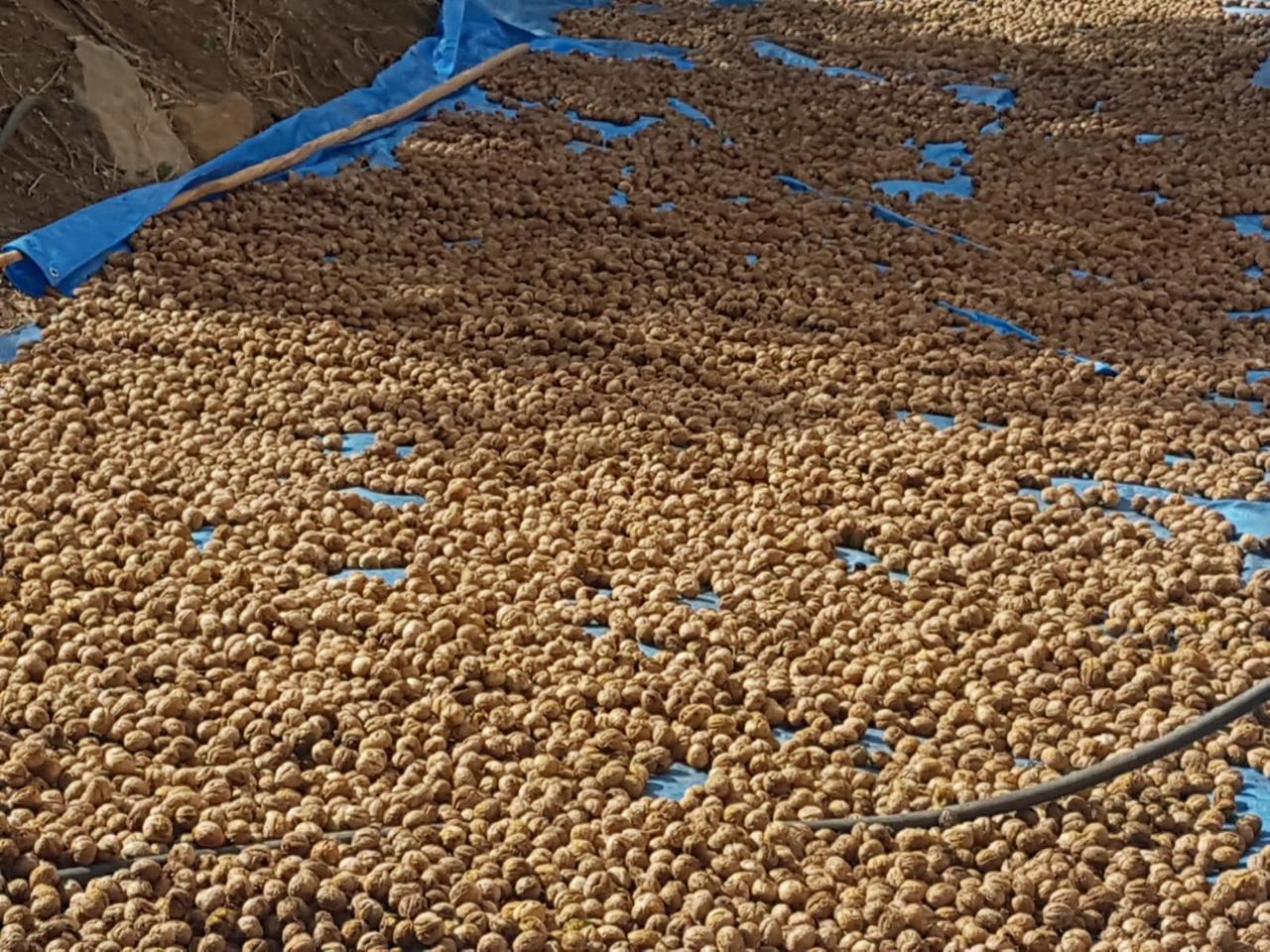
The harvest period coincides with the end of September, and the produce is dried before being marketed. Oğuzlar walnut exhibits high fruit yield and is classified as having a medium to late maturation period.
Quality control of the product is conducted under the coordination of the Oğuzlar Walnut Producers Agricultural Cooperative. The inspection board consists of a representative of the cooperative, an expert from the Department of Food Engineering at Hitit University, and an expert from the Çorum Provincial Directorate of Agriculture and Forestry. Inspections are carried out at least once annually as routine procedures; additional inspections may be conducted upon complaint or as needed.
The following criteria are evaluated during inspections:
The board may seek support from experts or institutions in the public or private sector when necessary. The registered cooperative is also responsible for safeguarding legal rights.
Turk Patent and Trademark Office. "Oğuzlar Cevizi." Accessed July 20, 2025. https://ci.turkpatent.gov.tr/cografi-isaretler/detay/38583.
Turkish Patent and Trademark Office. "Oğuzlar Cevizi Coğrafi İşaret Tescil Belgesi." PDF. Accessed July 20, 2025. https://ci.turkpatent.gov.tr/Files/GeographicalSigns/8b5b7065-babf-49f5-a2ec-afcd6699b7e8.pdf.

Registration Number | 493 | ||||||||
|---|---|---|---|---|---|---|---|---|---|
Registration Date | 13.03.2020 | ||||||||
Application Number | C2018/128 | ||||||||
Application Date | 21.06.2018 | ||||||||
Name of the Geographical Indication | Oğuzlar Walnut | ||||||||
Product / Product Group(s) | Walnut / Processed and unprocessed fruits and vegetables and mushrooms | ||||||||
Type of Geographical Indication | Place of origin | ||||||||
Applicant/Registrant(s) | Oğuzlar Walnut Producers Agricultural Cooperative | ||||||||
Address of the Registrant | Evrensel Street No:39 Karadonlu Neighborhood Oğuzlar / ÇORUM | ||||||||
Geographical Boundary | Oğuzlar District Çorum Province | ||||||||
Botanical and Morphological Characteristics
Fenological Development Process
Physical and Chemical Properties
Cultivation Methods and Ecological Adaptation
Monitoring and Quality Control