



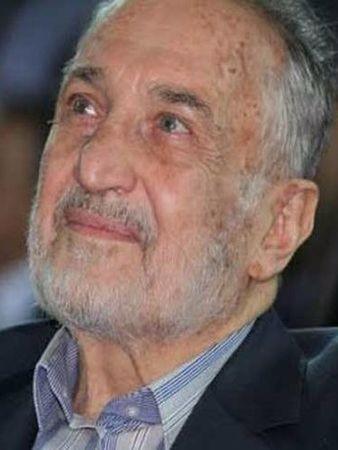
Oğuzhan Asiltürk (25 May 1935, Malatya – 1 October 2021, Ankara) was a politician and one of the leading figures of the Millî Görüş movement, who played an active role in Türkiye’s politics for over half a century. As one of the close associates of Necmettin Erbakan, he contributed to both the theoretical and practical dimensions of the National Outlook line and held positions as a member of parliament, minister, and party leader.
Oğuzhan Asiltürk was born on 25 May 1935 in the Hekimhan district of Malatya. He completed his primary and secondary education in Malatya before moving to Istanbul for higher education. He graduated from the Faculty of Civil Engineering at Istanbul Technical University (İTÜ). He later applied his technical expertise particularly in urban planning and infrastructure policies during his political roles.
After university graduation, he worked as an engineer on various public and private sector projects. He also established a private consultancy. Through his engineering firm, Asiltürk Proje, based in Ankara, he demonstrated expertise in construction, infrastructure, and consulting.
Oğuzhan Asiltürk began his political career in 1970 with the National Order Party (MNP). After the closure of MNP, he joined the founding cadre of the National Salvation Party (MSP), established in 1972. He was elected as a member of parliament for Ankara in the 1973 and 1977 elections and served in the Grand National Assembly of Türkiye. In the 1974 coalition government formed by the CHP and MSP, he served as Minister of Interior, playing an active role in shaping Türkiye’s security and internal governance policies.
Subsequently, he served in the National Front coalitions of 1975 and 1977, first as Minister of Interior and later as Minister of Industry and Technology.

Oğuzhan Asiltürk of MSP (center) making a statement to the press alongside Süleyman Arif Emre (right) on 16 July 1977. (Kadir Şengün – Anadolu Agency)

On 1 October 1977, then State Minister and Deputy Prime Minister Necmettin Erbakan (center) at the opening ceremony of the Yozgat Cement Factory. Attending the ceremony were (from left to right) Minister of Construction and Settlement Recai Kutan, Minister of Labor Fehmi Cumalioğlu, State Minister Ali Seki Erek, Deputy Prime Minister Necmettin Erbakan, Minister of Industry and Technology Oğuzhan Asiltürk, and Yozgat MP İhsan Arslan. (Mehmet Ünlü – Anadolu Agency)
Following the military coup on 12 September 1980, all political activities were suspended and Oğuzhan Asiltürk’s term as a member of parliament ended. He was tried under the MSP case but was acquitted. In the subsequent period, he was banned from politics for ten years. His political ban was lifted after the 1987 constitution referendum, after which he returned to political life.
After the lifting of his ban, he joined the Refah Partisi (Welfare Party, RP) and was elected as its General Secretary. He returned to the Grand National Assembly in the 1991 general elections as a deputy for Malatya. The party emerged as the leading party in the 1995 elections, during which Asiltürk became a key figure in its decision-making structures. After the RP was shut down by the Constitutional Court in 1998, he moved to the Fazilet Partisi (Virtue Party, FP). He was among the founding members of the subsequent Saadet Partisi (Felicity Party, SP) and played a significant role in ensuring the continuity of the movement.
Although he was not actively involved in day-to-day politics during the 2000s, he served as the Chairman of the High Consultative Council (YİK), one of the most authoritative bodies within the Saadet Partisi. He also held the presidency of the Görüş Foundation. He devoted considerable effort to maintaining internal party balance and ensuring stability in the post-Erbakan era.
Oğuzhan Asiltürk, known for his modest lifestyle, had limited public information available regarding his family life. He had four children from his marriage to Asiltürk.
On 13 September 2021, he was hospitalized in Ankara with a diagnosis of COVID-19. As his condition worsened, he continued to receive intensive care. Despite all medical interventions, he passed away on 1 October 2021 at the age of 86.
Anadolu Ajansı. "Milli Görüşün Çınarlarından Oğuzhan Asiltürk Vefatının Birinci Yılında Anılıyor." Accessed September 30, 2022. https://www.aa.com.tr/tr/pg/foto-galeri/milli-gorusun-cinarlarindan-oguzhan-asilturk-vefatinin-birinci-yilinda-aniliyor
Biographies, "Oğuzhan Asiltürk", Accessed January 5, 2024, https://www.biyografiler.com/kimdir/oguzhan-asilturk
Biography, "Oğuzhan Asiltürk", Accessed October 1, 2021. https://www.biyografya.com/tr/biographies/oguzhan-asilturk-752e3d75
Haber7. "Oğuzhan Asiltürk kimdir ve nerelidir? Oğuzhan Asiltürk biyografisi." Accessed September 30, 2022. https://www.haber7.com/biyografi/haber/3146377-oguzhan-asilturk-kimdir-ve-nerelidir-oguzhan-asilturk-biyografisi
Yeni Akit Gazetesi. "Oğuzhan Asiltürk kimdir?" Accessed November 24, 2016. https://www.yeniakit.com.tr/biyografi/oguzhan-asilturk

Childhood and Education
Engineering and Professional Career
Entry into Politics and MSP Years
Post-1980 Coup Period and Political Ban
Refah Partisi and the 1990s
Saadet Partisi and Chairmanship of the YİK
Personal Life and Death