This article was automatically translated from the original Turkish version.
Type of Geographical İndication | Traffic Sign | ||||||||
|---|---|---|---|---|---|---|---|---|---|
Registration Number | 127 | ||||||||
Registration Date | 22.02.2010 | ||||||||
Product / Product Group(s) | Meals and soups | ||||||||
Province(s) | Erzurum | ||||||||
Applicant/Registrant(s) | Oltu Chamber of Commerce and Industry | ||||||||
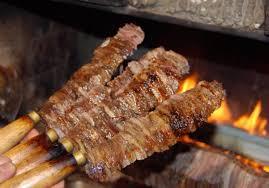
Oltu cağ kebabı is a type of kebab characterized by a unique production technique and ingredient specifications native to the Oltu district of Erzurum. It is prepared by grilling meat on a horizontal skewer over a wood fire. It was officially registered as a geographical indication by the Turkish Patent Institute on 3 July 2009, with effect from 17 May 2007. The registered holder is the Oltu Chamber of Commerce and Industry.
Distinctive Characteristics
The fundamental features that distinguish Oltu cağ kebabı from other kebab varieties are as follows:
Historical and Cultural Recognition
Oltu cağ kebabı has been prepared for many years using traditional methods unique to local artisans in the Oltu region, and this method has been widely adopted by the public. In a dictionary published by the Turkish Language Association in 1945, it was defined as “Oltu Kebabı”; various civil society organizations and the Anatolian Folk Cuisine Platform have since accepted it under the name “Oltu Cağ Kebabı”.
Compliance with the geographical indication requirements is monitored by a three-member commission established under the coordination of the Oltu Chamber of Commerce and Industry. The commission consists of one representative from Oltu Municipality, one food engineer from Oltu Vocational High School, and one representative from the Oltu Chamber of Commerce. Inspections are conducted annually on a regular basis and may be carried out at any time upon request or complaint. Inspection reports are submitted to the Turkish Patent Institute.
Oltu cağ kebabı may be produced within the borders of Türkiye, provided that it adheres to the technical specifications defined within the boundaries of the Oltu district of Erzurum Province.
Turk Patent and Trademark Office. "Oltu Cağ Kebabı." Geographical Indications Portal. Accessed October 24, 2025. https://ci.turkpatent.gov.tr/cografi-isaretler/detay/37981.
Turkish Patent and Trademark Office. "Oltu Cağ Kebabı Coğrafi İşaret Tescil Belgesi." Accessed October 24, 2025. https://ci.turkpatent.gov.tr/Files/GeographicalSigns/127.pdf.

Type of Geographical İndication | Traffic Sign | ||||||||
|---|---|---|---|---|---|---|---|---|---|
Registration Number | 127 | ||||||||
Registration Date | 22.02.2010 | ||||||||
Product / Product Group(s) | Meals and soups | ||||||||
Province(s) | Erzurum | ||||||||
Applicant/Registrant(s) | Oltu Chamber of Commerce and Industry | ||||||||
Cooking Technique
Service Style
Monitoring Mechanism