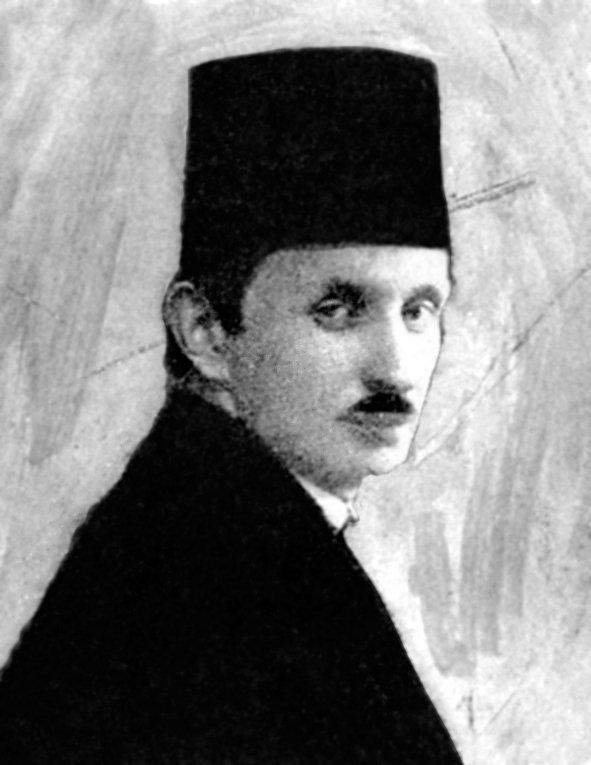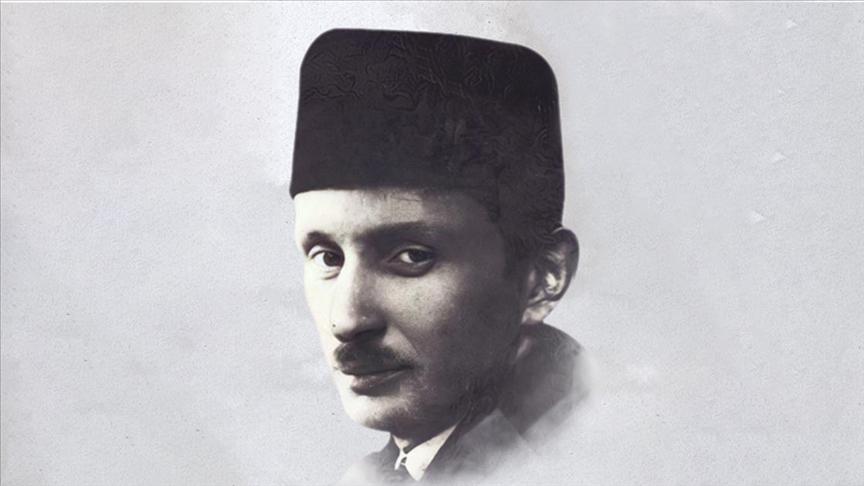
+2 More

Profession(s) | Officer Teacher Writer | ||||||||
|---|---|---|---|---|---|---|---|---|---|
Place of Death | Istanbul Haydarpaşa Hospital | ||||||||
Death | 6 March 1920 | ||||||||
Place of Birth | Balıkesir Gönen | ||||||||
Education | Military Academy Edirne Military High School Eyüp Military Intermediate School | ||||||||
Famous Stories | Yüksek Ökçeler Falaka Beyaz Lale Pembe İncili Kaftan Kaşağı | ||||||||
Important Works | Yalnız Efe Ashâb-ı Kehfimiz Efruz Bey | ||||||||
Teaching | Istanbul Male Teachers School Kabataş Sultanate | ||||||||
Narrative Approach | Maupassant-style incident story | ||||||||
Associated Movement | New Language Movement | ||||||||
Birth | 11 March 1884 | ||||||||
Literary Genre | Article Poetry Story | ||||||||
Literary Movement | National Literature | ||||||||
Ömer Seyfettin was a writer, teacher, and intellectual who played a significant role in the development of Turkish short-story writing in the early twentieth century. Born on 11 March 1884 in Gönen district of Balıkesir, he received military education and served for a time as an officer in the Ottoman Army. During his military service, he was stationed in the Balkans, captured during the Balkan Wars, and after his release from captivity, transitioned to civilian life where he continued his careers as a teacher and writer. Throughout his literary life, he produced stories, articles, and texts in various genres, and is particularly renowned for his short stories. He participated in the Yeni Lisan movement centered around the magazine Genç Kalemler and published writings aligned with the idea of linguistic simplification. His stories frequently addressed social life, individual-society relations, wartime experiences, and the social issues of his era. Ömer Seyfettin died in Istanbul in 1920; his works were collected and published posthumously and continue to be studied in Turkish literary research.
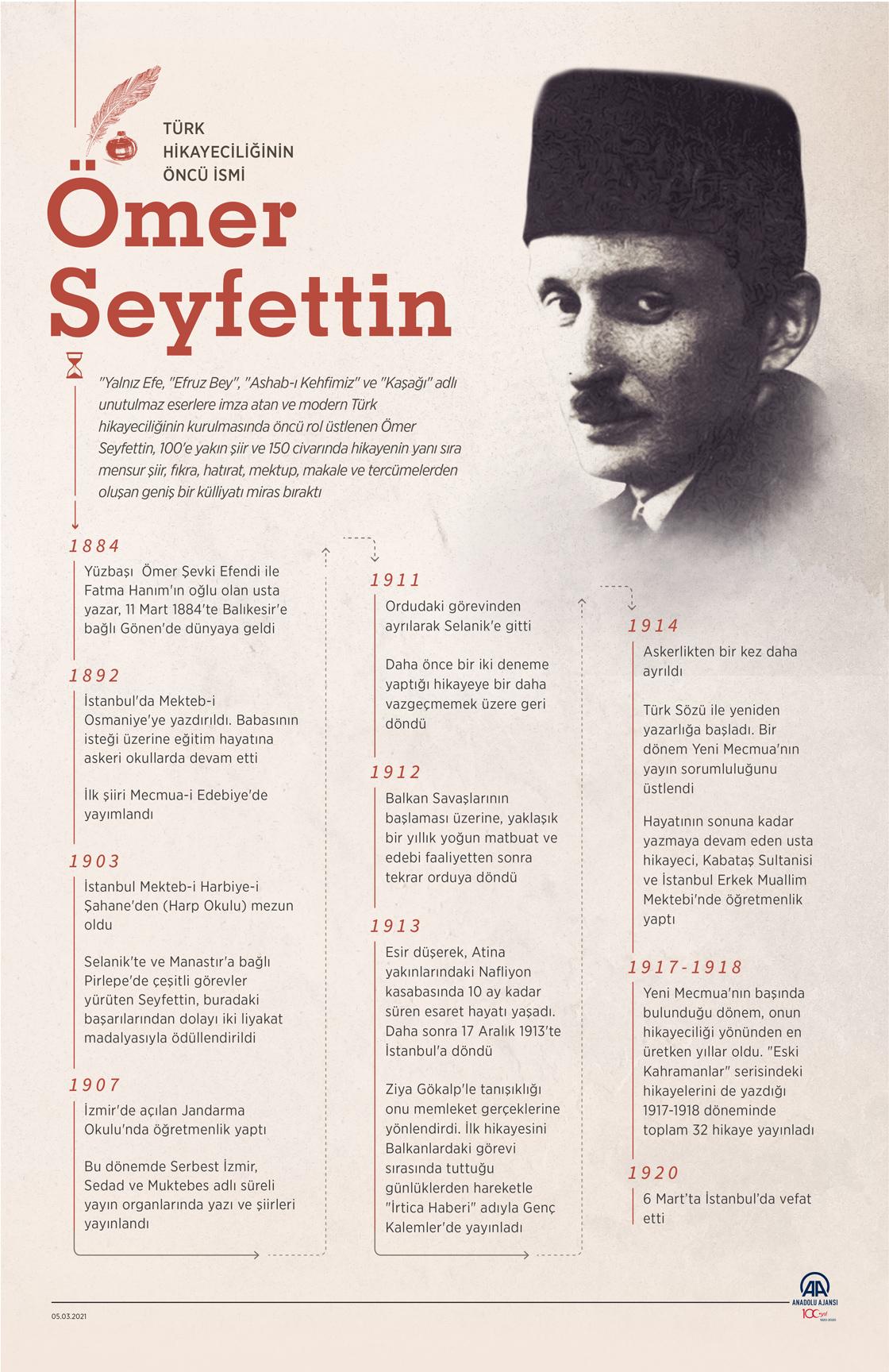
Ömer Seyfettin Infographic (Anadolu Ajansı)
Ömer Seyfettin was born on 11 March 1884 (Rumi 28 February 1299) in the Gönen district of Balıkesir. He was the second child of Lieutenant Colonel Ömer Şevki Efendi and Fatma Hanım. The writer was one of four children; he had an older sister named Güzide, a brother named Hasan who died of typhus, and a younger sister who also died in childhood.【1】
The writer’s father, Ömer Şevki Efendi, was a professional soldier who rose from the rank of erlik to binbaşı and served in reserve battalions. Ömer Şevki Efendi was a pure Turk from the Caucasus. The writer’s paternal grandfather traveled to Istanbul from the Caucasus on a pilgrimage to Mecca, entrusted his son Ömer Şevki to the Sheikh of Sultan Tepesi, and died in Mecca.【2】
His mother, Fatma Hanım, was from an educated Istanbul family. She was the daughter of Mehmet Bey, the Topçu Kaymakam of Ankara from the İsfendiyaroğulları dynasty. Ömer Şevki Efendi became part of this family through marriage. Due to his father’s military duties, the family lived in Gönen, spending summers at the Karalar Farm and winters in the town center.【3】
The distinctive characteristics of his parents directly influenced the formation of Ömer Seyfettin’s personality. His father was disciplined, stern, cold, and authoritarian; this environment fostered in the writer a strong sense of ethics and loyalty to the homeland. His mother, Fatma Hanım, was compassionate, sensitive, and affectionate, instilling in him fundamental religious and national values.【4】 After Fatma Hanım’s death from cancer in 1913, his father remarried another woman, and the family home was dissolved.
Ömer Seyfettin’s education began at the age of four at Reşit Efendi’s neighborhood school in his hometown of Gönen. Due to his father’s military postings, the family soon moved to İnebolu in Kastamonu and then to Ayancık in Sinop. The writer continued his education at the Sıbyan Mektebi, which functioned as the primary school of the time. However, his mother Fatma Hanım considered the quality of education in provincial schools inadequate and, aiming for a more modern education for her son, moved with him to Istanbul in 1892, settling in the family mansion in Kocamustafapaşa. This mansion provided a culturally rich environment; the divans and books in the house played a significant role in developing his early reading habits.【5】
After arriving in Istanbul, Ömer Seyfettin enrolled at Mekteb-i Osmanî located on Yusufpaşa Yokuşu in Aksaray. This was a private school that followed modern teaching methods and included French as a foreign language in its curriculum. The writer studied there for approximately one year. His father, Ömer Şevki Efendi, hoped his son would follow the military profession like himself and found the education at this civilian school too liberal from a military discipline perspective. With his father’s intervention, Ömer Seyfettin’s education at this school was terminated.
Ömer Şevki Efendi withdrew his son from Mekteb-i Osmanî and enrolled him in 1893 as a boarder at the Askerî Baytar Rüştiyesi in Eyüpsultan. Ömer Seyfettin received his education in the special section called “Sınıf-ı Mahsus,” reserved for children of officers. The foundations of the writer’s military identity were laid at this school.【6】
The years spent at Eyüp Askerî Rüştiyesi were decisive for Seyfettin’s personal and intellectual development. While studying there, he turned toward literature and began writing poetry. He became known among his peers for his literary curiosity and was nicknamed “Deli, Şair Ömer.” Ömer Seyfettin graduated from Eyüp Askerî Baytar Rüştiyesi in 1896.【7】
After completing his Rüştiye education, Ömer Seyfettin enrolled in Edirne Askerî İdadisi in 1896 together with his friend Aka Gündüz, who was also the son of an officer. During his four-year secondary military education, Ömer Seyfettin developed a serious interest in literature and began producing his first literary works.【8】
His years at Edirne Askerî İdadisi directly shaped his literary foundation. During this period, Ömer Seyfettin read the works of Tanzimat and especially Servet-i Fünun writers and was influenced by literary figures of the era, particularly Tevfik Fikret.【9】
As a result of these literary inclinations, he began experimenting with poetry and submitted works to literary journals. His poem “Yad” was published in Mecmua-i Edebiye. Although he received physical military training, mentally he was absorbed in literature and the arts.【10】
Ömer Seyfettin graduated from Edirne Askerî İdadisi in 1900 and enrolled in Mekteb-i Harbiye-i Şahane in Istanbul. This prestigious military academy, which trained officers for the Ottoman Army, was one of the most important educational institutions of the era. During his years at Harbiye, his interest in literature continued; he kept writing poetry and literary texts. Some of the poems and essays he composed during this period reflected the stylistic and linguistic influences of Servet-i Fünûn literature.
The educational period at Mekteb-i Harbiye ended earlier than scheduled due to political developments in the Balkans. In 1903, uprisings in Macedonia created an urgent need for officers in the army. Consequently, the final-year students of Harbiye were graduated early under the “sınıf-ı müstacele” system. Ömer Seyfettin was among these students and graduated in 1903 with the rank of piyade mülâzım-ı sânî (second lieutenant). Thus, his education was completed and he began his military service.【12】
During his years at Harbiye, his interest in literature continued; he kept writing poetry and literary texts. Some of the poems and essays he composed during this period reflected the stylistic and linguistic influences of Servet-i Fünûn literature.
Ömer Seyfettin graduated from Mekteb-i Harbiye-i Şahane on 22 August 1903 with the rank of second lieutenant in the infantry and was assigned by lottery to the Kuşadası Reserve Battalion under the Third Army, headquartered in Selanik. Although his initial posting was Kuşadası, he was immediately sent to Rumelia to suppress the Bulgarian uprising and participated in military operations in the Pirlepe and Selanik regions. As a result of his activities there, he received two merit medals and returned to Kuşadası on 6 September 1904 after his unit suppressed the revolt.【13】
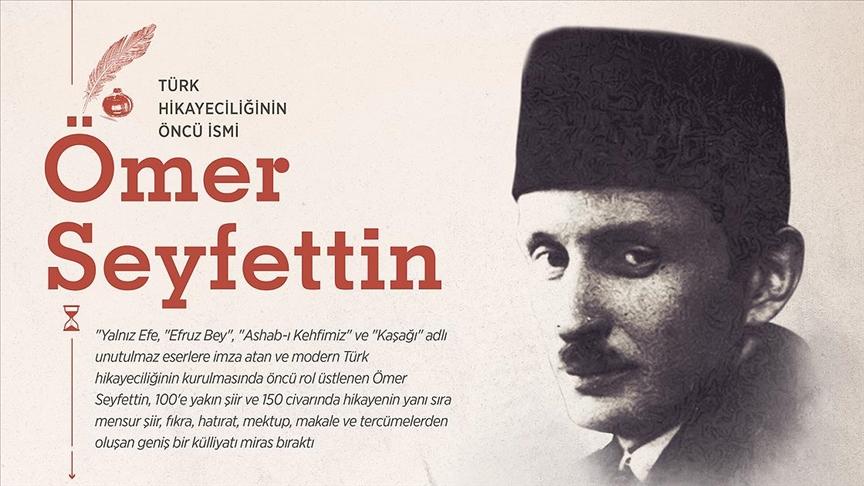
Ömer Seyfettin (Anadolu Ajansı)
In July 1907, he was appointed as a teacher at the newly opened Jandarma Zabitan ve Efrat Mektebi in İzmir, where he served as an interpreter for Italian officer Miralay Degiorgis Paşa during the establishment of the gendarmerie organization and taught religious classes.
In 1908, he was promoted to the rank of üsteğmen and transferred in early 1909 to the nizamiye battalions of the Third Army in Selanik. He assumed command of a border outpost near the village of Yakorit in the Razlık subdistrict of Serez Mutasarrıflığı. During this posting in the Balkans, he conducted surveillance operations against bandits and komitadjis in settlements such as Velmefçe, Pirlepe, Osenova, Pirbeliçe, Serez, İştip, Babina, Demirhisar, and Cuma-yı Bâlâ. In 1909, he briefly served as a physical education teacher at the Askerî Rüşdiye Mektebi in Köprülü and in April of the same year joined the Hareket Ordusu formed to suppress the 31 March Incident, traveling to Istanbul.【14】
Ömer Seyfettin resigned from military service in the summer of 1911 to focus on literary work and transition to civilian life. Since he had received his military education free of charge in exchange for a mandatory service commitment, the compensation owed to the Ottoman Army upon his resignation was covered by the Committee of Union and Progress through the mediation of Ziya Gökalp. After leaving the military, the writer settled in Selanik and joined the writing staff of the magazine Genç Kalemler as a civilian writer, where he helped establish the theoretical foundation of the Yeni Lisan movement.【15】
The writer’s civilian literary career was interrupted in the autumn of 1912 with the outbreak of the Balkan Wars, and he was recalled to military service on 14 September 1912. Serving as a üsteğmen in the 39th Regiment, 3rd Battalion, and 2nd Company of the Western Army, he fought against Serbian forces on the Komanova front.
After the defeat at Komanova, he joined the troops retreating to Albania and participated in the defense of Yanya Fortress. After a five-month siege, he was captured by Greek forces on 20 January 1913 at the Kanlıtepe position. He was taken to a prisoner-of-war camp in the town of Nafplion in Greece and spent approximately ten months in captivity.【16】
Ömer Seyfettin’s captivity ended on 28 November 1913 with his release, and he returned to Istanbul on 17 December 1913. Shortly after his return, an investigation was initiated against him by Deputy Chief Prosecutor Salih Bey on the grounds that he had violated the law prohibiting soldiers from engaging in politics and had written articles for pro-Committee of Union and Progress publications such as Tanin, Türk Yurdu, and Zekâ. The writer was referred to the Divan-ı Harp-i Örfî on charges of “iştilag-i siyasiyye” and, following a unanimous decision by the court and approval by Enver Paşa, was officially discharged from the military on 22 February 1914 by Imperial Decree (İrade-i Seniyye).【17】
After being discharged from the military on 22 February 1914, Ömer Seyfettin transitioned to civilian life and began earning his livelihood as a writer and teacher. He assumed the role of chief writer for the magazines Halka Doğru, published by the Committee of Union and Progress, and Türk Sözü. In 1914, he was appointed as a literature teacher at Kabataş Sultanisi, a position he held until his death. Additionally, he taught literary reading at the İstanbul Erkek Muallim Mektebi and was elected as a member of the Tedkikat-ı Lisâniye Encümeni established under Darülfünun, contributing to curriculum development.
During his teaching and writing career, he participated in a ten-day visit to the Çanakkale front organized by the Ministry of War on 15 July 1915. This delegation, composed of prominent writers, poets, and painters of the era, inspected the headquarters of the Fifth Army and Third Corps as well as the battle zones of Arıburnu and Seddülbahir. The primary purpose of the visit was to convey the experiences of the front to the public through literature and strengthen national consciousness. The writer fictionalized his personal observations from Çanakkale in stories published under the title “Yeni Kahramanlar”: “Kaç Yerinden?”, “Çanakkale’den Sonra”, “Müjde”, and “Bir Çocuk: Aleko”.【18】
Ömer Seyfettin married Calibe Hanım, daughter of Doctor Besim Edhem Bey, one of the leading figures of the Committee of Union and Progress, on 15 July 1915. As a result of this marriage, the writer moved into the mansion in Kadıköy where his wife’s family resided.【19】
The couple had a daughter, Fahire Güner, born on 6 December 1916. Clear conflicts emerged between Calibe Hanım’s Westernized lifestyle and expectations, shaped by her education in foreign schools, and the writer’s idealized model of the Turkish woman and worldview. The writer’s inability to adapt to his father-in-law’s lifestyle and the resulting family conflicts undermined the marriage. Due to ideological differences and persistent incompatibility, Ömer Seyfettin and Calibe Hanım divorced on 5 September 1918.【20】
Ömer Seyfettin Documentary and His Daughter Fahire Güner (TRT Arşiv)
After the dissolution of his marriage, the writer left his father-in-law’s house and moved into a small seaside villa in Kalamış Koyu owned by his former commander Cavit Paşa, which stood isolated from other buildings.
The period of solitude the writer spent in this home, which he called “Münferit Yalı,” was also his most productive literary phase. During the years remaining until his death, he continued teaching while dedicating all his time to reading and writing, publishing stories, anecdotes, and articles in numerous journals and newspapers such as Yeni Mecmua, Vakit, Zaman, Diken, Büyük Mecmua, İfhâm, and Yeni Dünya.【21】
Ömer Seyfettin’s health deteriorated in early February 1920, and he became bedridden. The illness, which had shown symptoms since 1917 and had been diagnosed by doctors as neuralgia and rheumatism, worsened significantly in the final week of February. After home treatment proved ineffective, he was admitted to Haydarpaşa Hospital on 4 March 1920 and placed under the care of Dr. Âkil Muhtar Bey. In his final days in the hospital, his consciousness weakened; he experienced hallucinations and began speaking to himself. During this period, he could no longer recognize his close friends and, in his delirium, uttered sentences referring to his daughter Güner and claimed that a representative from the Kuva-yı Milliye had arrived.【22】
During his hospitalization, doctors were unable to determine a definitive diagnosis. Unaware of the true nature of his illness, physicians continuously gave him mandarins and oranges until his final moments.【23】 Due to incorrect diagnosis and treatment methods, Ömer Seyfettin’s condition could not be controlled, and he died at 1:30 PM on 6 March 1920 at Haydarpaşa Hospital at the age of thirty-six.
Following his death, an autopsy was performed to determine the exact cause. The autopsy revealed that his primary illness was advanced diabetes and that his death resulted from diabetic coma.【24】
The news of his death reached the press and administrative offices late. His funeral was held one day after his death, on 7 March 1920, at 1:00 PM from the Faculty of Medicine Hospital.【25】
The funeral ceremony was attended by students from Darülmuallimîn, Galatasaray, and İstanbul Sultanisi, military medical students, colleagues, and close friends. His coffin was carried on the shoulders of students and intellectuals in a large procession to the Mahmut Baba Cemetery in Kadıköy’s Kuşdili district, where he was buried. After the burial, speeches emphasizing the writer’s literary and national contributions were delivered by Celal Sahir and Mustafa Tevfik at the graveside.【26】
Ömer Seyfettin’s grave at Mahmut Baba Cemetery, which had remained in place for years after burial, could not be preserved due to infrastructure works. The land where the cemetery stood was converted into a tram depot, and on 23 August 1939, the writer’s remains were exhumed from their original location.【27】
The remains were reburied on the same day at Zincirlikuyu Asri Mezarlığı. Following the transfer, a new gravestone was commissioned through the efforts of Ali Canip Yöntem, replacing the original inscription written in old Turkish script. The new stone bore an inscription in Latin letters identifying the writer’s name and grave.
Ömer Seyfettin began his literary career with poetry. His earliest published poems were strongly influenced by the Servet-i Fünun literary movement and particularly by Tevfik Fikret. In this early period, he employed the aruz meter, favored the sonnet form, and adopted a heavy language filled with Arabic and Persian compounds. The central themes of his first poems were love, nature, and individual emotions. Over time, the writer distanced himself from this individualistic and artistic style, prioritized social utility in literature, abandoned the aruz meter in favor of the hece meter, and simplified the poetic language.
Western literature, particularly French realist and naturalist writers, directly influenced the formation of the writer’s literary identity and style. Ömer Seyfettin read authors such as Gustave Flaubert and Émile Zola and took Guy de Maupassant as a model in terms of short-story technique.【28】
The intellectual environment in İzmir, where he served in the military, was decisive in grounding his literary outlook in a social context. Through interactions with Baha Tevfik and Turkish nationalist Necip, the idea of linguistic simplification in literature took root, and the notion of transforming Turkish into a language of science and art developed.【29】
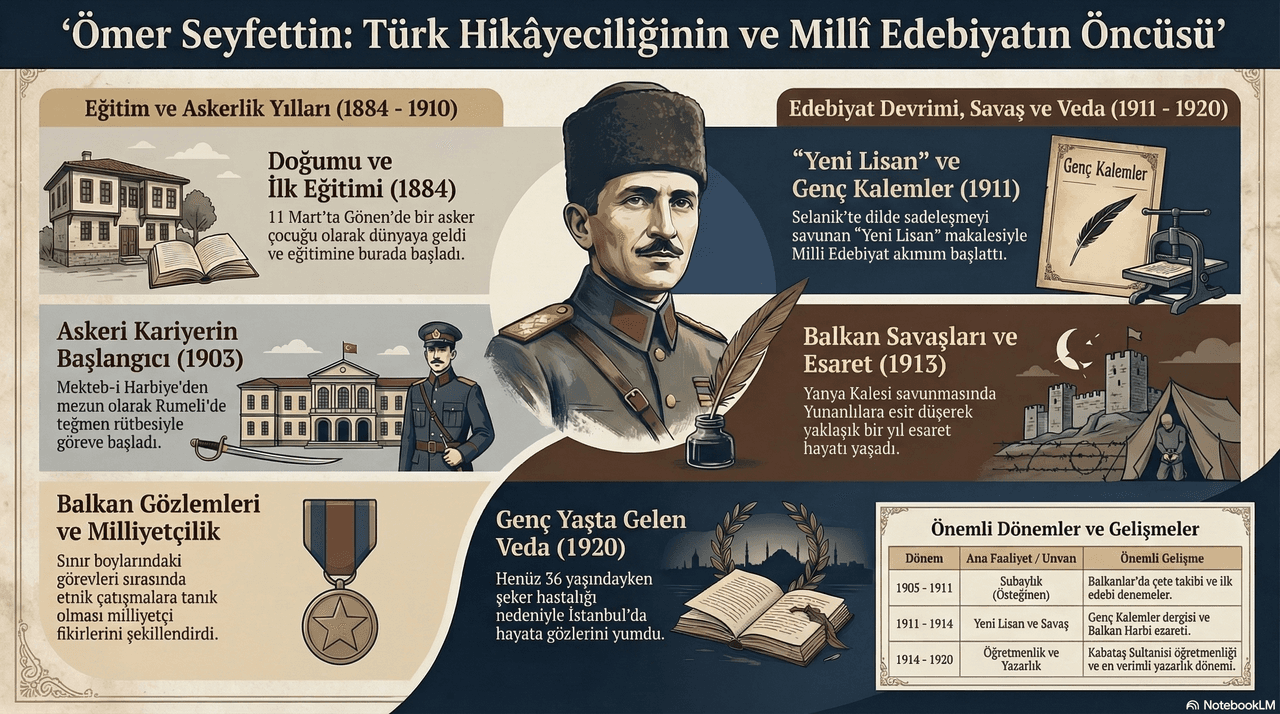
Ömer Seyfettin Infographic (Generated by Artificial Intelligence)
To translate the idea of linguistic simplification into concrete action, Ömer Seyfettin sent a historic letter dated 28 January 1911 from Yakorit village in Rumelia to his friend Ali Canip Yöntem. In this letter, contemporary Ottoman Turkish was described as an artificial, hostile language to science and logic, and the writer emphasized his hatred for this artificial language. He argued that Arabic and Persian compounds must be removed from the language and proposed to Ali Canip Yöntem that they initiate a major literary and linguistic revolution. This letter served as the founding manifesto of the linguistic simplification and national literature movement.
With Ali Canip Yöntem’s efforts securing Ziya Gökalp’s support, the magazine Genç Kalemler, published in Selanik, became the official organ of the Yeni Lisan movement. On 11 April 1911, Ömer Seyfettin published under the pseudonym “?” an article titled “Yeni Lisan” in the first issue of the magazine’s new series. In this article, the old language was declared sick, with its causes identified as unnecessary and foreign grammatical rules. The primary goal was to eliminate the disconnect between written and spoken language and to construct a national literary language understandable to the public.【30】
The Yeni Lisan movement had its theoretical foundation and core principles defined by Ömer Seyfettin. According to these principles, Arabic and Persian compounds and plural suffixes, except for established exceptions, were removed from the language. Turkish words were no longer to be conjugated according to Arabic and Persian grammatical rules. The standard for writing and literature was established as Istanbul Turkish and the everyday spoken language of the people. Simultaneously, the movement opposed the purist approach advocated by the Turkish Language Association and the reintroduction of archaic Eastern Turkic dialect words into Turkish, instead continuing to use Turkishized foreign words already present in the language.
The Yeni Lisan movement, with Ziya Gökalp’s participation and theoretical contributions, transcended being merely a linguistic and literary issue and transformed into a comprehensive social and national identity-building project called “Yeni Hayat.” The movement’s manifestos and practices of linguistic simplification faced sharp criticism from members of the Edebiyat-ı Cedide and Fecr-i Ati movements. Ömer Seyfettin waged vigorous theoretical polemics against writers such as Cenap Şahabettin, Süleyman Nazif, Ali Ekrem Bolayır, and Hüseyin Cahit Yalçın, who defended the old linguistic approach and aruz meter, in Genç Kalemler and other publications, unyieldingly defending the necessity of the new language and national literature.【31】
Ömer Seyfettin is the founder and most prominent representative in Turkish literature of the “Maupassant-style” event-based short story. He applied the classical narrative structure of exposition, climax, and resolution, concluding his stories with surprising and unexpected endings known as “terdit.”【32】 His short-story technique was directly influenced by French realist and naturalist writers Guy de Maupassant and Émile Zola. He reflected the external world, events, and characters with objective observation, prioritizing action and incident over psychological analysis and lengthy spatial descriptions.
The foundation of the writer’s short-story approach lies in the use of Istanbul dialect and the principle of “edebiyatsız edebiyat” (literature without literary embellishment). In accordance with this principle, he eliminated the gap between spoken and written language, placing Istanbul Turkish at the center of literary texts. Moving away from the goal of artistic expression and ornate sentence construction, he adopted a style stripped of Arabic and Persian compounds, devoid of metaphor and indirectness. He designed linguistic simplicity as the primary tool for conveying his message, aiming to enlighten his audience and instill a national consciousness.【33】
Ömer Seyfettin chose to convey his nationalist and social theses not through didactic preaching but through fictional characters and narrative structures. He employed a technique based on contrasting types and binary dialogues, positioning idealized characters who embodied national consciousness, spoke Turkish, and were loyal to tradition against those who rejected national identity, imitated the West, and were cosmopolitan and Westernized. He caricatured these opposing figures through humor, embedding the intellectual conflicts of the era into his texts through characters such as Efruz Bey and Cabi Efendi.
The Life of Ömer Seyfettin (Generated by Artificial Intelligence)
The first thematic group in his works consists of stories based on personal childhood memories. He fictionalized his early experiences in Gönen and Ayancık, the physical practices of the education system, and family relationships in texts such as “Ant,” “Falaka,” “Kaşağı,” “İlk Namaz,” and “İlk Cinayet.” These stories explore authoritarian parental figures, violent elements in educational institutions, and reflections of child psychology. While offering biographical insights, these narratives also contain sociological observations on provincial life and social customs of the era.
The second thematic group comprises stories based on the Balkan Wars, captivity experiences, and ethnic conflicts that he witnessed firsthand. In stories such as “Bomba,” “Beyaz Lale,” “Tuhaf Bir Zulüm,” and “Nakarat,” the administrative collapse of the Ottoman state in the Balkans, separatist nationalist movements among regional populations, and the actions of komitadjis are recounted. In these works, the violence, displacement, and massacres suffered by Turkish and Muslim subjects in the Balkans are rendered with objective and harsh realism. Through these depictions of destruction, contemporary political dangers were highlighted, aiming to foster a national defense consciousness among the Turkish population.
The third group consists of heroic tales drawn from Turkish history and written in response to military journal demands. Works such as “Pembe İncili Kaftan,” “Başını Vermeyen Şehit,” “Kızılelma Neresi?,” “Forsa,” “Ferman,” and “Kütük” belong to this category. Written during the First World War to maintain the morale of soldiers and civilians on the front, these stories explore themes of absolute loyalty to the state, personal sacrifice, courage, and unity around the national ideal. Historical events and figures are idealized through epic narration and presented as sources of motivation for contemporary society.
The fourth thematic group critically examines, through humor, the irrelevance of Ottomanism, social decay, superstitions, and institutional failures. In works such as “Ashab-ı Kehfimiz,” “Primo Türk Çocuğu,” and “Hürriyet Bayrakları,” the Ottoman ideal and lack of nationalism are criticized. Stories such as “Perili Köşk,” “Kurbağa Duası,” “Keramet,” “Türbe,” and “Yüksek Ökçeler” explore irrational superstitions, ignorance, and moral hypocrisy among the public. Humor and irony functioned as analytical tools to identify social problems, revealing through these texts the sociological obstacles preventing society from achieving a rational and national structure.
Ömer Seyfettin produced a vast number of literary and intellectual texts during his thirty-six-year life. His bibliography includes 163 short stories, 201 articles and anecdotes, 87 poems, 21 mensure, 15 letters, 22 translations, 3 plays, and 2 memoir notebooks. He published his texts under more than twenty pseudonyms, including Ayas, Ayın, Ayın Ha, Ayın Kef, Ayın Sin, Camsap, C. Nazmi, Ç. Kemâl, Feridun, F. Nezihi, Ömer Tarhan, Ö. Seyfettin, Perviz, Süheyl Feridun, Şit, Tarhan, and Tekin. His works appeared primarily in periodicals such as Genç Kalemler, Mecmua-i Edebiye, Sabah, İrtika, Kadın, Türk Yurdu, Türk Sözü, Donanma, Tanin, Yeni Mecmua, and Büyük Mecmua.【34】
Some of the texts he wrote during his lifetime were published as books. His published works during his lifetime include: “Tarih Ezelî Bir Tekerrürdür” (1911), “Millî Jimnastik” (1911), “Yeni Lisan ve Bir İstimzaç” (1911), co-authored with Ziya Gökalp and Ali Canip Yöntem, “Vatan! Yalnız Vatan...” (1911), “Herkes İçin İçtimaiyat: Ticaret ve Nasip” (1914), “Yarınki Turan Devleti” (1914), “Mektep Çocuklarında Türklük Mefkûresi” (1914), “Millî Tecrübelerden Çıkarılmış Amelî Siyaset” (1914), “Turan Masalları: İhtiyarlıkta mı Gençlikte mi?” (1914), “Ashab-ı Kehfimiz” (1918), “Harem” (1918), and “Efruz Bey” (1919). Among these, “Tarih Ezelî Bir Tekerrürdür” was the only book to go through a second edition during his lifetime.
Ömer Seyfettin also wrote texts in novel and long-story forms, pushing the boundaries of the short-story genre. “Ashab-ı Kehfimiz,” which he classified as an “İçtimai roman,” is a hundred-page long story. “Efruz Bey,” composed of five parts, was designed as a fantasy novel. His novel attempts—“Yalnız Efe,” “Foya,” “Sultanlığın Sonu,” “Ararken,” “Tatlısu Frenkleri,” and “Akropol Hacısı”—remained unfinished. In addition to his original works, he produced translations from French, translating the epic “Kalevala” and Homer’s “Iliad” into Turkish in 1918. He also authored a play titled “Mahçupluk İmtihanı” staged for the theater.
After his death, various efforts were undertaken to compile and publish his complete works and establish a bibliography. The first compilation efforts were initiated by Ali Canip Yöntem, and his stories were published in book form between 1926 and 1938. Subsequently, Şerif Hulusi Sayman (1950) and Tahir Alangu (1962–1964) expanded and republished his stories. All of the writer’s works were first gathered in a seventeen-volume complete edition by Muzaffer Uyguner (1970–1997). His poems were compiled by Fevziye Abdullah Tansel (1972), and Müjgan Cunbur prepared an extensive bibliography. Later, Hülya Argunşah (1997–2001) and Nazım Hikmet Polat (2011, 2015, 2016) published comprehensive complete editions based on original texts.【35】
Ömer Seyfettin’s literary works have been translated into Western languages and other dialects of Turkish. The first foreign-language text on the Yeni Lisan movement and the writer appeared in 1912 in the journal Mercure de France, followed by various translations by German scholars. Russian scholar Vasil Vasiloviç Dubrovskiy published eleven of his stories—including “Gizli Mabet,” “Vire,” and “Kurbağa Duası”—in book form in 1932 and published some in the journal Kızıl Yol in 1930. The writer is included in the Soviet Union’s literary encyclopedia, Litaraturnaya Ensiklopediya. In terms of translation into Turkish dialects, his story “Türkçe Reçete” was published in Uzbek Turkish in the 1927 issue of the journal Yir Yüzi in Tashkent.
"One of the most powerful and eminent short-story writers of our time, Ömer Seyfeddin Bey, (...) was the first torchbearer of the simple and beautiful Turkish promoted under the name Yeni Lisan in the magazine Genç Kalemler, published in Selanik after the Constitutional Monarchy. At the time Genç Kalemler advocated simplicity, Turkish print and literature were dominated by compound-laden language. It is only after and alongside Ömer Seyfeddin that literary Turkish began to reflect the taste of pure Turkish."【36】
Ömer Seyfettin is the founding figure who established the Turkish short story as an independent and fundamental literary form. From the outset of his literary career, he became the most powerful representative in Turkish literature of the classical event-based short story shaped by Guy de Maupassant in Western literature. Instead of lengthy spatial descriptions and deep psychological analyses, he placed direct action, movement, and surprising endings at the center of his texts. By combining the objective observational power he acquired from French realist and naturalist writers with the realities of his own society, he constructed the technical foundation of modern Turkish short-story writing.
His most significant contribution to the history of the Turkish language was the linguistic simplification revolution initiated by the Yeni Lisan manifesto. He codified the abandonment of artificial Arabic and Persian grammatical rules, the Turkification of compounds, and the adoption of Istanbul Turkish as the sole written language. This linguistic approach eliminated the historical divide between the Ottoman Turkish used by the intellectual elite and the language of the people. The practices of linguistic simplification were conceived as the direct construction of an independent national identity and culture, laying the foundations of modern Turkish.
The central aim of the writer’s artistic vision was to bring literature out of the exclusive domain of a narrow elite and deliver it directly to the public. Through his principle of “edebiyatsız edebiyat,” he detached art from the pursuit of art for art’s sake and developed a plain, metaphor-free, and direct style. Rejecting the detached and artificial aesthetics of Divan and Servet-i Fünun literature, he transformed literature into a tool for social awakening. This innovative stance enabled literature to shift from being an aesthetic object to becoming a sociological instrument.
Ömer Seyfettin is one of our original writers. Unlike the writers of Edebiyat-ı Cedide, he wrote stories in a natural and lively language, using simple and unadorned Turkish. His style is highly dynamic and compelling. His works, both in language and in spirit and subject matter, are imbued with a powerful sense of nationalism and love. He was greatly loved and widely read in his time. He wrote around a hundred short stories and was preparing to write a great novel when he died at a young age. His works have been published in book form under the title Ömer Seyfettin Külliyatı, each volume named after one of his stories.【37】
Ömer Seyfettin, along with Ali Canip Yöntem and Ziya Gökalp, was the most important theorist of the Millî Edebiyat movement that emerged around the magazine Genç Kalemler. After the Second Constitutional Monarchy, he emphasized the irrelevance of dominant political currents of the era—Ottomanism, Islamism, and Westernism—and championed the Turkishness ideal, systematically embedding this ideology into fictional texts. He grounded the idea of nationalism in logical, historical, and linguistic-scientific foundations and made the Turan ideal one of the central messages of his stories.
Ömer Seyfettin’s works serve as objective mirrors of the political, social, and moral transformations experienced by Turkish society during the transition from the Ottoman Empire to the nation-state model. He analytically rendered the shift in public mentality from imperial subjects to a national community, the crises they endured, the alienation caused by Western imitation, and the traumas resulting from wars. Through the idealized characters he created and the historical figures he brought to life, he provided moral support to society during its collapse and fostered a shared national identity.
Due to their moral qualities and plain language, Ömer Seyfettin’s texts have become one of the foundational pillars of Turkey’s education system and children’s literature. Although not written specifically for children, their universal and national values—honesty, patriotism, courage, sacrifice, and responsibility—led the Ministry of National Education to include them in curricula and textbooks from the Republican era onward. His stories, used in accordance with pedagogical expectations, have served as primary sources for transmitting national consciousness across generations.
Occupying a decisive position in the Turkish literary canon, the writer used his pen as a weapon in the service of his ideals. His vigorous polemics against powerful figures of the era such as Cenap Şahabettin, Süleyman Nazif, and Rıza Tevfik, who upheld the old literary and linguistic norms, were a natural reflection of his determination to establish a new value system. His intense literary and intellectual output within his short thirty-six-year life decisively determined the direction of modern Turkish literature and secured his enduring place in history.
Acemoğlu, Adil. “Ömer Seyfettin Öykülerinde Değerler Eğitimi.” PhD thesis, Department of Turkish and Social Sciences Education, Turkish Language Teaching Program, 2022. Accessed March 5, 2026. https://avesis.deu.edu.tr/yonetilen-tez/03251813-f4c8-4d92-9f6a-6f7e50b7d888/omer-seyfettin-oykulerinde-degerler-egitimi
Aktaş, Atilla. “Ömer Seyfettin’in Hikâyelerinde Türk Kimliği ve Milliyetçi Söylem.” PhD thesis,Ankara Üniversitesi Institute of Social Sciences, 2019. Accessed March 5, 2026. https://tez.yok.gov.tr/UlusalTezMerkezi/tezDetay.jsp?id=GnyGksi4-GksOJJcQuf93g
Anadolu Ajansı. "Türk öykücülüğünün öncü ismi: Ömer Seyfettin." Accessed March 5, 2026. https://www.aa.com.tr/tr/kultur-sanat/turk-hikayeciliginin-oncu-ismi-omer-seyfettin/2165797
Anadolu Ajansı. "Türk öykücülüğünün öncü ismi: Ömer Seyfettin." Accessed March 5, 2026. https://www.aa.com.tr/tr/kultur/turk-oykuculugunun-oncu-ismi-omer-seyfettin/3500508
Argunşah, Hülya Eraydın. "Ömer Seyfettin." *Türk Dünyası Ansiklopedisi*. Accessed March 5, 2026. https://turkdunyasiansiklopedisi.gov.tr/detay/1583/Ömer_Seyfettin
Argunşah, Hülya Eraydın. "Ömer Seyfettin.” *Türk Maarif Ansiklopedisi*. Accessed March 5, 2026. https://turkmaarifansiklopedisi.org.tr/omer-seyfettin
Başçallı, Şaban. “Ömer Seyfettin’in Eserlerinde Dil ve Milliyetçilik.” Master's thesis, Mimar Sinan Güzel Sanatlar Üniversitesi Sosyal Bilimler Enstitüsü, 2010. Accessed March 5, 2026. https://tez.yok.gov.tr/UlusalTezMerkezi/tezDetay.jsp?id=jHez-XK_ouqUgCAX7yOHiA&no=1LKRsQMxOQ5EOO-2ePS7lA
Birinci, Elif. “Ömer Seyfettin’in Hikâyelerinde Türk Toplumu.” Master's thesis,Sakarya Üniversitesi Institute of Social Sciences, 2002. Accessed March 5, 2026. https://acikerisim.sakarya.edu.tr/bitstream/handle/20.500.12619/93835/T01255.pdf?sequence=1
Cansız, Songül. “Kısa Bir Ömrün Uzun Hikâyesi: Hikâyelerinde Ömer Seyfettin.” Hars Akademi Uluslararası Hakemli Kültür Sanat Mimarlık Dergisi 3, no. 1 (2020): 26–64. https://dergipark.org.tr/tr/pub/hars/article/796711#article_cite
Işık, Mehmet. "Ömer Seyfettin Hikâyelerinde Milliyetçi Söylem ve Özne." PhD thesis, İstanbul Üniversitesi Sosyal Bilimler Enstitüsü, 2020. Accessed March 5, 2026. https://tez.yok.gov.tr/UlusalTezMerkezi/tezDetay.jsp?id=GnyGksi4-GksOJJcQuf93g
Kocatürk, Vasfi Mahir. Türk Edebiyatı Antolojisi: Başlangıçtan Bugüne Kadar Açıklamalı Türk Edebiyatı Şaheserleri. Ankara: Edebiyat Yayınevi, 1967.
Okay, Orhan M. Batılılaşma Devri Türk Edebiyatı. İstanbul: Dergâh Yayınları, 2016.
Polat, Nazım H. “Ömer Seyfeddin.” *TDV İslâm Ansiklopedisi*. Accessed March 5, 2026. https://islamansiklopedisi.org.tr/omer-seyfeddin
TRT Arşiv. "Yazar Evleri-Ömer Seyfettin." YouTube. Accessed March 5, 2026. https://www.youtube.com/watch?v=Tcj3oGrrqSs&t=856s
Umaç, Muhammed Alperen. “Ömer Seyfettin’in Eserlerinde Tarih ve Kimlik.” Master's thesis, Ankara Hacı Bayram Veli University Graduate School of Education, 2025. Accessed March 5, 2026. https://tez.yok.gov.tr/UlusalTezMerkezi/TezGoster?key=V-oEQd0LkkqRGCXNzJWCTY5r_h6eeHir0Eo5DuLmqyNaIT2MdDaBdgguA3X9NEC0
Yöntem, Ali Canip. Türk Edebiyatı Antolojisi. İstanbul: Devlet Matbaası, 1931.
Çelik, Hasan. “Ömer Seyfettin’in Ardından Yazılanlar.” Türklük Bilimi Araştırmaları, no. 48 (December 2020): 101–114. https://dergipark.org.tr/tr/pub/tubar/article/775505#article_cite
Çelik, Mazlum. “Ömer Seyfettin’in Eserlerinde Farklı Bakış Açıları.” Master's thesis, İstanbul Medeniyet Üniversitesi Sosyal Bilimler Enstitüsü, June 2022. Accessed March 5, 2026. https://tez.yok.gov.tr/UlusalTezMerkezi/TezGoster?key=sELqxhTlFGAjsbjOuuiyCOHR8xypUTMe6E5JDOK5-a37QaoQHRnnnUvL6X_d8BUy
Öksüz, Dilek. “Ömer Seyfettin’in Eserlerinde Sosyal ve Siyasi Meseleler.” Master's thesis,Marmara ÜniversitesiTürkiyat Araştırmaları Institute, 2022. Accessed March 5, 2026. https://openaccess.marmara.edu.tr/entities/publication/a4ee0e63-d758-48e2-9202-2d8d28b1a72e
Şahin, Veysel, and Merve Torğut. “Ömer Seyfettin’in Hikâyelerinde Ahlak ve Aile Sosyolojisi.” Bingöl Üniversitesi Sosyal Bilimler Enstitüsü Dergisi 25 (2023): 82–94. Accessed March 5, 2026. https://dergipark.org.tr/tr/pub/busbed/article/1236336#article_cite
Şahinaslan, Yasemin. “Türk Düşüncesinde Ömer Seyfettin.” Master's thesis,Akdeniz Üniversitesi Institute of Social Sciences, 2019. Accessed March 5, 2026. https://tez.yok.gov.tr/UlusalTezMerkezi/tezDetay.jsp?id=kjQdbRhzEk1sKQ2HtQhdTA&no=qsisNFgZZExJpkq0iqrtnQ
Şengül, Abdullah and Ahmet Bozdoğan. “Ömer Seyfettin.” *Türk Edebiyatı İsimler Sözlüğü*. Accessed March 5, 2026. https://teis.yesevi.edu.tr/madde-detay/omer-seyfettin
[1]
Songül Cansız. “Kısa Bir Ömrün Uzun Hikâyesi: Hikâyelerinde Ömer Seyfettin.” Hars Akademi Uluslararası Hakemli Kültür Sanat Mimarlık Dergisi 3, no. 1 (2020): S.30-32. https://dergipark.org.tr/tr/pub/hars/article/796711#article_cite
[2]
Elif Birinci. “Ömer Seyfettin’in Hikâyelerinde Türk Toplumu.” Yüksek lisans tezi, Sakarya Üniversitesi Sosyal Bilimler Enstitüsü, 2002. Erişim Tarihi: 5 Mart 2026. S.5. https://acikerisim.sakarya.edu.tr/bitstream/handle/20.500.12619/93835/T01255.pdf?sequence=1
[3]
Şaban Başçallı. “Ömer Seyfettin’in Eserlerinde Dil ve Milliyetçilik.” Yüksek lisans tezi, Mimar Sinan Güzel Sanatlar Üniversitesi Sosyal Bilimler Enstitüsü, 2010. Erişim Tarihi: 5 Mart 2026. S.41. https://tez.yok.gov.tr/UlusalTezMerkezi/tezDetay.jsp?id=jHez-XK_ouqUgCAX7yOHiA&no=1LKRsQMxOQ5EOO-2ePS7lA
[4]
Adil Acemoğlu. “Ömer Seyfettin Öykülerinde Değerler Eğitimi.” Doktora tezi, Türkçe ve Sosyal Bilimler Eğitimi Anabilim Dalı Türkçe Öğretmenliği Programı, 2022. Erişim Tarihi: 5 Mart 2026. S.15. https://avesis.deu.edu.tr/yonetilen-tez/03251813-f4c8-4d92-9f6a-6f7e50b7d888/omer-seyfettin-oykulerinde-degerler-egitimi
[5]
Mazlum Çelik. “Ömer Seyfettin’in Eserlerinde Farklı Bakış Açıları.” Yüksek lisans tezi, İstanbul Medeniyet Üniversitesi Sosyal Bilimler Enstitüsü, Haziran 2022. Erişim Tarihi: 5 Mart 2026. S.12. https://tez.yok.gov.tr/UlusalTezMerkezi/TezGoster?key=sELqxhTlFGAjsbjOuuiyCOHR8xypUTMe6E5JDOK5-a37QaoQHRnnnUvL6X_d8BUy
[6]
Şaban Başçallı. “Ömer Seyfettin’in Eserlerinde Dil ve Milliyetçilik.” Yüksek lisans tezi, Mimar Sinan Güzel Sanatlar Üniversitesi Sosyal Bilimler Enstitüsü, 2010. Erişim Tarihi: 5 Mart 2026. S.41. https://tez.yok.gov.tr/UlusalTezMerkezi/tezDetay.jsp?id=jHez-XK_ouqUgCAX7yOHiA&no=1LKRsQMxOQ5EOO-2ePS7lA
[7]
Abdullah Şengül ve Ahmet Bozdoğan. “Ömer Seyfettin.” Türk Edebiyatı İsimler Sözlüğü. Erişim tarihi: 5 Mart 2026. https://teis.yesevi.edu.tr/madde-detay/omer-seyfettin
[8]
Şaban Başçallı. “Ömer Seyfettin’in Eserlerinde Dil ve Milliyetçilik.” Yüksek lisans tezi, Mimar Sinan Güzel Sanatlar Üniversitesi Sosyal Bilimler Enstitüsü, 2010. Erişim Tarihi: 5 Mart 2026. S.41. https://tez.yok.gov.tr/UlusalTezMerkezi/tezDetay.jsp?id=jHez-XK_ouqUgCAX7yOHiA&no=1LKRsQMxOQ5EOO-2ePS7lA
[9]
Mehmet Işık. Ömer Seyfettin Hikâyelerinde Milliyetçi Söylem ve Özne. Doktora tezi, İstanbul Üniversitesi Sosyal Bilimler Enstitüsü, 2020. Erişim Tarihi: 5 Mart 2026. S.10. https://tez.yok.gov.tr/UlusalTezMerkezi/tezDetay.jsp?id=GnyGksi4-GksOJJcQuf93g
[10]
Muhammed Alperen Umaç. “Ömer Seyfettin’in Eserlerinde Tarih ve Kimlik.” Yüksek lisans tezi, Ankara Hacı Bayram Veli Üniversitesi Lisansüstü Eğitim Enstitüsü, 2025. Erişim Tarihi: 5 Mart 2026. S.6. https://tez.yok.gov.tr/UlusalTezMerkezi/TezGoster?key=V-oEQd0LkkqRGCXNzJWCTY5r_h6eeHir0Eo5DuLmqyNaIT2MdDaBdgguA3X9NEC0
[12]
Nazım H. Polat. “Ömer Seyfeddin.” TDV İslâm Ansiklopedisi. Erişim tarihi: 5 Mart 2026. https://islamansiklopedisi.org.tr/omer-seyfeddin
[13]
Mehmet Işık. Ömer Seyfettin Hikâyelerinde Milliyetçi Söylem ve Özne. Doktora tezi, İstanbul Üniversitesi Sosyal Bilimler Enstitüsü, 2020. Erişim Tarihi: 5 Mart 2026. S.11. https://tez.yok.gov.tr/UlusalTezMerkezi/tezDetay.jsp?id=GnyGksi4-GksOJJcQuf93g
[14]
Mehmet Işık. Ömer Seyfettin Hikâyelerinde Milliyetçi Söylem ve Özne. Doktora tezi, İstanbul Üniversitesi Sosyal Bilimler Enstitüsü, 2020. Erişim Tarihi: 5 Mart 2026. S.14. https://tez.yok.gov.tr/UlusalTezMerkezi/tezDetay.jsp?id=GnyGksi4-GksOJJcQuf93g
[15]
Mehmet Işık. Ömer Seyfettin Hikâyelerinde Milliyetçi Söylem ve Özne. Doktora tezi, İstanbul Üniversitesi Sosyal Bilimler Enstitüsü, 2020. Erişim Tarihi: 5 Mart 2026. S.15. https://tez.yok.gov.tr/UlusalTezMerkezi/tezDetay.jsp?id=GnyGksi4-GksOJJcQuf93g
[16]
Mehmet Işık. Ömer Seyfettin Hikâyelerinde Milliyetçi Söylem ve Özne. Doktora tezi, İstanbul Üniversitesi Sosyal Bilimler Enstitüsü, 2020. Erişim Tarihi: 5 Mart 2026. S.15. https://tez.yok.gov.tr/UlusalTezMerkezi/tezDetay.jsp?id=GnyGksi4-GksOJJcQuf93g
[17]
Mehmet Işık. Ömer Seyfettin Hikâyelerinde Milliyetçi Söylem ve Özne. Doktora tezi, İstanbul Üniversitesi Sosyal Bilimler Enstitüsü, 2020. Erişim Tarihi: 5 Mart 2026. S.15. https://tez.yok.gov.tr/UlusalTezMerkezi/tezDetay.jsp?id=GnyGksi4-GksOJJcQuf93g
[18]
Atilla Aktaş. “Ömer Seyfettin’in Hikâyelerinde Türk Kimliği ve Milliyetçi Söylem.” Doktora tezi, Ankara Üniversitesi Sosyal Bilimler Enstitüsü. 2019. Erişim Tarihi: 5 Mart 2026. S.104. https://tez.yok.gov.tr/UlusalTezMerkezi/tezDetay.jsp?id=GnyGksi4-GksOJJcQuf93g
[19]
Atilla Aktaş. “Ömer Seyfettin’in Hikâyelerinde Türk Kimliği ve Milliyetçi Söylem.” Doktora tezi, Ankara Üniversitesi Sosyal Bilimler Enstitüsü. 2019. Erişim Tarihi: 5 Mart 2026. S.103. https://tez.yok.gov.tr/UlusalTezMerkezi/tezDetay.jsp?id=GnyGksi4-GksOJJcQuf93g
[20]
Atilla Aktaş. “Ömer Seyfettin’in Hikâyelerinde Türk Kimliği ve Milliyetçi Söylem.” Doktora tezi, Ankara Üniversitesi Sosyal Bilimler Enstitüsü. 2019. Erişim Tarihi: 5 Mart 2026. S.104. https://tez.yok.gov.tr/UlusalTezMerkezi/tezDetay.jsp?id=GnyGksi4-GksOJJcQuf93g
[21]
Hülya Eraydın Argunşah. "Ömer Seyfettin". Türk Dünyası Ansiklopedisi. Erişim Tarihi: 5 Mart 2026. https://turkdunyasiansiklopedisi.gov.tr/detay/1583/Ömer_Seyfettinhttps://turkdunyasiansiklopedisi.gov.tr/detay/1583/Ömer_Seyfettin
[22]
Atilla Aktaş. “Ömer Seyfettin’in Hikâyelerinde Türk Kimliği ve Milliyetçi Söylem.” Doktora tezi, Ankara Üniversitesi Sosyal Bilimler Enstitüsü. 2019. Erişim Tarihi: 5 Mart 2026. S.106. https://tez.yok.gov.tr/UlusalTezMerkezi/tezDetay.jsp?id=GnyGksi4-GksOJJcQuf93g
[23]
Hasan Çelik. “Ömer Seyfettin’in Ardından Yazılanlar.” Türklük Bilimi Araştırmaları, sy. 48 (Aralık 2020): S.112. https://dergipark.org.tr/tr/pub/tubar/article/775505#article_cite
[24]
Çelik, Hasan. “Ömer Seyfettin’in Ardından Yazılanlar.” Türklük Bilimi Araştırmaları, sy. 48 (Aralık 2020): S.112. https://dergipark.org.tr/tr/pub/tubar/article/775505#article_cite
[25]
Çelik, Hasan. “Ömer Seyfettin’in Ardından Yazılanlar.” Türklük Bilimi Araştırmaları, sy. 48 (Aralık 2020): S.112. https://dergipark.org.tr/tr/pub/tubar/article/775505#article_cite
[26]
Çelik, Hasan. “Ömer Seyfettin’in Ardından Yazılanlar.” Türklük Bilimi Araştırmaları, sy. 48 (Aralık 2020): S.111-113. https://dergipark.org.tr/tr/pub/tubar/article/775505#article_cite
[27]
Mehmet Işık. Ömer Seyfettin Hikâyelerinde Milliyetçi Söylem ve Özne. Doktora tezi, İstanbul Üniversitesi Sosyal Bilimler Enstitüsü, 2020. Erişim Tarihi: 5 Mart 2026. S.19. https://tez.yok.gov.tr/UlusalTezMerkezi/tezDetay.jsp?id=GnyGksi4-GksOJJcQuf93g
[28]
Atilla Aktaş. “Ömer Seyfettin’in Hikâyelerinde Türk Kimliği ve Milliyetçi Söylem.” Doktora tezi, Ankara Üniversitesi Sosyal Bilimler Enstitüsü. 2019. Erişim Tarihi: 5 Mart 2026. S.100. https://tez.yok.gov.tr/UlusalTezMerkezi/tezDetay.jsp?id=GnyGksi4-GksOJJcQuf93g
[29]
Atilla Aktaş. “Ömer Seyfettin’in Hikâyelerinde Türk Kimliği ve Milliyetçi Söylem.” Doktora tezi, Ankara Üniversitesi Sosyal Bilimler Enstitüsü. 2019. Erişim Tarihi: 5 Mart 2026. S.100. https://tez.yok.gov.tr/UlusalTezMerkezi/tezDetay.jsp?id=GnyGksi4-GksOJJcQuf93g
[30]
Hülya Eraydın Argunşah. "Ömer Seyfettin". Türk Dünyası Ansiklopedisi. Erişim Tarihi: 5 Mart 2026. https://turkdunyasiansiklopedisi.gov.tr/detay/1583/Ömer_Seyfettin
[31]
Şaban Başçallı. “Ömer Seyfettin’in Eserlerinde Dil ve Milliyetçilik.” Yüksek lisans tezi, Mimar Sinan Güzel Sanatlar Üniversitesi Sosyal Bilimler Enstitüsü, 2010. Erişim Tarihi: 5 Mart 2026. S.54. https://tez.yok.gov.tr/UlusalTezMerkezi/tezDetay.jsp?id=jHez-XK_ouqUgCAX7yOHiA&no=1LKRsQMxOQ5EOO-2ePS7lA
[32]
Hülya Eraydın Argunşah. "Ömer Seyfettin". Türk Dünyası Ansiklopedisi. Erişim Tarihi: 5 Mart 2026. https://turkdunyasiansiklopedisi.gov.tr/detay/1583/Ömer_Seyfettin
[33]
Acemoğlu, Adil. “Ömer Seyfettin Öykülerinde Değerler Eğitimi.” Doktora tezi, Türkçe ve Sosyal Bilimler Eğitimi Anabilim Dalı Türkçe Öğretmenliği Programı, 2022. Erişim Tarihi: 5 Mart 2026. S.29-30. https://avesis.deu.edu.tr/yonetilen-tez/03251813-f4c8-4d92-9f6a-6f7e50b7d888/omer-seyfettin-oykulerinde-degerler-egitimi
[34]
Mehmet Işık. Ömer Seyfettin Hikâyelerinde Milliyetçi Söylem ve Özne. Doktora tezi, İstanbul Üniversitesi Sosyal Bilimler Enstitüsü, 2020. Erişim Tarihi: 5 Mart 2026. S.63. https://tez.yok.gov.tr/UlusalTezMerkezi/tezDetay.jsp?id=GnyGksi4-GksOJJcQuf93g
[35]
Mehmet Işık. Ömer Seyfettin Hikâyelerinde Milliyetçi Söylem ve Özne. Doktora tezi, İstanbul Üniversitesi Sosyal Bilimler Enstitüsü, 2020. Erişim Tarihi: 5 Mart 2026. S.64-65. https://tez.yok.gov.tr/UlusalTezMerkezi/tezDetay.jsp?id=GnyGksi4-GksOJJcQuf93g
[36]
Ali Canip Yöntem. Türk Edebiyatı Antolojisi. İstanbul: Devlet Matbaası, 1931. S. 296.
[37]
Vasfi Mahir Kocatürk. Türk Edebiyatı Antolojisi: Başlangıçtan Bugüne Kadar Açıklamalı Türk Edebiyatı Şaheserleri. Ankara: Edebiyat Yayınevi, 1967. S.589.

Profession(s) | Officer Teacher Writer | ||||||||
|---|---|---|---|---|---|---|---|---|---|
Place of Death | Istanbul Haydarpaşa Hospital | ||||||||
Death | 6 March 1920 | ||||||||
Place of Birth | Balıkesir Gönen | ||||||||
Education | Military Academy Edirne Military High School Eyüp Military Intermediate School | ||||||||
Famous Stories | Yüksek Ökçeler Falaka Beyaz Lale Pembe İncili Kaftan Kaşağı | ||||||||
Important Works | Yalnız Efe Ashâb-ı Kehfimiz Efruz Bey | ||||||||
Teaching | Istanbul Male Teachers School Kabataş Sultanate | ||||||||
Narrative Approach | Maupassant-style incident story | ||||||||
Associated Movement | New Language Movement | ||||||||
Birth | 11 March 1884 | ||||||||
Literary Genre | Article Poetry Story | ||||||||
Literary Movement | National Literature | ||||||||
Birth and Family
Education
Military Service and Captivity
Civilian Life, Teaching Career, and Marriage
Illness and Death
Literary Identity and the Yeni Lisan Movement
Short-Story Approach and Themes in His Works
Works
Ömer Seyfettin’s Place in Turkish Language and Literature