

This article was automatically translated from the original Turkish version.
+2 More
Also Known as | Ömereyn Camii | ||||||||
|---|---|---|---|---|---|---|---|---|---|
Location | Şahinbey Türkiye Gaziantep | ||||||||
Protection | By Gaziantep Provincial Directorate of Culture and Tourism | ||||||||
Material(s) | Basalt Limestone | ||||||||
Ömeriye Camii is one of the oldest mosques in Gaziantep. It is located within the boundaries of Düğmeci Mahallesi. Known as the city’s oldest religious structure, the mosque holds significant historical and architectural importance. Among the local population, it is also referred to as "Ömereyn Camii," a name meaning "Two Ömers."
The earliest written records concerning the mosque indicate that the structure already existed during the Ayyubid period (1210 / H. 607). According to three restoration inscriptions on the building, it underwent repairs in the years 1210, 1785, and 1850.
The exact date of its original construction and its founder remain uncertain, but various local traditions exist. According to these accounts, the mosque was either built during the time of Caliph Hz. Ömer (mid-7th century) or commissioned by his grandson Ömer bin Abdülaziz. Some sources state that the mosque was originally built by Caliph Hz. Ömer and later restored by his grandson Ömer bin Abdülaziz. For this reason, the structure is also known locally as "Ömereyn (Two Ömers)."
The 1210 restoration inscription confirms the mosque’s existence during the Ayyubid rule. However, the absence of the name "Ömeriye" on this stone suggests the possibility that the inscription was later relocated from another structure.
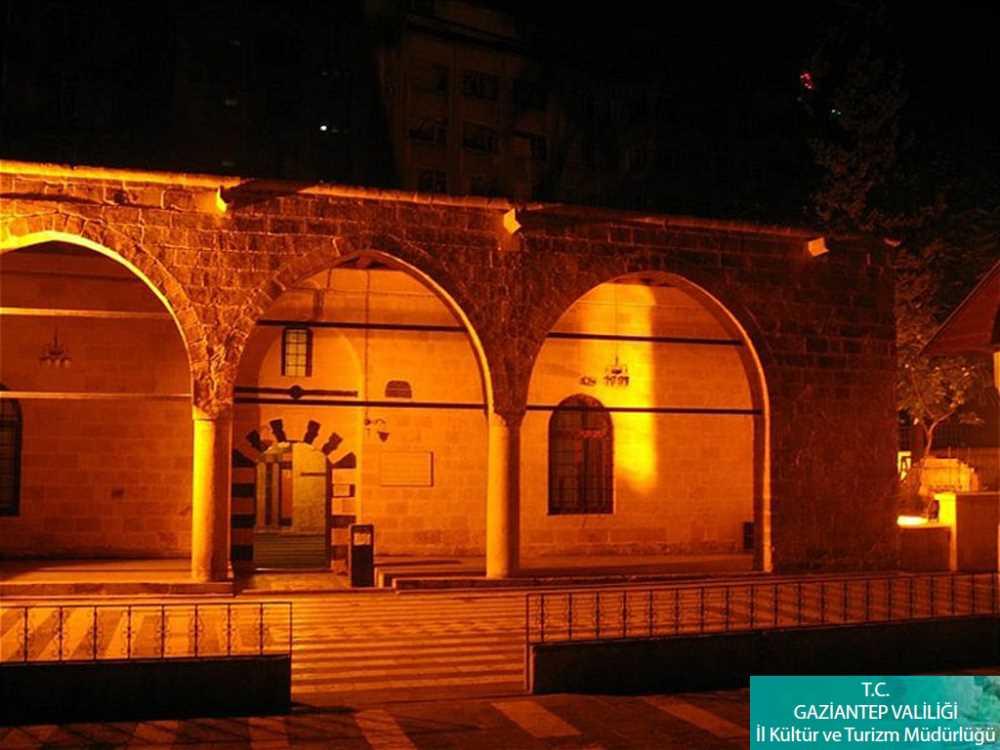
Ömeriye Camii is regarded as one of the earliest examples of Gaziantep stone masonry. The most distinctive feature of the building is its façade, constructed with alternating courses of white (limestone) and black (basalt) stone. This two-colored stone pattern gives the mosque a unique visual character.
The mosque’s main portal and mihrab reflect refined examples of carved stone craftsmanship. The area surrounding the mihrab is decorated with geometric and vegetal motifs. The minaret, located on the northern side of the structure, is single-balconied. The balustrades of the minaret’s balcony feature delicate stone carvings.
Visible on the minaret’s shaft are still-extant shrapnel and bullet marks from the 1920 Defense of Gaziantep; these marks have become a historical layer embedded in the structure. The mosque has a simple rectangular prayer hall with a minimal interior layout, yet its stone decorative details are richly elaborate.
Stone masonry throughout the building has been carefully executed, with particular emphasis on the entrance portal and mihrab area, reflecting the restoration styles of 18th and 19th century Antep. In these aspects, Ömeriye Camii represents an important cultural heritage example, significant both for Ayyubid-era stone craftsmanship and the Ottoman restoration tradition.
Ömeriye Camii (< Gaziantep Metropolitan Municipality)
Among the people of Gaziantep, various legends surround Ömeriye Camii. The most widespread belief is that the mosque sinks slightly into the ground each year and that the Day of Judgment will occur once it is completely buried. This narrative reflects popular beliefs attributing sacredness to the mosque.
The mosque has undergone multiple restorations over the centuries and is now protected by the Gaziantep Provincial Directorate of Culture and Tourism. As one of the oldest Islamic heritage sites in the city, it remains an essential component of both religious tourism and cultural heritage.
GBB Kültür Tanıtım ve Tasarım A.Ş. "Ömeriye Camii I Tarihi Gaziantep Camileri I Prof. Dr. Halil İbrahim Yakar." YouTube Video, 4:28. Accessed October 11, 2025. https://www.youtube.com/watch?v=QNsuaglAK_M
Sungur, Serpil. "Ömeriye Camii." *Türkiye Turizm Ansiklopedisi*. 2019. Accessed October 11, 2025. https://turkiyeturizmansiklopedisi.com/omeriye-camii
T.C. Ministry of Culture and Tourism, Gaziantep Provincial Directorate of Culture and Tourism. "Tarihi Gaziantep Camileri." *gaziantep.ktb.gov*. Accessed October 11, 2025. https://gaziantep.ktb.gov.tr/TR-52362/tarihi-gaziantep-camileri.html
Türkiye Kültür Portalı. "Ömeriye Cami - Gaziantep." *kulturportali*. Accessed October 11, 2025. https://www.kulturportali.gov.tr/turkiye/gaziantep/gezilecekyer/tarihi-camiler719433

Also Known as | Ömereyn Camii | ||||||||
|---|---|---|---|---|---|---|---|---|---|
Location | Şahinbey Türkiye Gaziantep | ||||||||
Protection | By Gaziantep Provincial Directorate of Culture and Tourism | ||||||||
Material(s) | Basalt Limestone | ||||||||
No Discussion Added Yet
Start discussion for "Ömeriye Camii (Gaziantep)" article
History
Architectural Features
Legends and Popular Beliefs
Conservation Status