


This article was automatically translated from the original Turkish version.
+1 More
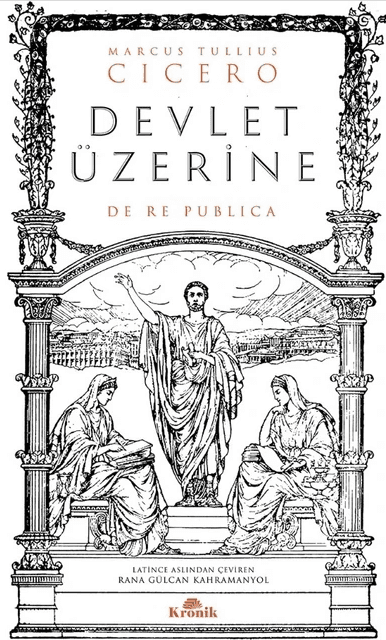
On the State is a dialogue-style work written by Marcus Tullius Cicero, a Roman statesman and philosopher, on the ideal structure of the state and the concept of citizenship. While influenced by Plato’s State, it is grounded in Roman experience and practical politics. Cicero defends a rule-of-law model of governance and grounds the idea of the republic in Roman tradition.
Marcus Tullius Cicero (106–43 BCE) was an orator, lawyer, philosopher, and politician who lived during the final years of the Roman Republic. Renowned especially for his rhetorical skill, Cicero was deeply immersed in Stoic and Academic philosophy and actively participated in Roman political life. He served as consul in Rome, defended republican values, and opposed the rise of Julius Caesar. He was executed for political reasons. His philosophical writings played a vital role in introducing Rome to Greek philosophy.
On the State is written within the framework of the question of how an ideal state should be structured. Drawing on Roman political experience, Cicero examines fundamental political concepts such as justice, law, forms of government, and citizenship. The work proceeds in dialogue form, with different characters debating the foundations of the state, its governing structures, and its organization. According to Cicero, good governance is a mixed system bound by law and oriented toward the public good.
According to Cicero, there exists a universal and unchanging conception of law. The legitimacy of the state depends on its alignment with reason and justice inherent in human nature.
The best form of government is a balanced structure that combines the positive aspects of monarchy, aristocracy, and democracy, based on the separation of powers. This balance prevents corruption and ensures stability.
The republic is a community governed by laws and dedicated to the common good. This definition forms the cornerstone of Cicero’s political and legal thought.
Citizens are not merely bearers of rights; they are individuals who bear duties toward the state and their fellow citizens. Citizenship is an active obligation.
Politics must have moral foundations. A wise ruler must possess not only practical knowledge but also philosophical insight grounded in ethical values.
Cicero’s thought was significantly influenced by Plato’s State and Aristotle’s Politics. However, rather than constructing an ideal society, Cicero developed a more practical and legal approach centered on Roman experience. His adoption of the Stoic concept of natural law established the principle of “natural justice” as the foundation of the state.
Most of the work has been lost over time, but portions have been reconstructed from quotations by medieval authors and from the Vatican Palimpsest, discovered in the 19th century. The text currently available has been partially restored through the work of modern editors. Thus, the book is not a complete text but a fragmented corpus recovered through philological and archaeological efforts.
The Turkish edition published by Kapra Publishing is translated directly from the original Latin text of Cicero’s De Re Publica. In the translation, conceptual consistency has been maintained in rendering specialized terms of political philosophy into Turkish. While presentation varies by edition, some versions include explanatory footnotes and contextual information.
On the State is one of the most important sources for Roman political thought. Cicero’s approach to the relationship between law, justice, and politics has influenced both classical and modern political philosophy as well as Christian medieval thought. The work is also one of the few texts that theoretically examine Rome’s republican experience.

No Discussion Added Yet
Start discussion for "On the State (Book)" article
About the Author (Brief Biography)
Subject Matter
Themes and Explanations
Philosophical Background of the Work
Textual Structure and Preservation Status
Information on the Translation
Literary and Intellectual Significance