

This article was automatically translated from the original Turkish version.
Place of Celebration | Kerala, India | ||||||||
|---|---|---|---|---|---|---|---|---|---|
Significance | It is a harvest festival | ||||||||
Duration | Ten days | ||||||||
Date(s) | August - September | ||||||||
Main Day | Thiruvonam (Tenth Day) | ||||||||
Religious Context | An annual Hindu festival | ||||||||
Commemoration Purpose | The annual return of King Mahabali's reign and people | ||||||||
Onam is an annual Hindu festival celebrated over a ten-day period, typically falling between August and September. In the southern Indian state of Kerala, it holds special significance as a state festival, commemorating both a harvest celebration and the New Year. Although primarily observed in Kerala, it is also honored by Malayalis (Keralites) worldwide and recognized in certain regions of other Indian states such as Uttar Pradesh, Gujarat, and Maharashtra. Onam is a regional celebration observed by all Keralites, regardless of caste or religion.

Onam Festival (Generated by Artificial Intelligence.)
As with many other Hindu festivals, multiple legends explain the religious significance and reason for celebrating Onam. The most widely known among them is the story of King Mahabali’s devotion.
Onam commemorates the return of King Mahabali, the grandson of Prahlada, a devoted follower of Lord Vishnu. King Mahabali conquered the three worlds—heaven, earth, and sky—by defeating the gods and gained power and dominion. Though the defeated gods sought help from Lord Vishnu, he refused to join the war, recognizing Mahabali as a faithful devotee and a just ruler. However, Lord Vishnu decided to test Mahabali’s devotion. One day, while Mahabali was performing a yagna (a Hindu ritual), Lord Vishnu approached him in the guise of a small boy named Vamana.
Vamana asked for land no larger than three of his steps. Mahabali’s guru, the wise Shukracharya, warned him that Vamana was none other than Lord Vishnu in disguise. Nevertheless, King Mahabali, disregarding his guru’s advice, accepted the request. Upon Mahabali’s consent, Lord Vishnu transformed into his Trivikrama form, meaning “he who took three steps.” With his first step, he covered the entire earth, including Mahabali’s kingdom. With his second step, he encompassed the entire sky. He then asked Mahabali where he should place his third step.
To demonstrate his absolute devotion, surrender, and loyalty, Mahabali offered his own head. Impressed by Mahabali’s generosity and selflessness, Lord Vishnu blessed him and sent him to another loka (realm). At the request of Mahabali’s people, Lord Vishnu granted him permission to return once every year to visit his subjects. This day of return—the tenth day of the festival—is officially recognized as Onam.
Celebration of Kerala's Tradition and Culture | Onam | Kerala Tourism (Kerala Tourism)
The Onam festivities last for ten days, each with its own name and a unique combination of customs that evolve over time. The tenth day, Thiruvonam, is the main day of celebration.

After Onam: Some observe an eleventh day, known as Avvittom or Third Onam, to mark the end of Onam and prepare for King Mahabali’s departure. On this day, the idols of King Mahabali and Vamana are immersed in the sea or a river, and the Pookalam are cleaned and removed. Celebrations such as boat races and Pulikali tiger games continue for several more days after Onam.
Onam encompasses numerous ceremonial elements that reflect the imagery of its ten-day festivities.
Pookalam resembles rangoli but is typically more intricate and larger, as it is built layer by layer over ten days. Most Pookalam feature ten concentric rings of flowers, with the central yellow flowers symbolizing King Mahabali. Once completed, a miniature umbrella may be hung above the design to protect it from weather conditions.
Onam Sadya is the traditional feast held on the tenth day of Onam. It is customarily served on banana leaves and typically consists of at least nine different dishes, mostly made from vegetables. Home-cooked meals and sweet desserts such as payasam (a type of pudding) are common delicacies.

Onam Sadya (Flickr)
Vallamkali Boat Races are also known as snake boat races. According to legend, these boats were originally used to protect food supplies being transported from river pirates to temples.
Onathallu is a traditional, friendly form of unarmed combat unique to Kerala. During Onam, Onathallu is performed to commemorate the struggle against betrayal and oppression.
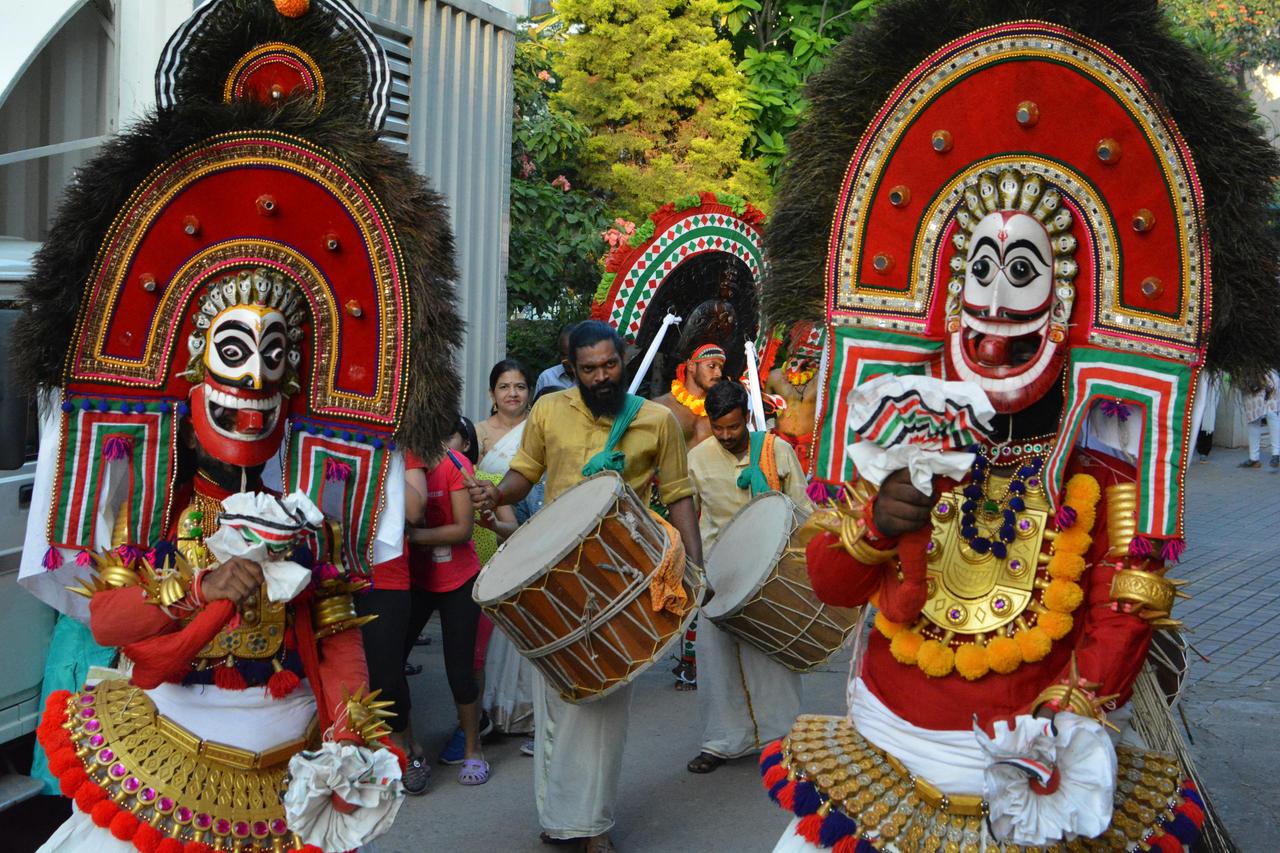
Pulikali involves artists painting their bodies to resemble tigers or leopards and dancing through the streets to the rhythm of traditional instruments. Dancers often wear masks and imitate tigers and leopards, receiving enthusiastic cheers from crowds.

Pulikali During Onam Festival in Kerala (Flickr)
Elephant processions are among the most anticipated events of Onam. Decorated with flowers, ornaments, and trappings, elephants parade through the streets, often “dancing” and interacting with the crowd.
Folk dances, as part of the festival, include various forms unique to Kerala and/or the Onam celebrations.

Thiruvathira Kali Performance (Flickr)
The games associated with the festival, known as Onamkali, include activities such as ball games, tug-of-war, and archery. In villages and rural areas, swings where young couples and children sing Onappaatt (Onam songs) are an integral part of Onam.
Hari_Menon. “Maathevar on Uthradam Day.” Flickr. Accessed November 25, 2025. https://www.flickr.com/photos/me_haridas/1239523597
Hindu American Foundation. "All About Onam." HinduAmerican.org. Accessed November 25, 2025. https://www.hinduamerican.org/onam-explainer
Hindu American Foundation. “Symbolism of Onam – Onam Explainer.” _HAFN_20_049–OnamExplainer_ (PDF). Accessed November 25, 2025. https://www.hinduamerican.org/wp-content/uploads/2020/08/HAFN_20_049-OnamExplainer.pdf
Joseph TI. “Onam Sadhya.” Flickr. Accessed November 25, 2025.
Josephjoyc. “Pulikali During Onam Festival Kerala.” Flickr. Accessed November 25, 2025. https://www.flickr.com/photos/josephjoyc/4929733515/in/photostream/
Kerala Tourism. "Celebration of Kerala's Tradition and Culture | Onam | Kerala Tourism." YouTube. Accessed November 25, 2025. https://www.youtube.com/watch?v=gHESEeS1kGk
Marvelous Kerala. “ThiruvathiraKali: A View from College Onam Day.” Flickr. Accessed November 25, 2025. https://www.flickr.com/photos/marvelouskerala/9798018875
Ravi Mittal. “Traditional Folk Dancers in Thira Costumes during a Festival in Kerala, South India.” Pexels. Accessed November 25, 2025. https://www.pexels.com/photo/traditional-folk-dancers-in-thira-costumes-during-a-festival-in-kerala-south-india-12517554/
Utsav.gov.in. "Onam Festival." Accessed November 25, 2025. https://utsav.gov.in/view-event/onam-festival-1
Place of Celebration | Kerala, India | ||||||||
|---|---|---|---|---|---|---|---|---|---|
Significance | It is a harvest festival | ||||||||
Duration | Ten days | ||||||||
Date(s) | August - September | ||||||||
Main Day | Thiruvonam (Tenth Day) | ||||||||
Religious Context | An annual Hindu festival | ||||||||
Commemoration Purpose | The annual return of King Mahabali's reign and people | ||||||||
Origins and Legend
The Story of King Mahabali
The Ten-Day Celebrations
Symbolism and Traditional Activities of Onam
Pookalam (Floral Rugs)
Onam Sadya (Traditional Feast)
Vallamkali Boat Races
Onathallu (Martial Arts)
Pulikali (Tiger Dance)
Elephant Processions
Folk Dances and Games