


This article was automatically translated from the original Turkish version.
+1 More
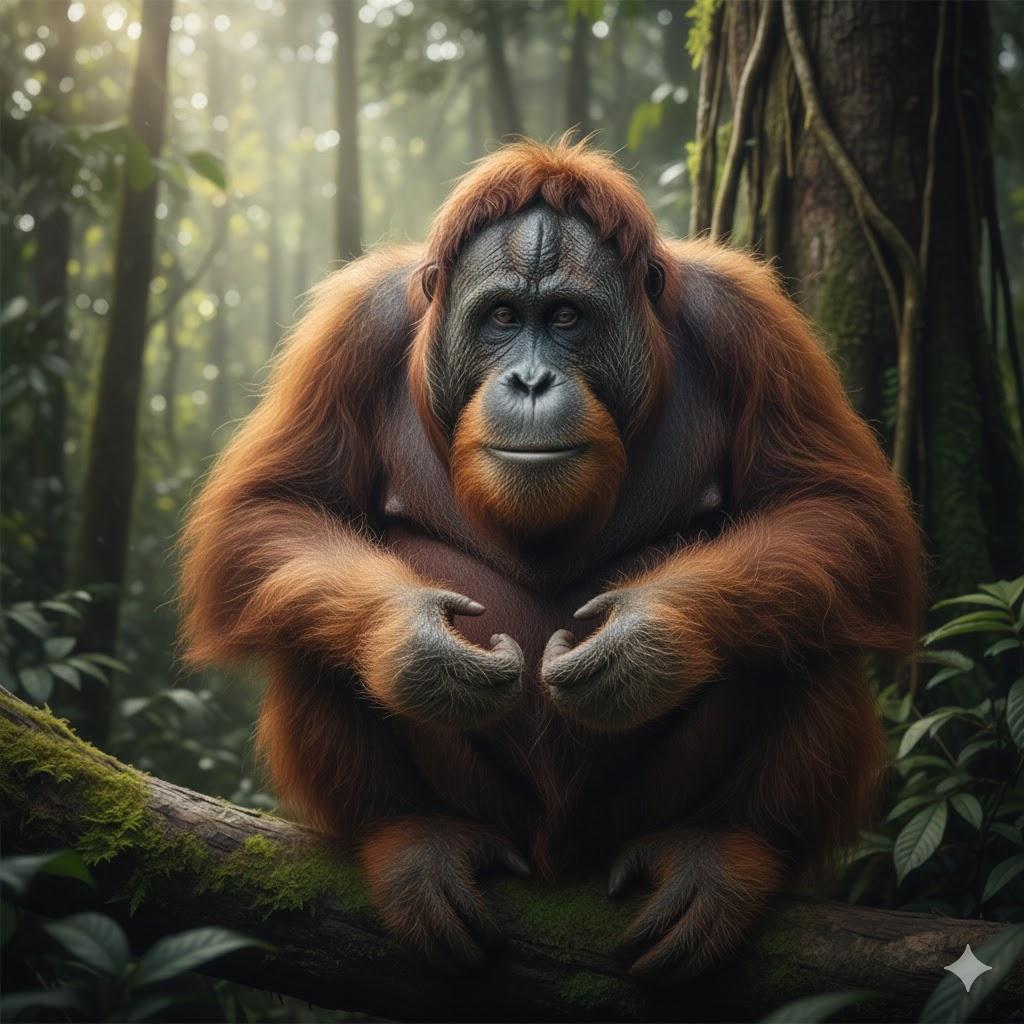
Orangutanlar
(Yapay Zeka ile Oluşturulmuştur)
Orangutans (Pongo) is a genus belonging to the Great Apes (Hominidae) family and consists of three species found in the tropical forests of Southeast Asia: Pongo abelii (Sumatran), Pongo pygmaeus (Bornean), and Pongo tapanuliensis (Tapanuli). They are the largest primates that live primarily in trees. In 2001, mitochondrial DNA analyses confirmed P. abelii and P. pygmaeus as distinct species, and in 2017, P. tapanuliensis was identified as an independent species based on morphological and genetic differences.

Orangutan
(Generated by Artificial Intelligence)
Orangutans are found only on the islands of Sumatra and Borneo. P. abelii and P. tapanuliensis inhabit the northern regions of Sumatra, while P. pygmaeus ranges from the northern provinces of Borneo to Kalimantan. The habitats of all orangutan species are rapidly disappearing, particularly due to the expansion of oil palm plantations and deforestation, which threaten their survival.
Orangutans are recognized by their orange reddish fur and long body hair. Males typically weigh around 160 kilograms while females weigh approximately 80 kilograms. Their long arms, which can extend up to 7 to 8 meters, allow them to move easily through trees. Flexible hip joints facilitate swinging movements between branches.
Male orangutans are physically larger than females and are distinguished by cheek flanges and throat sacs. These features serve as indicators of sexual maturity and dominance. One of the most noticeable differences between Sumatran and Bornean orangutans is the shape of the males’ cheek flanges. Sumatran orangutans have diamond-shaped flanges, while Bornean orangutans have square-shaped flanges.
Unlike other great apes, orangutans are primarily solitary animals. Adult males and females typically travel alone. Their solitary behavior is largely due to the dispersed nature of food resources and their arboreal locomotion habits. Additionally, competition among males for mating opportunities and territorial hierarchies is common.
Orangutans communicate not only through vocalizations but also through gestures. In particular, long-distance calls made by adult males are used to establish territory, warn off other males, or attract females. These calls can be heard up to 1.2 miles away and may last for extended periods.
Orangutans are among the slowest-reproducing mammals. Females typically begin reproducing around the age of 15 and give birth to a single offspring approximately every nine years, the longest interbirth interval of any land animal. Males attain reproductive maturity as their cheek flanges develop.

Orangutan Family
(Generated by Artificial Intelligence)
Orangutan infants are nursed by their mothers for the first two years of life. They learn survival skills by imitating their mothers’ behaviors. Females provide extensive care to ensure their offspring’s safety. Males do not participate in rearing young, as orangutans lead a largely solitary lifestyle.
In the wild, orangutans live approximately 30 to 40 years, while in captivity their lifespan can reach up to 50 years. The oldest recorded orangutan lived to 61 years in captivity. Aging is the most common cause of death among orangutans; however, human-induced threats such as deforestation, poaching, and habitat loss have pushed these species to the brink of extinction.

Orangutan Family
(Generated by Artificial Intelligence)
Orangutans are omnivores and primarily consume fruit, leaves, and tree bark. Occasionally, they also eat invertebrates and small vertebrates. Sumatran and Bornean orangutans prefer different fruits depending on their local environment. For example, Sumatran orangutans commonly feed on figs, while Bornean orangutans favor other fruit species.
When foraging, orangutans often remain in trees for extended periods. This behavior makes them highly strategic in defending feeding areas and locating food. Notably, they also use various tools to extract fruit and insects from trees.
All orangutan species are classified as Critically Endangered by the IUCN. Major threats include habitat loss, deforestation, illegal hunting, and other human-induced environmental pressures. Conservation plans exist for all species except the Bornean orangutan (P. pygmaeus). Various international regulations and awareness campaigns have been initiated to protect these species.
The greatest threat to orangutans is the conversion of forests into agricultural land, particularly the expansion of oil palm plantations. This reduces their natural habitat and pushes them toward extinction. Illegal wildlife trade and habitat fragmentation are also significant factors threatening the survival of these primates.
Although several protected areas have been established for orangutan species, sufficient protected habitat has not been secured for species such as the Bornean orangutan. While 90 percent of Sumatran orangutans live in protected areas, the proportion for Tapanuli orangutans remains between 1 and 10 percent. Despite international trade bans and conservation initiatives, orangutans continue to lose their habitats.
Fox, ElizaBeth A., Carel P. van Schaik, Arnold Sitompul, and Donielle N. Wright. “Intra- and Interpopulational Differences in Orangutan (Pongo pygmaeus) Activity and Diet: Implications for the Invention of Tool Use.” American Journal of Physical Anthropology 125, no. 2 (October 2004): 162–174. Accessed February 18, 2026. https://doi.org/10.1002/ajpa.10386
Galdikas, Biruté M. F., and Alison Ashbury. “Reproductive Parameters of Female Orangutans (Pongo pygmaeus wurmbii) 1971–2011, a 40-Year Study at Tanjung Puting National Park, Central Kalimantan, Indonesia.” Primates 54 (2013): 61–72. Accessed February 18, 2026. https://link.springer.com/article/10.1007/s10329-012-0331-5
Novita Amalia, Dyah Perwitasari-Farajallah, Sri Suci Utami-Atmoko, and Azhari Purbatrapsila. “Orang-utans’ (Pongo pygmaeus wurmbii) Activity Pattern in Camp Release and Feeding Site of Lamandau Wildlife Sanctuary, Central Borneo, Indonesia.” Journal of Tropical Biodiversity and Biotechnology (year not provided). Accessed February 18, 2026. https://jurnal.ugm.ac.id/jtbb/article/view/70001
Perea Garcia, Juan Olvido, Alessandro Miani, Aage Kristian Olsen Alstrup, Jens Malmkvist, Cino Pertoldi, Trine Hammer Jensen, Rikke Kruse Nielsen, Dan Witzner Hansen, and Lars A. Bach. “Orangulas: Effect of Scheduled Visual Enrichment on Behavioral and Endocrine Aspects of a Captive Orangutan (Pongo pygmaeus).” Journal of Zoo and Aquarium Research 8, no. 1 (2020): 67–72. Accessed February 18, 2026. https://doi.org/10.19227/jzar.v8i1.416

Orangutanlar
(Yapay Zeka ile Oluşturulmuştur)
Geographic Distribution
Physical Characteristics and Morphology
General Physical Features
Sexual Dimorphism
Behavior and Lifestyle
Solitary Tendency
Communication
Reproduction and Life Cycle
Reproduction
Infants and Parental Investment
Lifespan
Feeding Habits
Diet
Feeding Behavior
Conservation Status and Threats
Conservation Status
Threats
Conservation Efforts