

This article was automatically translated from the original Turkish version.
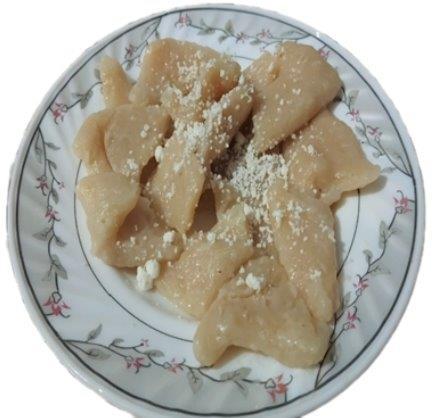
Osmancık kaypak is a traditional dough dish originating from the Osmancık district of Çorum Province, made by preparing a firm dough from water, flour, and salt, rolling it into a circular shape, and cutting it into small square pieces. These pieces may be left unfilled or stuffed with a filling as desired, then folded into triangular shapes and boiled in water. When served, ingredients such as tulum cheese, çökelek, yogurt, walnut kernels, butter, mint, and red pepper flakes may be added on top. This dish, consumed daily in Osmancık and also served at weddings, holidays, and special occasions, has been officially registered with a geographical indication due to its distinctive preparation method and deep cultural ties to the region.
Osmancık kaypak is a traditional dough dish unique to the Osmancık district of Çorum Province. It is prepared by making a firm dough from water, flour, and salt, rolling it out, cutting it into small squares, and then folding the pieces either plain or filled, before boiling them in water. The prepared dough pieces are sealed in triangular or muska shapes, known locally as “kaypak.” After boiling, toppings such as tulum cheese, çökelek, yogurt, walnut kernels, mint, parsley, red pepper flakes, and melted butter may be added, and the dish may be served either hot or cold.
The dish derives its name from the local term “kaypak,” which refers to the hollow or filled dough pieces. It holds an important place in the culinary culture of the district and is consumed as part of daily meals as well as served during special occasions such as weddings, holidays, banquets, and festivals. The selection of ingredients, the firmness of the dough, the shaping, the use of filling, and the cooking technique all require specific skill, establishing a strong association between the dish and the Osmancık district.
Flour, water, and salt are mixed and kneaded until a firm, elastic dough is formed. The dough is divided into portions, covered, and left to rest for approximately 30 minutes. The rested portions are rolled out into circular shapes with a diameter of 60–80 cm. The rolled dough is then cut into 4x4 cm squares. These pieces may be left unfilled or filled with ingredients such as çökelek, tulum cheese, parsley, and red pepper flakes, then folded into triangular shapes. The folding is done by hand, and the edges are sealed using a fork-like tool. The prepared pieces are left to rest for an additional 60 minutes.
In a separate pot, sunflower oil and salt are added to boiling water or meat broth. The kaypak dough pieces are then added and boiled for approximately 10 minutes. After cooking, the dough pieces are rinsed in cold water to achieve a firm texture. They are then transferred to a serving dish. Optional toppings such as cheese, yogurt, walnut kernels, melted butter, or spice mixtures are added according to preference. The dish may be served either hot or cold, and mint, parsley, and red pepper flakes may be used for garnish as desired.
Kaypak that has been prepared but not immediately cooked can be stored by freezing at temperatures of -18 °C or lower.
The entire production process of Osmancık kaypak is carried out exclusively within the boundaries of the Osmancık district of Çorum Province. This requirement is necessary due to the skill-intensive production method and the culturally rooted traditions that define the dish.
At least one annual inspection is conducted by a monitoring team of at least three members coordinated by the Osmancık District Governor’s Office, including representatives from the District Governor’s Office and the Osmancık District Directorate of Agriculture and Forestry. The inspection is documented in accordance with Law No. 6769 on Industrial Property and submitted to the Turkish Patent and Trademark Office. Additional inspections may be carried out as needed. The following criteria are used during inspections:
Any non-compliance and required corrective measures are communicated to the relevant individuals or institutions. Expert assistance or services may be obtained during the inspection process.
Turk Patent and Trademark Office. "Osmancık Kaypak Yemeği (Registration No: 1718)." Geographical Indications Detail Page. Accessed 2025. https://ci.turkpatent.gov.tr/cografi-isaretler/detay/11765.
Turk Patent and Trademark Office. "Osmancık Kaypak Yemeği Coğrafi İşaret Tescil Dosyası." PDF document, 2025. Accessed 2025. https://ci.turkpatent.gov.tr/Files/GeographicalSigns/4f7010df-281a-4cdf-b70c-fbb9175f8f7f.pdf.

No Discussion Added Yet
Start discussion for "Osmancık Kaypak Dish" article
General Characteristics
Origin and Cultural Context
Ingredients (Serves 6)
For the dough:
For boiling:
Optional fillings and serving ingredients:
Preparation Process
Cooking and Serving
Storage Conditions
Production Area and Geographic Boundaries
Monitoring Process