


This article was automatically translated from the original Turkish version.
P5.js is an open-source JavaScript-based source library used for creating visuals, animations, interactive graphics, and creative projects. P5.js is employed in various ways in the fields of visual arts, design, and education. Library enables the development of algorithmic art, interactive media, educational projects, and graphics-based applications. The primary goal of the library is to provide artists, designers, and beginners in software development with the opportunity to create creative content using programming.
P5.js was developed as a JavaScript adaptation of the Processing language. Processing is a software language created in 2001 by Ben Fry and Casey Reas specifically for artists. Processing has helped individuals interested in visual arts acquire programming skills by simplifying complex software development processes. P5.js is a web-based alternative to Processing, written in JavaScript to reach a broader user base.

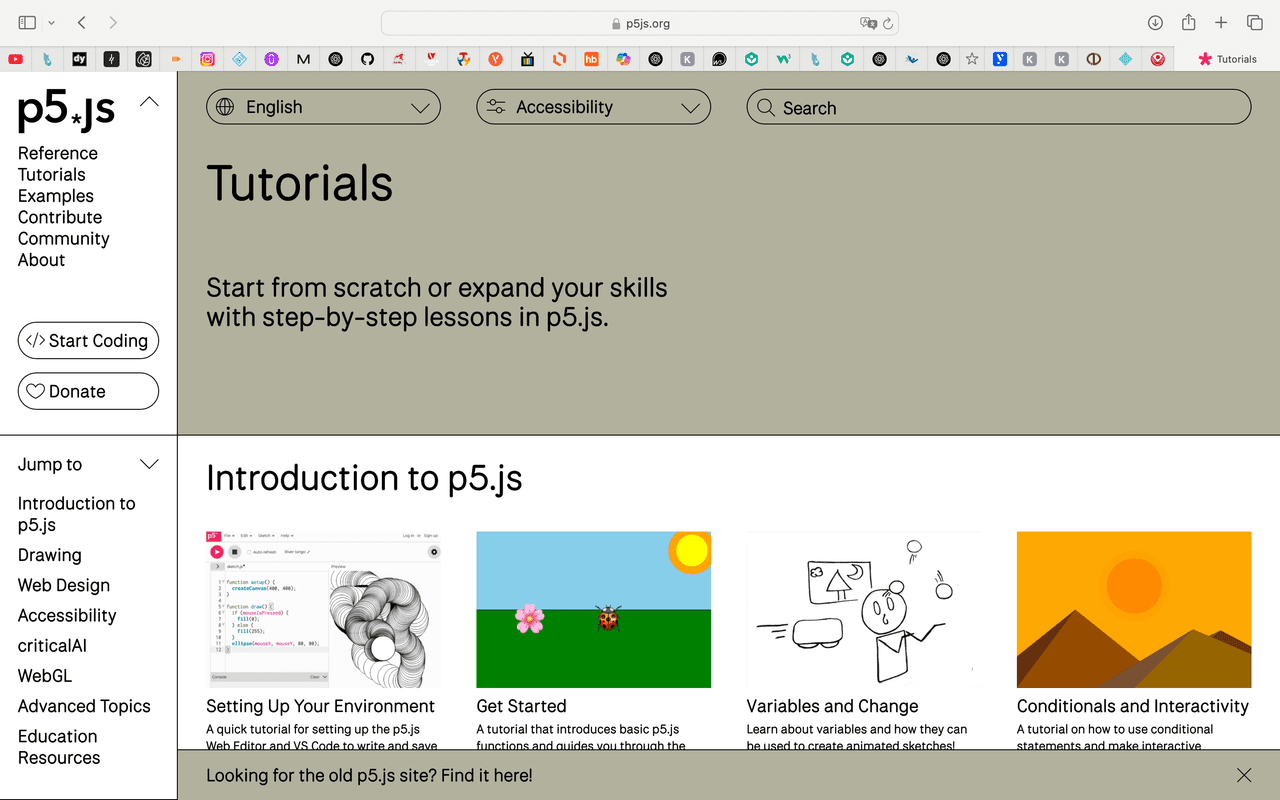
P5.js was developed by embracing the core philosophy of the Processing language. Processing is a language designed to make it easier for artists and designers to produce graphical and visual projects, and it was released in 2001 by Ben Fry and Casey Reas. The aim of Processing is to make software development more accessible to art. P5.js was initiated in 2014 by Daniel Shiffman as a JavaScript version of Processing. Shiffman designed P5.js specifically to be usable by individuals engaged in visual arts. P5.js enables the development of web-based projects by utilizing the HTML5 canvas element. The library developed by Shiffman empowers visual artists and beginners in programming to create creative projects in digital environments.
P5.js provides a simple API that allows users to easily create interactive visuals and animations. Its structure is accessible even to beginners, making it easy to understand and use. The API creates a more suitable environment for visual artists by distancing itself from complex software development processes.
P5.js uses the HTML5 canvas element to generate visual content. Canvas provides an area for drawing two-dimensional images and creating animations. P5.js offers various functions through this element to draw shapes, apply colors, and organize visual content.
P5.js enables users to create animations and interactive graphics. Users can modify animations or generate new content through interactions such as mouse clicks, touch, keyboard input like. This capability is especially important for interactive media projects.

P5.js is not limited to creating visual content. It also supports audio, video, and other media types. Users can build integrated projects using audio files, videos, and other multimedia elements. This enhances P5.js’s applicability across various fields, particularly in interactive media projects.
P5.js offers comprehensive documentation and instructional content for those wishing to learn software development. The The Coding Train YouTube channel, managed by Daniel Shiffman, features numerous tutorial videos on P5.js and other software development tools. P5.js provides educational materials focused on visual programming and the creation of creative projects.
Since P5.js is based on JavaScript, it enables the development of projects that run in web browsers. HTML5 and JavaScript are natively supported by web browsers, allowing P5.js projects to be easily shared on the internet. Web-based projects offer broad accessibility, especially in education and creative endeavors.
P5.js is widely used in the following areas:
P5.js is commonly used to produce digital art projects. Visual artists can generate visual content through algorithms, exhibit their artworks in digital formats, and develop interactive media projects.
P5.js is an educational tool used for teaching programming to beginners. Students can learn the fundamentals of algorithms and software development through a visual programming approach. Additionally, educators and online resources frequently recommend P5.js in schools offering instruction in visual arts and design.
P5.js can also be used to create data visualizations. Numerical data can be represented visually and presented in a more comprehensible manner through analysis. Data visualizations are particularly useful for scientific research and reporting.
P5.js can be used in web design and media projects to create interactive content. Users can generate interactive graphics, animations, and visual designs within web pages.
P5.js can be employed in scientific research for data visualization and the graphical presentation of results. Visualized data can make complex research processes more accessible and improve understanding of outcomes.
Although P5.js is an effective vehicle for visual arts and creative projects, it has certain limitations. The library may not be sufficient for more complex graphical projects. For tasks such as game development, high-performance applications, and low-level graphics processing, more powerful tools are often preferred. Additionally, some features in P5.js may fall short in meeting advanced software development requirements, potentially necessitating the use of more sophisticated graphics libraries.
The future of P5.js will be shaped by the growing popularity of web-based projects. The library serves as a valuable important tool for creating creative projects in the fields of visual arts and software development. In the future, advancements in P5.js and increased integration with technologies such as augmented reality (AR) and virtual reality (VR) are anticipated. Such integrations could further expand the application areas of P5.js. As digital media continues to evolve in education and visual arts, the library will find increasingly diverse uses.

History
Key Features
Simple and Intuitive API
Canvas Feature
Animation and Interaction
Support for Various Media
Education and Documentation
Compatibility with Web-Based Applications
Applications
Visual Arts
Education
Data Visualization
Interactive Web Design and Media
Scientific Research
Criticisms and Limitations
Future Perspectives