


This article was automatically translated from the original Turkish version.
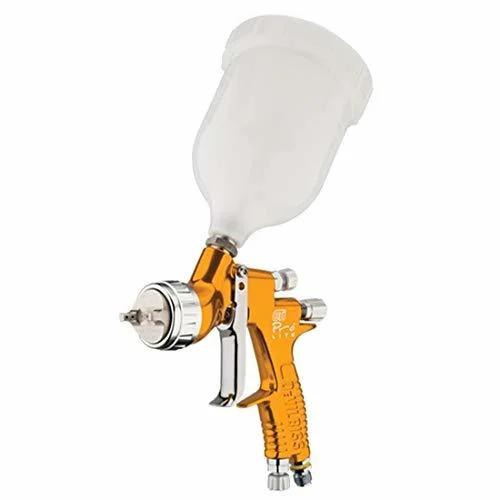
Paint Sprayer
Type(s) | Paint Application Equipment | ||||||||
|---|---|---|---|---|---|---|---|---|---|
Working Principle | Pneumatic, Electric, HVLP | ||||||||
Purpose of Use(s) | Uniform Coating on Surface | ||||||||
Field of Use | Automotive, Furniture, Construction, Industry | ||||||||
Standards | ISO 16122-2, TS EN 1953 | ||||||||
A spray gun is an application device powered by air or electricity, used to evenly and controllably spray liquids such as paint, varnish, and primer onto surfaces. It ensures homogeneous distribution, uniform film thickness, and high efficiency in surface coatings. It is widely preferred in industrial painting systems, the automotive sector, furniture manufacturing, and decorative applications.
Spray guns are used on a wide variety of surfaces:
Millî Eğitim Bakanlığı (MEGEP). *Kimya Teknolojisi – Boyama Ekipmanları ve Teknikleri*. Ankara: MEB Yayınları, 2013. Accessed June 17, 2025. .
Millî Eğitim Bakanlığı (MEGEP). *Yüzey Hazırlama ve Boya Uygulama Ekipmanları*. Ankara: MEB Yayınları, 2013. Accessed June 17, 2025. .

Paint Sprayer
Type(s) | Paint Application Equipment | ||||||||
|---|---|---|---|---|---|---|---|---|---|
Working Principle | Pneumatic, Electric, HVLP | ||||||||
Purpose of Use(s) | Uniform Coating on Surface | ||||||||
Field of Use | Automotive, Furniture, Construction, Industry | ||||||||
Standards | ISO 16122-2, TS EN 1953 | ||||||||
Features
Application Surfaces
Application Areas
Application Techniques
Usage Method
Advantages
Limitations