This article was automatically translated from the original Turkish version.
Duration | 1 hour 58 minutes | ||||||||
|---|---|---|---|---|---|---|---|---|---|
Production Companies | Snowglobe MK Productions Corniche Media Autonomous Philistine Films | ||||||||
Director(s) | Annemarie Jacir | ||||||||
Cast(s) | Khouloud – Yasmine Al Massri Rabab – Yafa Bakri Khalid – Saleh Bakri Hanan – Hiam Abbass Yusuf – Karim Daoud Anaya | ||||||||
Distribution(s) | Watermelon Pictures | ||||||||
Producer(s) | Ossama Bawardi | ||||||||
Type(s) | History War Drama | ||||||||
Screenplay(s) | Annemarie Jacir | ||||||||
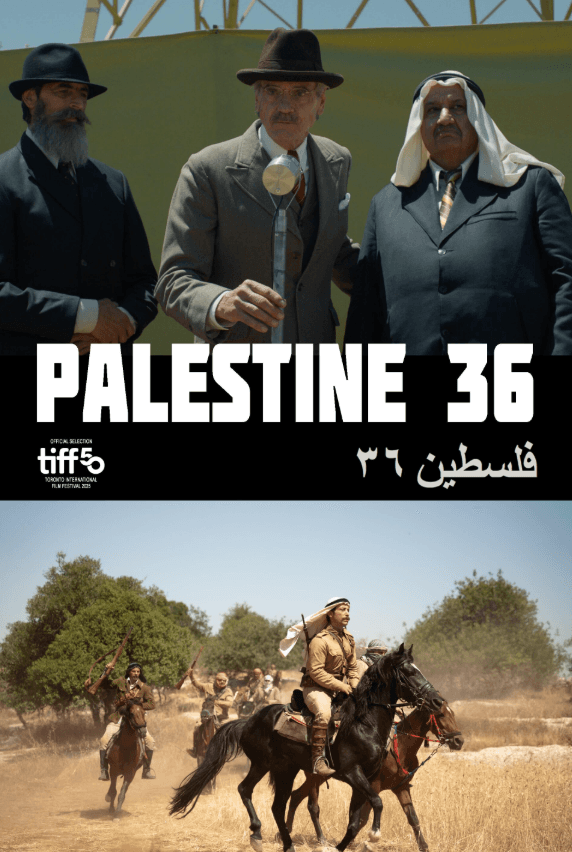
Palestine 36 is a film that examines the political transformation in Palestine under British Mandate rule in 1936, presenting the conditions of the era within their historical context. The film traces the relationships between rural and urban life, the practices of British administration, the social structure, and the atmosphere of the emerging resistance movement through an extensive network of characters. Although the narrative unfolds through fictional characters, the historical backdrop is constructed with reference to documents, testimonies, and the political developments of the time. As highlighted in various reviews and interviews, the story is structured around the conditions of the 1936–1939 Great Palestinian Revolt, with the political tensions of the period shaped across both rural and urban spaces.
The character of Yusuf at the center of the film is designed as a connecting thread between different social classes and spatial layers. Information from director Annemarie Jacir’s statements, actor interviews, and cinema critiques reveals that the production process was interrupted multiple times due to recent developments in the region. Nevertheless, the film’s connection to its historical period has been preserved, and despite the challenges of production, the film was completed along its designated historical axis.
PALESTINE 36 | Official UK Trailer - In Cinemas 31 October (Curzon)
The events portrayed in the film center on the rising tensions during the British Mandate period in Palestine, the disputes over land loss, and the societal transformations following the acceleration of Jewish immigration. The 1936 revolt is described as “the largest and longest resistance movement led by peasants against thirty years of British rule.” During this period, villages, urban centers, the press, and social organizations participated in the uprising in various forms. The British administration imposed martial law, deployed over twenty thousand troops, and intensified military intervention.
Historical records indicate that the revolt was not limited to agricultural land loss and tax boycotts but was also characterized by targeted settlements, mutual attacks, and harsh actions by security forces. The documentary details the historical context of the events in Al Bassa in 1938 and notes that some scenes in the film are based on these real incidents.
The film depicts the agricultural ties of rural communities, the symbolic importance of land, and family structures, while emphasizing the press, bureaucracy, British administration, and social class distinctions in urban life. Actor testimonies reveal that the significance of land for Palestinians plays a central role in the film. Actor Liam Cunningham speaks through his character about the impact of British policies of the era, while Saleh Bakri notes that the conditions of the 1930s exhibit a historical continuity with contemporary events.
Yusuf, a young man living in a village, moves between scenes set in both rural and urban areas. He is a character who works as an assistant to a journalist in Jerusalem, thereby offering a perspective that bridges villagers and urban elites.
The film’s plot functions by positioning Yusuf as the character who connects the city and the village, developing the narrative through his movements.
Key characters representing the village include Rabab, Hanan, Afra, and Khalid, a representative of resistance groups operating in the mountainous regions. Their relationships and daily lives are structured to illustrate how society was transforming. The film details their family bonds, neighborhood relations, and the social order of the village.
The city’s journalistic circles, political debates, and British administrative decision-making processes occupy a prominent place in the film. Amir and his wife Khouloud serve as characters representing the constraints of the media environment, gender practices, and political fragmentation. The film highlights that Khouloud was forced to write under a male pseudonym, examining the position of female journalists during this period.
Representatives of the British administration include High Commissioner Wauchope and various military officers. The film emphasizes Orde Wingate’s punitive methods and the British army’s pressure on villages. The historical counterparts of these figures are extensively addressed, though some critics have argued that certain elements in these scenes do not fully align with the historical context.
The impact of land loss on Palestinian society lies at the heart of the narrative. The film demonstrates that land is not only an economic asset but also a central element of identity. The pressures faced by rural farmers are portrayed as intertwined with bureaucratic land policies in urban areas.
Resistance organized in different forms in the city and the village is depicted through scenes such as train attacks and mass actions. Various characters in the film are positioned to represent different dimensions of the resistance movement.
The use of a Shakespearean range of characters allows for the inclusion of diverse experiences among journalists, politicians, British officials, farmers, and children. Due to the scope of events, some characters are portrayed with broad strokes.
The film experienced various delays during production due to the pandemic and developments in the region after 2023. Nevertheless, the crew completed filming in the West Bank and Jordan. The film’s technical team includes cinematographers such as Hélène Louvart and Sarah Blum.
Archival footage from the 1930s has been colorized and incorporated into the film, thereby uniting the historical context with fictional scenes within a cohesive atmosphere.
The music composed by Ben Frost is evaluated as fitting the atmosphere of the period through various sources. It is noted that these compositions blend traditional Arab instruments and heighten the emotional intensity of the scenes.
The film’s cast is extensive and multi-layered according to historical documentation. The principal actors are:
While some of these characters do not have direct historical counterparts, each has been selected to represent distinct social and political positions of the era.
Anadolu Ajansı. "Palestine 36 filmi, Filistin sorununun tarihsel kökenini ele alıyor." Accessed November 24, 2025. https://www.aa.com.tr/tr/kultur/palestine-36-filmi-filistin-sorununun-tarihsel-kokenini-ele-aliyor/3749908
BFI – Sight & Sound. “Palestine 36: a broad primer on a complex period in Palestinian history.” Accessed November 24, 2025. https://www.bfi.org.uk/sight-and-sound/reviews/palestine-36-broad-primer-complex-period-palestinian-history
Curzon Cinema & Arts. "Palestine 36." Accessed November 24, 2025. https://www.curzon.org.uk/film/palestine-36/
Curzon Film. "Palestine 36." Accessed November 24, 2025. https://film.curzon.com/film/palestine-36/
Engelsberg Ideas. "Palestine 36’s distorted history." Accessed November 24, 2025. https://engelsbergideas.com/reviews/palestine-36s-distorted-history/
Film Review Daily. "Palestine 36 — Film Review." Accessed November 24, 2025. https://www.filmreviewdaily.com/new-reviews/palestine-36
IMDb. “Palestine 36 (2025).” Accessed November 24, 2025. https://www.imdb.com/title/tt29271622/?ref_=mv_close
Rotten Tomatoes. "Palestine 36." Accessed November 24, 2025. https://www.rottentomatoes.com/m/palestine_36
Variety. “‘Palestine 36’ Review: The Country’s Epic Oscar Submission Offers a Sweeping View of a Tumultuous Time.” Accessed November 24, 2025. https://variety.com/2025/film/reviews/palestine-36-review-1236514104/
YouTube. "PALESTINE 36 | Official UK Trailer - In Cinemas 31 October." YouTube Video, Accessed November 24, 2025. https://www.youtube.com/watch?v=wWtwnae_5UI

Duration | 1 hour 58 minutes | ||||||||
|---|---|---|---|---|---|---|---|---|---|
Production Companies | Snowglobe MK Productions Corniche Media Autonomous Philistine Films | ||||||||
Director(s) | Annemarie Jacir | ||||||||
Cast(s) | Khouloud – Yasmine Al Massri Rabab – Yafa Bakri Khalid – Saleh Bakri Hanan – Hiam Abbass Yusuf – Karim Daoud Anaya | ||||||||
Distribution(s) | Watermelon Pictures | ||||||||
Producer(s) | Ossama Bawardi | ||||||||
Type(s) | History War Drama | ||||||||
Screenplay(s) | Annemarie Jacir | ||||||||
No Discussion Added Yet
Start discussion for "Palestine 36 (Film)" article
Historical Background
The Emergence of the 1936 Revolt
Social Division Between Village and City
Narrative Structure and Key Characters
Yusuf and His Connecting Role
Characters in the Village
Characters in the City
British Administration and Military Figures
Thematic Focuses
The Land Issue and Economic Conflicts
The Development of Resistance and Social Organization
Political Pressure and the Public Sphere
Production Process and Technical Framework
Shooting Conditions
Imagery and Archival Use
Music and Sound Design
Cast