


This article was automatically translated from the original Turkish version.
+2 More
Palu Castle is a historical fortress located in the Palu district of Elazığ Province in Eastern Anatolia, Türkiye. It is situated on a high and steep rock face along the eastern bank of the Murat River, the eastern branch of the Euphrates River. This strategic location provided natural defensive advantages and conferred significant strategic importance throughout history. Evliya Çelebi described the castle as “a fortress that reaches toward the sky” and noted that Timur passed by without attempting to capture it.
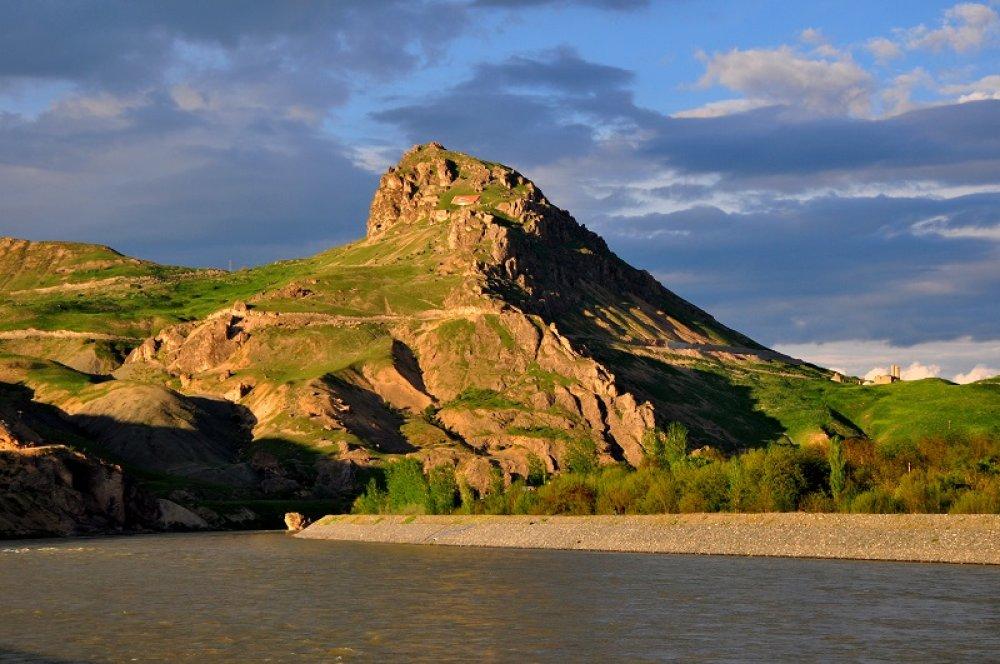
Palu Castle (Palu Municipality)
According to archaeological and written sources from the region, the history of Palu Castle extends back to ancient times, as far as the 8th century BCE during the Urartian Kingdom. It is believed to have been constructed by the Urartians or at least to have foundations dating to that period. Subsequently, the castle came under the rule of numerous civilizations including the Persians, the Roman and Byzantine Empires, the Arabs, the Seljuks, and the Ottomans. Excavations within the castle have uncovered remains of palaces and military structures from the Artuklid, Seljuk, and Ottoman periods. According to some historical sources, Artuklid ruler Belek Gazi married Seljuk princess Ayşe Hatun within this castle, and their wedding ceremony was held here.
During the Middle Ages, the castle became one of the region’s key military bases and served as the administrative center of the Palu Beylik during the Ottoman period, particularly in the 16th century. Ottoman archives frequently reference the castle and its surrounding area.
Constructed on a high and steep rock mass along the eastern bank of the Murat River, the castle benefits from a design that harmonizes with the natural topography, granting it significant defensive advantages. Its military function was further reinforced by the steep cliffs on its northern and western sides. Over time, the castle’s perimeter was enclosed by stone walls that underwent repeated repairs, and defensive towers were strategically positioned to strengthen its fortifications. Internally, the castle contains rock-cut tombs, tunnels, shrines, niches, storage chambers, and rock-cut stairways dating to the Urartian period, serving both religious and domestic functions. Additionally, numerous underground cisterns carved into the bedrock ensured the fortress’s resilience during prolonged sieges.
Remains of an Ottoman-era mosque have been found within the castle, indicating its religious function. The ruins of palaces and military structures from the Artuklid, Seljuk, and Ottoman periods demonstrate that the castle served not only a defensive role but also administrative and residential functions. The cuneiform inscription attributed to Urartian King Menua is among the most important epigraphic evidence documenting the site’s historical continuity.
The castle’s architecture reflects traces of Urartian stonework alongside later additions of Islamic and Ottoman elements, revealing a layered historical development.
The castle bears the cultural imprints of successive civilizations from the Urartian period through the Persian, Roman, Byzantine, Arab, Seljuk, Artuklid, and Ottoman eras. In this regard, it serves as a vital archaeological source for understanding historical continuity in the region.
The castle has also become embedded in the cultural memory of the region not only through its physical structure but also through local narratives, legends, and written records. Evliya Çelebi’s descriptions and the historical accounts associated with Belek Gazi and Ayşe Hatun illustrate the castle’s influence on the formation of local identity.
Most of the castle is currently in ruins. Although many structures have collapsed, it has been officially registered and protected by the Ministry of Culture and Tourism, with conservation projects underway. As of 2025, excavation work will be initiated under the auspices of the Elazığ Archaeology and Ethnography Museum. These excavations are expected to uncover new artifacts and revitalize tourism at the site.

History
Architectural Features
Cultural Significance
Conservation Status and Tourism