


This article was automatically translated from the original Turkish version.
+1 More
Palu (District)
Mayor(s) | Muhammet SEPTİOĞLU | ||||||||
|---|---|---|---|---|---|---|---|---|---|
District Governor | Hulusi TEKE | ||||||||
Population | 18,648 (2021) | ||||||||
Geographical Location(s) | Eastern Anatolia Region | ||||||||
Province(s) | Elazığ | ||||||||
In the East Anatolia region of Türkiye, Palu is one of the districts of Elazığ province, notable for its place area, historical legacy, natural structure, cultural richness and strategic location. With a multi-layered historical accumulation, Palu stands as a carrier of regional culture through its archaeological remnants and architectural fabric that reflect traces of ancient civilizations.
The history of Palu district extends back to antiquity and has been home to numerous civilizations. Following the Urartians, Persians, Romans and Byzantines, Palu came under Turkish rule with the settlement of Turkic peoples in Anatolia, subsequently falling under Seljuk and Ottoman authority. Particularly during the Middle Ages, Palu emerged as one of the key settlement centers in Eastern Anatolia and, due to its strategic location, played a significant role in military and commercial terms throughout history.
The Palu Castle stands out as one of the strongest symbols of the district’s historical identity. The ancient settlement areas and archaeological remains surrounding it shed light on the region’s past. Additionally, mosques, bathhouses and madrasas from the Ottoman period are among the key examples of the district’s historical and cultural heritage.
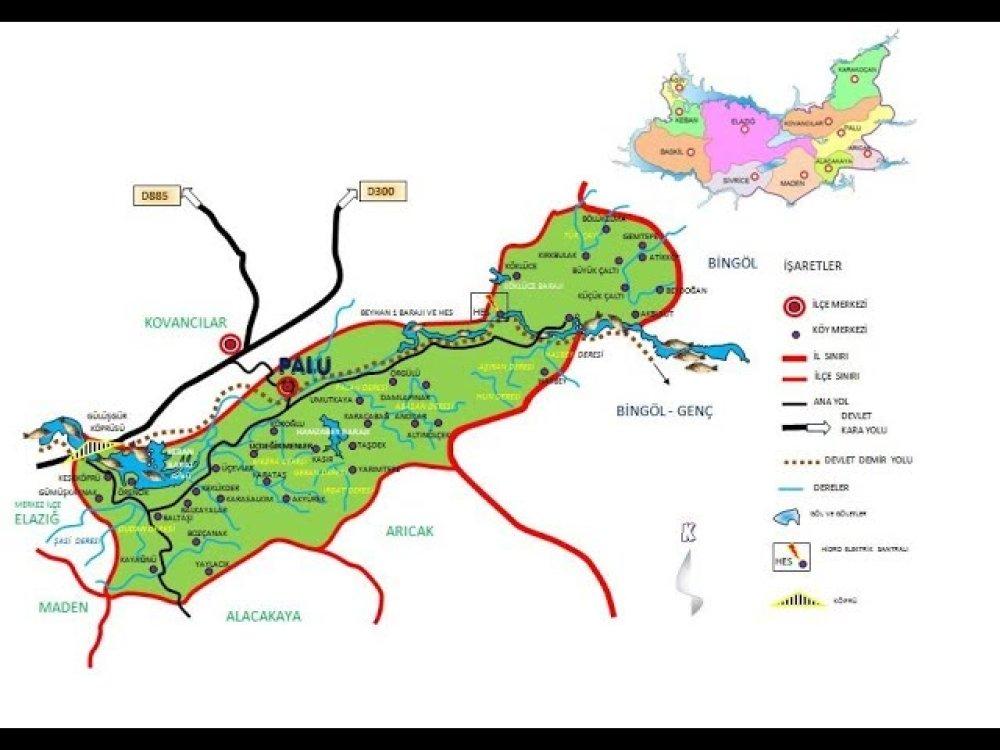
Palu district is located in the eastern part of Elazığ province, along the banks of the Murat River. The district covers an area of 1,061 km² and has an average elevation of 872 meters above sea level. It is bordered by Bingöl to the east, Kovancılar to the west, Arıcak to the south and Karakoçan to the north. The natural landscape of the district is characterized by rugged and mountainous terrain. This geographical structure limits agricultural activity but provides favorable conditions for livestock farming.
The Murat River plays a vital role in both the historical and contemporary economic structure of Palu. Agricultural lands and water resources developed along its course form important sources of livelihood for the local population. Moreover, Palu’s natural beauties hold significant potential for nature-based tourism.
Palu district possesses a rich cultural heritage. Among its historical monuments, Palu Castle, ancient mosques, caravanserais and bridges are particularly prominent. These structures illustrate the profound influence of traditional architecture in the region. Furthermore, from a cultural perspective, local handicrafts, traditional cuisine and folkloric elements are vital components reflecting Palu’s cultural identity.
Cultural events held annually in the district contribute to preserving local traditions and strengthening social cohesion. These activities also promote the district’s visibility and support the development of its tourism potential.
Palu district consists of 68 villages and 6 neighborhoods. In the district center, public institution and institutions provide services, while education and healthcare infrastructure remain at a basic level. The majority of the population resides in rural areas. This pattern has led to the phenomenon of situation migration. In particular, the migration of large segments of the youth population to major cities is altering the district’s demographic structure.
Local administrations are implementing projects aimed at improving the district’s infrastructure and service quality. Social, cultural and infrastructure investments made by the municipal government are regarded as important steps toward enhancing the quality of local life.
The economy of Palu district is predominantly based on agriculture and livestock farming. The main agricultural products include wheat, barley and chickpeas. Viticulture and vegetable cultivation also hold significant importance in the local economy. Livestock farming is practiced in both large and small animal husbandry forms, with dairy and meat products serving as key income sources for the local population.
Industrial and mining activities are limited, but small-scale workshops and enterprises provide services to meet local needs. Nevertheless, investments in tourism hold potential to diversify the district’s economy.
T.C. Elazığ Valiliği. "Palu." *elazig.gov.tr*. Accessed April 19, 2025. http://www.elazig.gov.tr/palu
T.C. Ministry of Culture and Tourism. “Palu İlçesi.” *elazig.ktb.gov.tr*. Accessed April 19, 2025. https://elazig.ktb.gov.tr/TR-187351/palu-ilcesi.html
T.C.Elazığ Belediyesi. “Palu.” *elazig.bel.tr*. Accessed April 19, 2025. https://www.elazig.bel.tr/kent-rehberi/palu/226/
T.C.Palu Belediyesi. *palu.bel.tr*. Accessed April 19, 2025. https://www.palu.bel.tr/

Palu (District)
Mayor(s) | Muhammet SEPTİOĞLU | ||||||||
|---|---|---|---|---|---|---|---|---|---|
District Governor | Hulusi TEKE | ||||||||
Population | 18,648 (2021) | ||||||||
Geographical Location(s) | Eastern Anatolia Region | ||||||||
Province(s) | Elazığ | ||||||||
Historical Development
Geographical Structure and Natural Features
Cultural Structure and Heritage
Administrative Structure and Demographic Situation
Economic Structure