

This article was automatically translated from the original Turkish version.
+2 More
Location | Şavşat Türkiye Artvin | ||||||||
|---|---|---|---|---|---|---|---|---|---|
Coordinate(s) | 41.230° N 42.337° E | ||||||||
Elevation Range | 00–2300 m | ||||||||
Protection Status | Grade I and III natural protected area (2010) | ||||||||
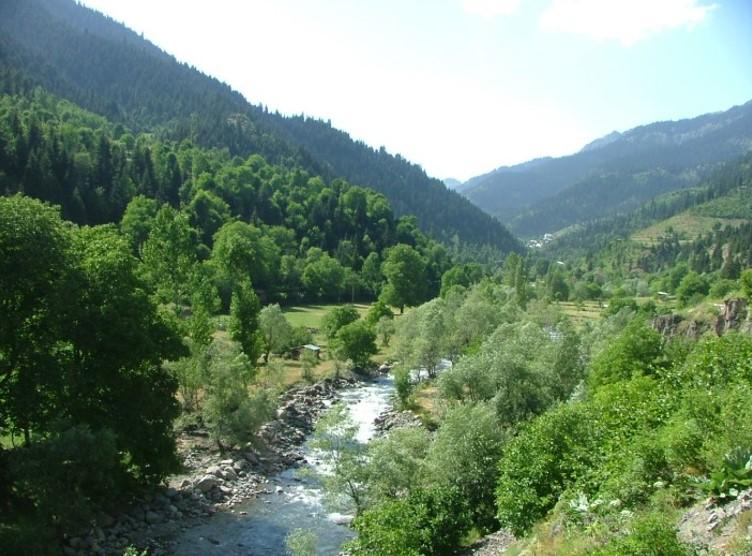
Papart Valley is a natural landscape area located within the boundaries of Şavşat District, Artvin Province, and situated within the significant natural area of the Karçal Mountains. The Papart Stream (Göknar River), which flows through the valley, has played a key role in shaping its topography and has created an ecosystem notable for its rich biodiversity and natural integrity. The valley lies to the east of the Karçal Mountains’ significant natural area and to the north of the Yalnızçam Mountains’ significant natural area.

Papart Valley (Culture Portal)
Papart Valley, within the high topographic diversity of the Karçal Mountains, supports a range of vegetation types between elevations of 400 and 2,300 metres. Between 400 and 1,300 metres, mixed deciduous forests predominate, while between 1,500 and 2,300 metres, coniferous forests are dominant. The valley contains various habitats including natural old-growth forests, high mountain meadows, steep rocky outcrops, summit plant communities and tall shrub formations.
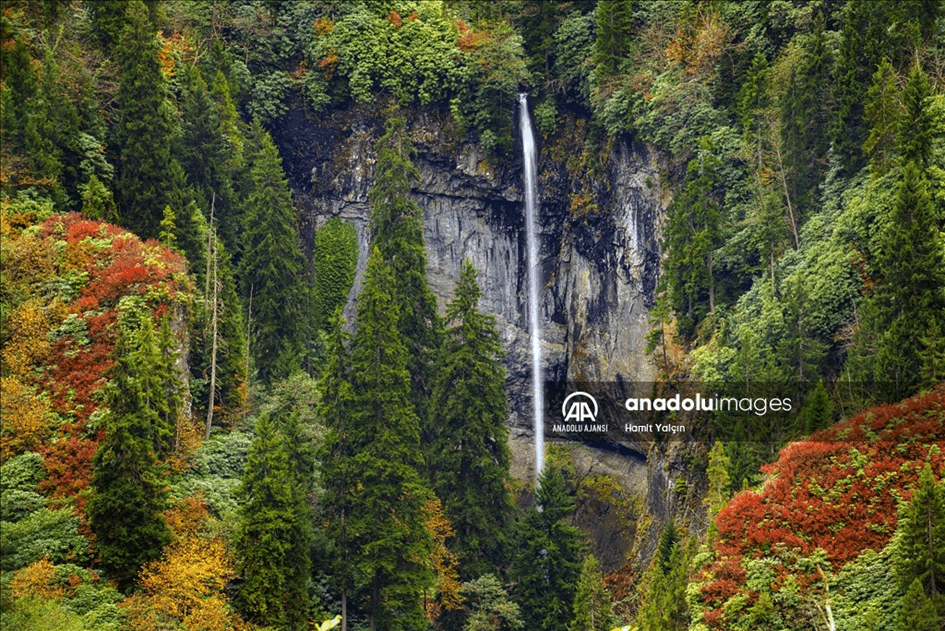
Papart Valley (Anadolu Agency)
The valley and its surroundings host approximately 70 plant species endemic to Türkiye. Twenty-six plant taxa meet the criteria for designation as a Significant Natural Area. Despite this high level of endemism, the valley’s location adjacent to the Georgian border makes it botanically remarkable.
Papart Valley serves as a breeding ground for bird species that meet the criteria for Significant Natural Areas, including the Caucasian grouse (Tetrao mlokosiewiczi) and the Caucasian snowcock (Tetraogallus caspius). Additionally, the valley lies along a migratory route for raptors, making it a site of intense migratory activity during autumn months. The region is home to important mammal and reptile species such as the Eurasian lynx (Lynx lynx), brown bear (Ursus arctos), long-clawed field mouse (Prometheomys schaposchnikowi), Caucasian salamander (Mertensiella caucasica), and Caucasian viper (Vipera kaznakovi). The Turkish endemic subspecies of the Apollo butterfly, Parnassius apollo trabizonus, and Pyrgus cirsii (five-fingered skipper) are also found in the valley.
In 2010, the majority of Papart Valley was designated as a Class I natural protected area due to its natural landscape values and biological diversity, while some settlement areas were classified as Class III. The traditional wooden architecture of the region, its cultural fabric integrated with topographic richness, and its preserved natural forests formed the basis for this conservation decision.
Human settlements within the valley have developed in harmony with the natural environment without disrupting its ecological integrity. Examples of regional wooden architecture are evident in these settlements. The valley also possesses favorable microclimatic conditions for natural honey production and is recognized as one of Türkiye’s important natural honey-producing regions.
Anadolu Ajansı. “Doğu Karadeniz’in Doğal Sit Alanı: Papart Vadisi.” Accessed August 16, 2025. https://www.aa.com.tr/tr/pg/foto-galeri/dogu-karadeniz-in-dogal-sit-alani-papart-vadisi
T.C. Ministry of Culture and Tourism. "Papart Valley." *Culture Portal.* Accessed August 16, 2025. https://www.kulturportali.gov.tr/turkiye/artvin/gezilecekyer/papart-vadisi.
T.C. Ministry of Culture and Tourism. "Şavşat Meydancık Papart Vadisi Doğal Sit Alanı." Artvin İl Kültür ve Turizm Müdürlüğü. Accessed August 16, 2025.

Location | Şavşat Türkiye Artvin | ||||||||
|---|---|---|---|---|---|---|---|---|---|
Coordinate(s) | 41.230° N 42.337° E | ||||||||
Elevation Range | 00–2300 m | ||||||||
Protection Status | Grade I and III natural protected area (2010) | ||||||||
Ecological Features
Flora
Fauna
Conservation Status
Human Impact and Settlement