

This article was automatically translated from the original Turkish version.
+1 More
Parallax is the phenomenon in which the apparent position of a celestial object on the celestial sphere shifts angularly relative to much more distant background objects due to a change in the observer’s position in space. This shift arises not from any physical movement of the object in space but from a change in the observer’s line of sight. The parallax method relies on measuring this angular change, which is evaluated geometrically and mathematically from observational data. Parallax is defined as one of the fundamental methods used in astronomy to determine the distances to celestial objects.
The conceptual basis of astronomical parallax rests on the principle that the positions of celestial objects are defined relative to the observer’s location rather than in an absolute spatial framework. Within this framework, the observer’s change in position in space produces a detectable shift in the perceived direction of the target celestial object, manifesting as a measurable angular difference.
The parallax phenomenon is interpreted within the framework of the celestial sphere, where the position of the target object is determined relative to much more distant background stars. These background stars are assumed to be fixed reference points over the duration of observation. This assumption ensures that the measured angular difference is attributed solely to the observer’s change in position, revealing the geometric nature of parallax as a relative positional measurement.

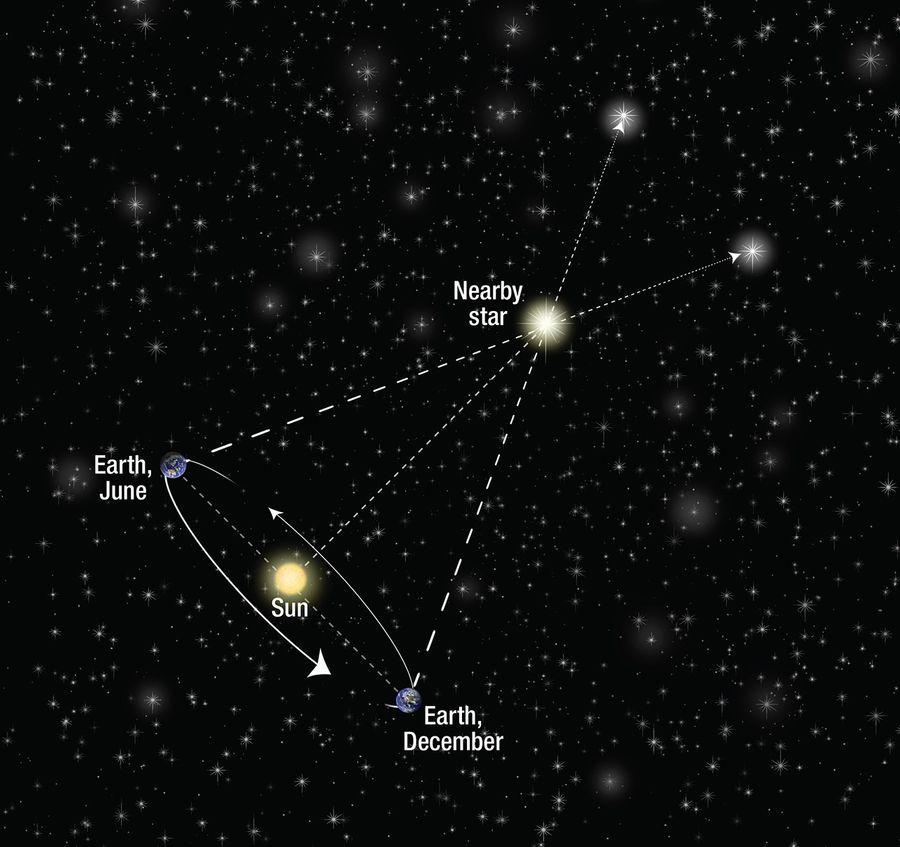
Apparent Position Change of Nearby Stars Due to Earth’s Orbital Motion (NASA)
In astronomical parallax measurements, the position of the target celestial object on the celestial sphere is determined through observations made at different times. During these observations, the object’s celestial coordinates are systematically recorded, and the time interval between observations defines the baseline used in the measurement.
The observational geometry of parallax provides the mathematical and empirical foundation for the measurement. The observer occupies two distinct positions in space separated by a known distance, and this distance is defined as the measurement baseline. In astronomical parallax applications, this baseline is typically determined by Earth’s orbital motion around the Sun.
At each observation, the object’s position on the celestial sphere is recorded, and the resulting positional data are compared to calculate the angular displacement. Repeating the measurements allows random errors to be reduced and enables statistical evaluation of the results. The angular difference between the lines of sight from different observation points constitutes the quantitative expression of the parallax effect.
In parallax measurements, distant background stars serve as the reference system and are assumed to maintain fixed positions throughout the observation period. The position of the target celestial object is determined relative to these reference stars, and the measured angular displacement is linked to the observer’s change in position. This structure ensures the geometric consistency of the measurement.
The parallax angle is defined as half the total angular difference between the directions to the target celestial object as observed from two different positions. Because this angle is typically very small, measurements are expressed in arcseconds. Determining the parallax angle relies on comparing the object’s position on the celestial sphere as observed at different times. Uncertainties in angular measurements directly affect the calculated distance values, making measurement precision one of the key factors in this stage.
The determined parallax angle, together with the known baseline, is incorporated into a trigonometric model to calculate the distance. There is an inverse relationship between the parallax angle and the distance to the target object. This modeling process converts the observational angular data into quantitative astronomical distance values. During calculations, measurement uncertainties are taken into account, and the resulting distances are evaluated within defined error limits.
Parallax is one of the fundamental methods in astronomy for directly determining the distances to celestial objects using observational data. Distance values obtained through parallax measurements serve as references for calculating the absolute luminosities of stars, enabling quantitative analysis of their physical properties.
Parallax data also serve to test and calibrate other distance determination methods in astronomy. Distances to nearby stars determined via parallax are compared with results from indirect methods to assess their validity. In this context, parallax forms one of the foundational steps in the chain of astronomical distance measurements.
Space-based observations have eliminated atmospheric effects that limit ground-based parallax measurements. Atmospheric refraction, light absorption, and image fluctuations constrain the precision of angular measurements, whereas observations conducted in space are unaffected by these phenomena.
Parallax measurements performed by space probes have enabled the reliable detection of much smaller angular differences. Furthermore, placing space observatories beyond Earth’s orbit has expanded the measurement baseline, increasing the range of distances over which the parallax method can be applied. These advances have significantly broadened the scope of parallax measurements.
High-precision parallax measurements provide essential data for determining the absolute luminosities of stars. These absolute luminosity values enable quantitative analysis of stellar physical properties and evolutionary states. Parallax data are also used to determine the spatial distribution of star clusters and specific astronomical structures. Comparing the distances of objects belonging to the same structure allows calculation of its physical dimensions and internal organization. In this context, parallax measurements are among the fundamental data sources used in advanced observational analyses in modern astronomy.
Esenoğlu, Hasan H., Gamal M. Hamed, and Abdullah Tufan. “Genişleme Paralaksı ile Nova Zarfları Araştırması.” Turkish Journal of Astronomy and Astrophysics 6, Special Issue. (2025): 217–222. Accessed February 2, 2026. https://doi.org/10.55064/tjaa.1598416
NASA. "Hubble Combines Parallax and Spatial Scanning." *NASA Science*. Accessed February 28, 2026. https://science.nasa.gov/image-detail/14-104-hubble-parallax-png_0/
NASA. “Stellar Parallax.” *NASA Science*. Accessed February 2, 2026. https://science.nasa.gov/asset/hubble/stellar-parallax/
NASA. “Stellar Parallax.” *NASA Science: Hubble Space Telescope*. Accessed February 28, 2026. https://science.nasa.gov/asset/hubble/stellar-parallax/
StarChild Team. “Parallax.” NASA Goddard Space Flight Center. Accessed February 28, 2026. https://starchild.gsfc.nasa.gov/docs/StarChild/questions/parallax.html
Talbert, Tricia. “NASA’s New Horizons Conducts the First Interstellar Parallax Experiment.” NASA. Accessed February 2, 2026. https://www.nasa.gov/solar-system/nasas-new-horizons-conducts-the-first-interstellar-parallax-experiment/

The Parallax Method in Astronomy
Observational Measurement Process and Observational Geometry
Reference System and Angular Displacement
Determining the Parallax Angle
Mathematical Modeling and Distance Calculation
The Role of Parallax in Astronomy
Space-Based Observations and Expanded Measurement Capacity
Advanced Scientific Applications of Parallax