


This article was automatically translated from the original Turkish version.
In ancient times, scientific knowledge was obtained with limited means. Nevertheless, despite these challenges, people succeeded in acquiring knowledge that transcended the limits of their era through observation and rational reasoning. One such individual was the Greek mathematician and geographer Eratosthenes, who lived in 235 BCE. His method for calculating the Earth’s diameter is still regarded today as a prime example of scientific ingenuity.
Eratosthenes’ Method
Eratosthenes knew that on the summer solstice, at noon, the Sun was directly overhead in Syene (modern-day Aswan). This observation was based on sunlight reaching the bottom of a well in Syene. At the same time, in Alexandria, located to the north, a vertical stick cast a shadow at a distinct angle. This difference in shadow indicated that the Sun’s rays arrived at different angles depending on the distance between the two cities.
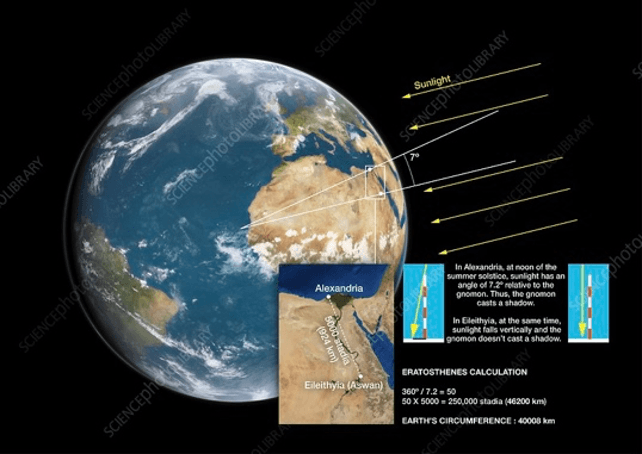
Illustrates the angular difference between Alexandria and Aswan.
Eratosthenes carefully measured the shadow of the stick in Alexandria and calculated the angle between the Sun’s rays and the stick to be 7.2°. Knowing that a full circle comprises 360°, he determined that 7.2° represented 1/50 of a circle. This meant that the distance between Syene and Alexandria must be 1/50 of the Earth’s total circumference.
Determining the Distance
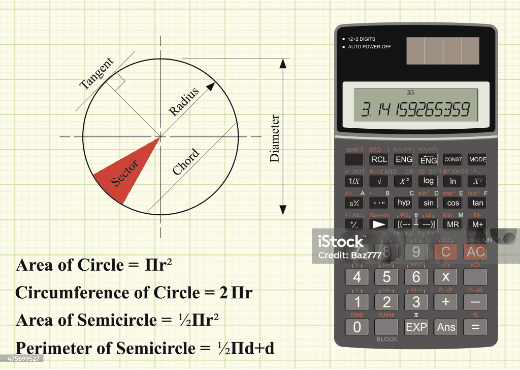
Method of calculating circumference based on the angular difference between two locations.
The distance between Syene and Alexandria was measured in ancient times using a unit called the stadium, and this distance was accepted as 5,000 stadia. According to modern conversions, this distance is approximately 800 kilometers. Eratosthenes multiplied this distance by 50 to calculate the Earth’s total circumference: 250,000 stadia. His calculation is remarkably close to the currently accepted value of 40,075 kilometers.
Alternative Approaches
Eratosthenes could have used a different approach in his calculations. He noted that the length of the shadow cast by the stick in Alexandria was exactly 1/8 of the stick’s height. This ratio was equivalent to the ratio between the distance from Alexandria to Syene and the Earth’s radius. By combining this geometric relationship, it became possible to calculate the Earth’s radius and thus its circumference. Modern simulations and reconstructions confirm the accuracy of this alternative method.
Contemporary Use
Eratosthenes’ method is a striking example of achieving scientific insight without modern technological tools. Today, a person seeking to replicate such a calculation can measure the shadows of vertical sticks in two different cities to determine the Earth’s circumference. This approach, enhanced with modern instruments, can become an engaging scientific project for students. In fact, it is now possible to use smartphones to determine distances between cities and measure shadow angles.
Another interesting approach involves determining distance using shadow ratios. For instance, when the distance between cities is unknown, the lengths of shadows cast by flagpoles in two different locations can be measured to estimate the distance. These ratios can be resolved using modern trigonometric knowledge.
Other Methods and Errors
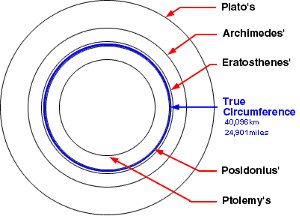
Earth’s circumference according to calculations by various scientists.
Although Eratosthenes’ method was impressive, it contained some errors. For example, Syene is not located exactly on the Tropic of Cancer but approximately 37 kilometers north of it. Additionally, the distance between Syene and Alexandria is not precisely 805 kilometers, and the angular measurement should have been 7° 30′ rather than 7° 12′. Despite these inaccuracies, Eratosthenes’ result was astonishingly close to the true value.
Scientists following Eratosthenes also attempted to calculate the Earth’s circumference. For instance, Posidonius used stars to estimate the Earth’s size. He observed a star just above the horizon at Rhodes and measured its altitude in Alexandria, calculating the angular difference between the two locations as 7.5°. This corresponded to 1/48 of a circle. Assuming the distance between Rhodes and Alexandria to be 805 kilometers, he calculated the Earth’s circumference as 38,647 kilometers—an error of about 3%. However, because Rhodes and Alexandria do not lie on the same meridian, this introduced systematic errors into Posidonius’ method.
In the second century CE, Claudius Ptolemaeus (Ptolemy), living in Alexandria, revised Posidonius’ calculations and determined the Earth’s circumference to be 28,985 kilometers. This value, however, contained a large error of about 28%. Due to Ptolemy’s significant contributions to astronomy and cartography, this erroneous value remained in use for centuries. Christopher Columbus even relied on Ptolemy’s figures when planning his voyage to India. This miscalculation led Columbus to encounter a continent unknown to him.
Eratosthenes’ Contribution to Science
Eratosthenes’ calculations were not merely a mathematical achievement; they also demonstrated the power and elegance of the scientific method. His approach stands as evidence of the boundless potential offered by scientific curiosity and rational thought. Even today, despite our advanced technology, Eratosthenes’ simple and elegant methods continue to inspire the scientific community.
Hewitt, P. (2015). Conceptual Physics (13th ed., p. 23). San Francisco: Pearson Education.
Hunter College. (n.d.). Determining the Earth's size. Accessed [Date]. http://www.geo.hunter.cuny.edu/~jochen/gtech201/lectures/lec6concepts/Datums/Determining%20the%20earths%20size.htm

No Discussion Added Yet
Start discussion for "How Was the Diameter of the Earth Measured Thousands of Years Ago?" article