

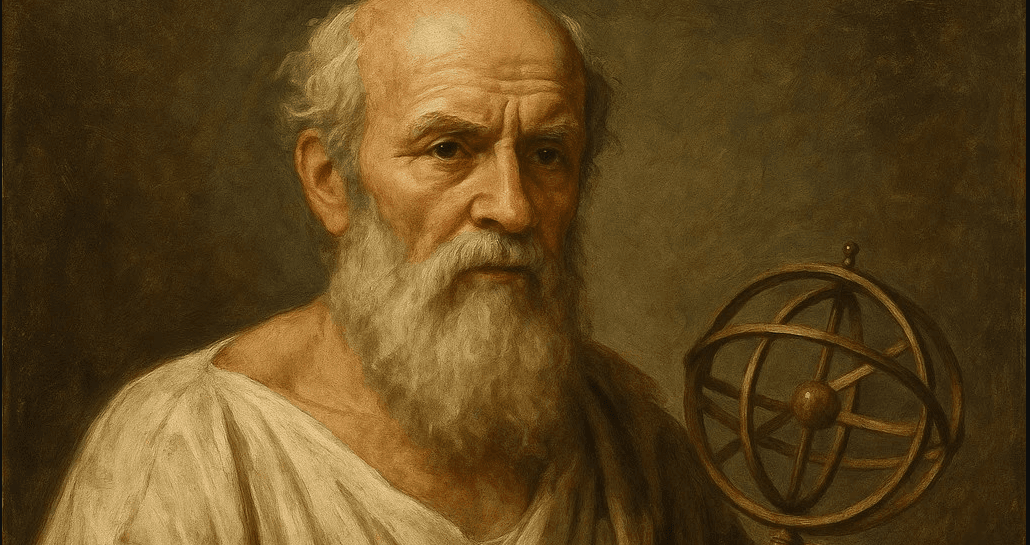
+1 More

Generated with Artificial Intelligence
Period(s) | 3rd century BC | ||||||||
|---|---|---|---|---|---|---|---|---|---|
Profession(s) | Geographer Philosopher Inventor Poet Librarian Scholar | ||||||||
Eratosthenes (c. 276–194 BCE) was one of the most versatile scholars of the ancient world. He made contributions as a mathematician, astronomer, geographer, poet, philosopher, and librarian. He is particularly known for measuring the Earth’s circumference, developing the “Sieve of Eratosthenes” to identify prime numbers, and laying the foundations of geography as a scientific discipline. During his tenure as chief librarian of the Library of Alexandria, he played a leading role in the institutionalization of scientific research.
Eratosthenes was born around 276 BCE in Cyrene (modern-day Shahhat in eastern Libya), which was then an ancient Greek colony. Cyrene was a city-state with a rich cultural and intellectual heritage, and this environment significantly influenced Eratosthenes’ early education. His father’s name was Aglaos, though detailed information about his family is limited. In his youth, he traveled to Athens, where he studied at the major philosophical schools of the time. He worked with Platonist philosophers and was influenced by Stoic thought. His education in Athens shaped his interests in mathematics, astronomy, and literature. He also met the prominent scholar Callimachus, whose poetic style left a strong impression on him. Eratosthenes’ multifaceted personality emerged from this period, as he developed both a scientific and a literary foundation.
Around 245 BCE, his appointment as chief librarian of the Library of Alexandria by Ptolemy III Euergetes marked a turning point in Eratosthenes’ career. Alexandria was the center of science and culture during the Ptolemaic dynasty, and the library was regarded as the largest repository of knowledge in the ancient world. Eratosthenes held this position for approximately forty years, transforming the library from a mere collection of scrolls into a center for scientific research and intellectual debate. During his administration, he wrote numerous works on mathematics, astronomy, geography, philosophy, and literature. Most of these works have not survived to the present day, but information about them is preserved in ancient sources such as Strabo, Pliny, and Cleomedes. Eratosthenes stood out among his contemporaries for his commitment to scientific methods and interdisciplinary approaches. He was given nicknames such as “Pentathlos” (an athlete competing in five disciplines) and “Beta” (the second-best in every field), reflecting his wide-ranging abilities and mastery.
Eratosthenes’ most famous achievement was measuring the Earth’s circumference. This experiment is regarded as one of the most remarkable in the history of science. Eratosthenes learned that at Syene (modern-day Aswan, Egypt), on the summer solstice, the Sun was directly overhead and vertical objects cast no shadow. At the same time in Alexandria, he measured the shadow cast by a vertical rod and found it formed an angle of approximately 7.2 degrees with the ground. He realized this angle corresponded to one-fiftieth of a full circle. Using caravan travel records, he estimated the distance between Syene and Alexandria at about 5,000 stadia (an ancient Greek unit of length). By scaling this up to 360 degrees, he calculated the Earth’s total circumference as approximately 250,000 stadia. Modern estimates place this value at about 39,375 kilometers, remarkably close to the actual equatorial circumference of 40,075 kilometers. This calculation demonstrated both Eratosthenes’ mathematical skill and his observational precision. Moreover, his acceptance of the Earth’s sphericity reflected a sophisticated scientific understanding for his time.
In mathematics, Eratosthenes developed the “Sieve of Eratosthenes,” an efficient algorithm for identifying prime numbers. This method systematically eliminates composite numbers to isolate all primes up to a given limit. The process works as follows:
This algorithm remains in use today in mathematics and computer science, illustrating Eratosthenes’ enduring contribution to mathematical thought.
Eratosthenes is regarded as one of the founders of geography. In his work Geographica, he systematically described the known regions of the Earth. This was the first work to employ the concepts of latitude and longitude. Eratosthenes treated the Earth as a sphere and laid the foundations of a geographic coordinate system using meridians and parallels. He divided the inhabited world (oikoumene) into five climatic zones: two polar regions, two temperate zones, and a tropical zone. This classification anticipated modern climatology. Eratosthenes was among the first scholars to investigate the source of the Nile River and the geographical features of the Mediterranean. On his maps, he drew the main outlines of Asia, Europe, and Africa based on the knowledge available in his time.
In astronomy, Eratosthenes compiled star catalogs and attempted to systematically record the positions of stars. He measured the tilt of the Earth’s axis at approximately 23.5 degrees, very close to the modern value of 23.44 degrees. This measurement contributed to calendar reforms and helped explain the seasons. He also attempted to estimate the distances of the Sun and Moon from the Earth, though these calculations were not as accurate as his measurement of the Earth’s circumference. Nevertheless, his astronomical observations provided a foundation for later scholars, especially Hipparchus.
In addition to his scientific works, Eratosthenes wrote poetry and philosophical texts. Influenced by Callimachus, his poems exhibited an elegant and intellectual style characteristic of Hellenistic Greek literature. In his philosophical writings, he drew on Platonic and Stoic ideas to develop thoughts on ethics and epistemology. He also examined Homer’s Iliad and Odyssey from a geographical perspective, discussing possible real-world locations of mythological events.
Very little is known about Eratosthenes’ personal life. There are no definitive records regarding whether he was married or had children. However, ancient sources indicate that in his later years, he suffered from blindness, which deeply affected him. Some accounts suggest that around 194 BCE, in Alexandria, he chose to die by refusing food. This form of death was rare among ancient Greek scholars and may reflect his adherence to Stoic philosophy.
Eratosthenes is regarded as one of the pioneers of the scientific method, contributing to the foundations of modern science through his emphasis on observation, measurement, and mathematical analysis. His experiment to measure the Earth’s circumference remains one of the most significant achievements in scientific history, both methodologically and in its outcome. His work in geography and astronomy served as a reference for scholars until the Renaissance. While managing the Library of Alexandria, he led the institutionalization of scientific research, and later scholars such as Archimedes, Hipparchus, and Strabo built upon his findings. The Sieve of Eratosthenes continues to be used in mathematics today, demonstrating his lasting influence. Although most of Eratosthenes’ original works have been lost, his ideas have survived through ancient sources. Modern scientists celebrate his method of measuring the Earth’s circumference as an early triumph of scientific reasoning. Furthermore, his innovations in geography and cartography laid the groundwork for modern map-making techniques.
Plinius. Naturalis Historia. Accessed July 10, 2025. http://www.perseus.tufts.edu/hopper/text?doc=Perseus%3Atext%3A1999.02.0137
Strabo. Geographica. Accessed July 10, 2025. http://www.perseus.tufts.edu/hopper/text?doc=Perseus%3Atext%3A1999.01.0239

Generated with Artificial Intelligence
Period(s) | 3rd century BC | ||||||||
|---|---|---|---|---|---|---|---|---|---|
Profession(s) | Geographer Philosopher Inventor Poet Librarian Scholar | ||||||||
Early Life and Education
Library of Alexandria and Career
Scientific Contributions
Measurement of the Earth’s Circumference
Eratosthenes’ Sieve
Geographical Works
Astronomical Studies
Literary and Philosophical Works
Personal Life and Death
Legacy