


This article was automatically translated from the original Turkish version.
The polar circles are geographical boundary lines caused by the tilt of Earth’s rotational axis, resulting in changing illumination conditions in the polar regions throughout the year. These circles are known as the Arctic Circle in the north and the Antarctic Circle in the south. Since Earth’s axis is tilted at 23°27′, regions near the poles experience 24-hour daylight or 24-hour night during certain times of the year. Thus, the polar regions form a cyclical pattern of light and darkness governed by an astronomical cycle. These phenomena are known as the polar day and the polar night and determine the dynamics of both ecosystems and local communities.

Polar Circles and Annual Illumination Cycle (Generated by Artificial Intelligence.)
The polar circles originate astronomically from Earth’s orbital motion and axial tilt. During the summer solstice, around June 21, the Sun remains above the horizon for 24 hours north of the Arctic Circle, resulting in a polar day. During this period, the Sun moves slowly in a spiral path near the horizon and no night occurs. The polar day affects the biological cycles of Arctic-dwelling organisms and the lifestyles of local populations. Plants enter a phase of rapid growth by using the 24-hour daylight for photosynthesis. For humans, however, this can lead to challenges such as sleep deprivation and disruptions to biological rhythms.
During the winter solstice (around December 21), the polar night begins in the northern polar region, and the Sun does not rise for weeks. This prolonged period of darkness causes temperatures to drop rapidly and the ground to become covered by thick snow. Atmospheric phenomena such as the northern lights are more clearly observable during the polar night. Animals slow their metabolism or migrate during this time when food becomes scarce. The polar night is not merely an astronomical event; it is also the beginning of ecological and cultural transformations.
The southern hemisphere counterpart of these phenomena occurs at the Antarctic Circle. South of the Antarctic Circle, 24-hour daylight is observed on December 21 and 24-hour night on June 21. During the long polar day in Antarctica, sea ice melts and mixes with ocean waters, triggering rapid blooms of plankton and phytoplankton. Thus, the polar circles play a critical role not only for terrestrial but also for marine ecosystems. This cycle of light and darkness sustains the foundations of global food webs.
The polar day and night phenomena are also of great importance to climate scientists. Changing illumination conditions throughout the year affect the regional energy balance and atmospheric circulation. For example, the extended days in the Arctic accelerate ice melt and reduce albedo, leading to further temperature increases. Therefore, these cycles generated by the polar circles are essential parameters that must be considered in climate change models.
In addition, the polar circles serve as reference points in geophysical and geomagnetic studies. Magnetic field lines at the poles shape the pathways through which solar winds and cosmic rays enter Earth. During long polar nights, phenomena such as auroras occur more intensely. Scientists use these periods to study the structure of the magnetosphere and the effects of space weather on Earth. Thus, the polar circles provide an important observational window not only for understanding Earth’s surface but also for comprehending Earth’s interactions with its space environment.
The polar circles play a vital role in the delicate balance of the global climate system. These regions directly influence the distribution of Earth’s energy balance at the poles. In particular, the 24-hour cycles of light and darkness during polar day and polar night shape temperature variations and atmospheric movements in the region. For instance, prolonged darkness and radiative cooling during the polar night reduce atmospheric water vapor and cause sharp temperature drops. These intense cold periods contribute to the preservation of thick ice sheets in both northern and southern polar regions.
The polar circles also determine the albedo effect in polar regions. The presence of permanent snow and ice cover reflects a large portion of incoming solar radiation back into space, creating a cooling effect. The extended daylight periods generated by the polar circles, however, cause partial melting of snow and ice during summer months. This melting reduces reflected energy and accelerates temperature increases. This feedback mechanism is a crucial factor shaping polar climates and, indirectly, the global climate.
Due to the influence of the polar circles, pressure centers and air currents in the atmosphere also differ. For example, the Arctic vortex strengthens during the polar night and causes cold air masses from the northern hemisphere to move toward lower latitudes. This can lead to harsher winters in mid-latitudes. Similarly, extended summer days in the polar regions facilitate the arrival of warm air currents to the poles, contributing to ice melt. These dynamics provide a critical perspective for understanding the complex structure of global atmospheric circulation.
Recent research has more clearly revealed the role of the polar circles in climate change. Due to global warming, the rapid reduction of ice cover in polar regions weakens polar albedo and causes the poles to warm even more. This triggers a process known as “polar amplification”: the poles warm faster than the global average. The polar circles are among the starting points of this amplification process and represent an indispensable observational field for climate scientists.
Moreover, the effects of the polar circles on sea ice and ocean currents are significant. Particularly, extended summer days increase the rate of sea ice melt, disrupting the balance of major glaciers such as those in Greenland and Antarctica. This process leads to global consequences such as rising sea levels and increased risk to coastal regions. Thus, the polar circles have become a factor that affects habitats and ecosystems worldwide, beyond their local impacts.
The polar circles are fundamental elements that shape not only physical and climatic processes but also ecological cycles and the lives of local communities. The organisms living in these regions have developed specialized ecosystems adapted to the cycles of polar day and polar night. For example, Arctic tundra plants have evolved rapid growth and flowering strategies to maximize the use of 24-hour daylight during summer months. These plants store nutrients during their short but intense photosynthetic period, enabling them to survive the long polar night. These characteristics form the foundation of ecosystems created by the polar circles.
The prolonged darkness caused by the polar circles also shapes animal migration and reproductive behaviors. For instance, species such as polar bears and seals increase foraging and energy storage activities during the long summer days. In winter, their hunting strategies change as the ice cover becomes more stable. Some bird species undertake thousands of kilometers of migration to escape the harsh conditions of the polar night. Thus, the polar circles play a significant role in the evolutionary adaptation of life for survival.
For local communities, the polar circles are an inseparable part of traditional ways of life. Inuit, Sami, and other polar peoples design their hunting and gathering calendars according to light patterns. During the polar day, activities such as marine mammal hunting and fishing intensify, while during the long polar night, community solidarity and cultural rituals take center stage. For example, stories told throughout the winter and communal gatherings help alleviate the isolation brought by the polar night.
Ecologically, the seasonal changes in the polar circle region determine the fundamental building blocks of food chains. During summer, the melting of sea ice triggers plankton blooms, which serve as a vital food source for marine mammals and fish. This short but intense period of productivity supports the entire food web throughout the year. Thus, the polar circles maintain the dynamic balance of food networks.
In recent years, climate change has made the ecological effects of the polar circles even more pronounced. Extended polar days accelerate sea ice melt and disrupt food chains. Local communities also struggle to adapt to these changes, as their livelihoods are threatened. For example, fishing seasons and hunting calendars must be reorganized due to the disruption of natural rhythms dictated by the polar circles. Therefore, the polar circles emerge as a point of intersection between the cultural heritage of indigenous peoples and global climate policy.
The polar circles function as open-air laboratories for the scientific community. These regions hold immense scientific value as the intersection points of Earth’s astronomical, climatic, and ecological systems. In particular, the long day and night cycles allow direct observation of fundamental processes such as solar radiation and atmospheric circulation. Scientists collect critical data on temperature, humidity, wind speed, and ice thickness year-round through observation stations established in the polar circle regions, thereby feeding global climate models.
These observation stations also monitor the unique light regimes created by the polar circles and their effects on ecosystems. For example, the 24-hour sunlight during the summer solstice accelerates microbial activity in the soil and enhances the contribution of vegetation to the carbon cycle. These processes play a pivotal role in understanding atmospheric greenhouse gas balance and, indirectly, climate change. Scientists use this data to clarify the role of the poles within Earth’s overall climate system.
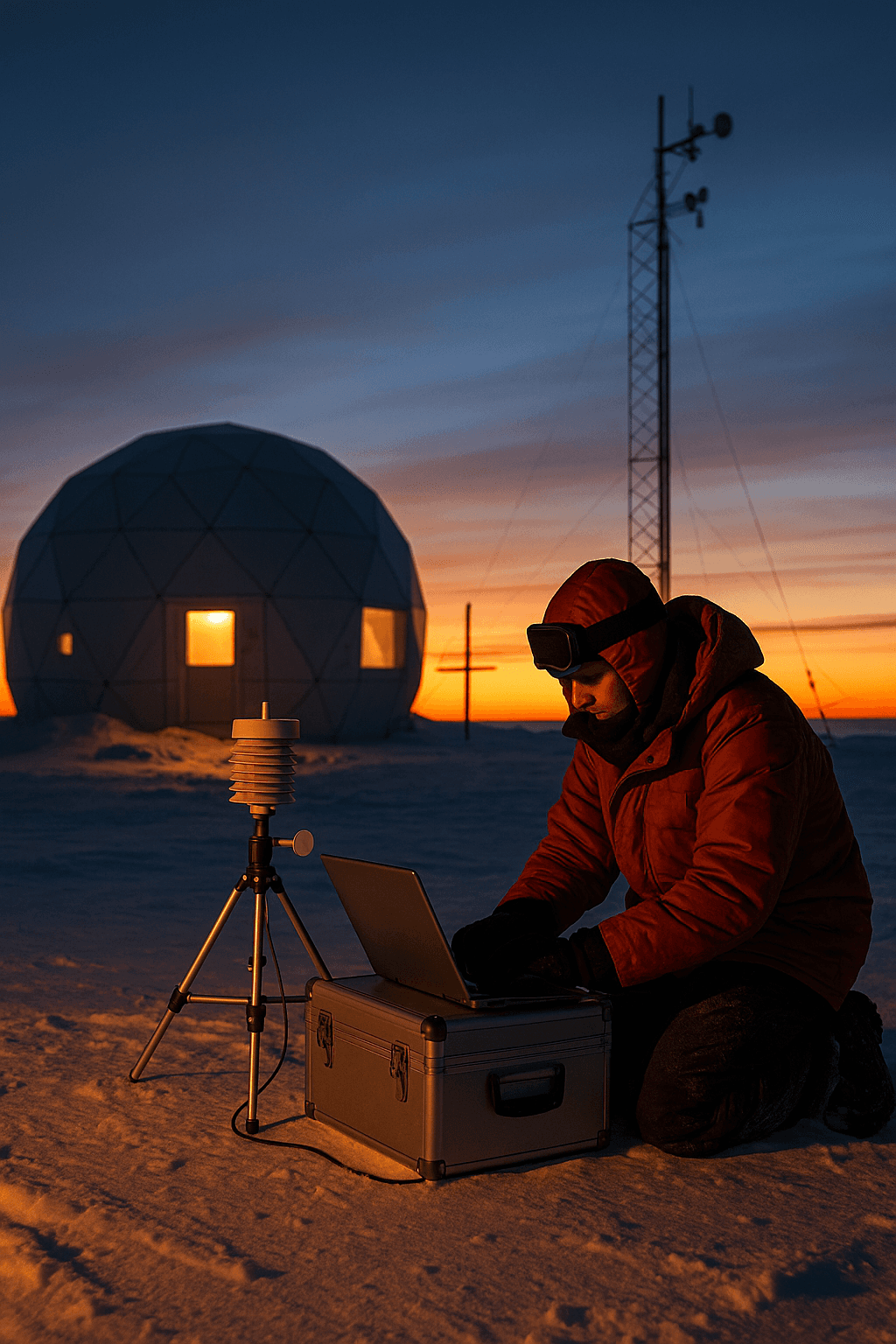
Polar Circles and Scientific Observations (Generated by Artificial Intelligence.)
Scientific observations in the polar circle regions extend beyond Earth’s surface and also examine interactions between the space environment and Earth. Particularly during polar nights, space weather phenomena such as auroras are more clearly observed at the poles where magnetic field lines are concentrated. These events provide critical data for understanding the impact of solar winds on the magnetosphere.
Scientific observations not only track natural processes but also monitor human-induced impacts. Rapid ice melt and habitat changes in the polar circle regions due to global warming have become a major focus for scientists. The polar circles, as regions where the earliest and most visible signs of climate change are observed, function as “early warning” systems. Therefore, data from the polar circles and their surroundings are integrated into international studies such as reports by the Intergovernmental Panel on Climate Change (IPCC).
Barry, Roger G. *Mountain Weather and Climate*. 3rd ed. Cambridge: Cambridge University Press, 2008. Accessed June 12, 2025. https://www.cambridge.org/core/books/mountain-weather-and-climate/AB88E7CA8DE0FD36123922EBBCBF3B1E.
National Snow and Ice Data Center. “Arctic Sea Ice News and Analysis.” Updated 2023. Accessed June 12, 2025. https://nsidc.org/arcticseaicenews/.
Serreze, Mark C., and Roger G. Barry. *The Arctic Climate System*. 2nd ed. Cambridge: Cambridge University Press, 2014. Accessed June 12, 2025. https://www.cambridge.org/core/books/arctic-climate-system/F545712C019C3FA55E5E290248E9D50B.
Stroeve, Julienne C., Mark C. Serreze, Marika M. Holland, Jennifer E. Kay, James Malanik, and Andrew P. Barrett. "The Arctic’s Rapidly Shrinking Sea Ice Cover: A Research Synthesis." *Climatic Change* 110, no. 3–4 (2012): 1005–1027. Accessed June 12, 2025. https://link.springer.com/article/10.1007/s10584-011-0101-1.
Van Loon, Harry, and David J. Shea. “The Global 11-Year Solar Signal in July–August.” *Geophysical Research Letters* 26, no. 18 (1999): 2893–2896. Accessed June 12, 2025. https://doi.org/10.1029/2000GL003764.

No Discussion Added Yet
Start discussion for "Tropic of Cancer and Tropic of Capricorn" article
Polar Day and Polar Night Phenomena
Polar Circles and Climate Dynamics
Ecological Importance of the Polar Circles and Their Impact on Local Communities
Polar Circles and Scientific Observations