


This article was automatically translated from the original Turkish version.
+1 More
In astronomy, the concept of time【1】 is not limited solely to the cycles of day and night or seasonal changes on World. On the scale of the Sun System, planetary motions, orbital cycles, and gravitational interactions determine many factors that define different dimensions of time.
In astronomy, time is a system of measuring time based on the movements of celestial bodies and large-scale processes in the universe. Beyond daily and annual cycles on Earth, it encompasses much longer time intervals such as planetary orbital periods, stellar evolution, galactic rotation, and the timescales of cosmic events. Astronomical timescales cover a wide range from very short durations (seconds, minutes) to events lasting billions of years.
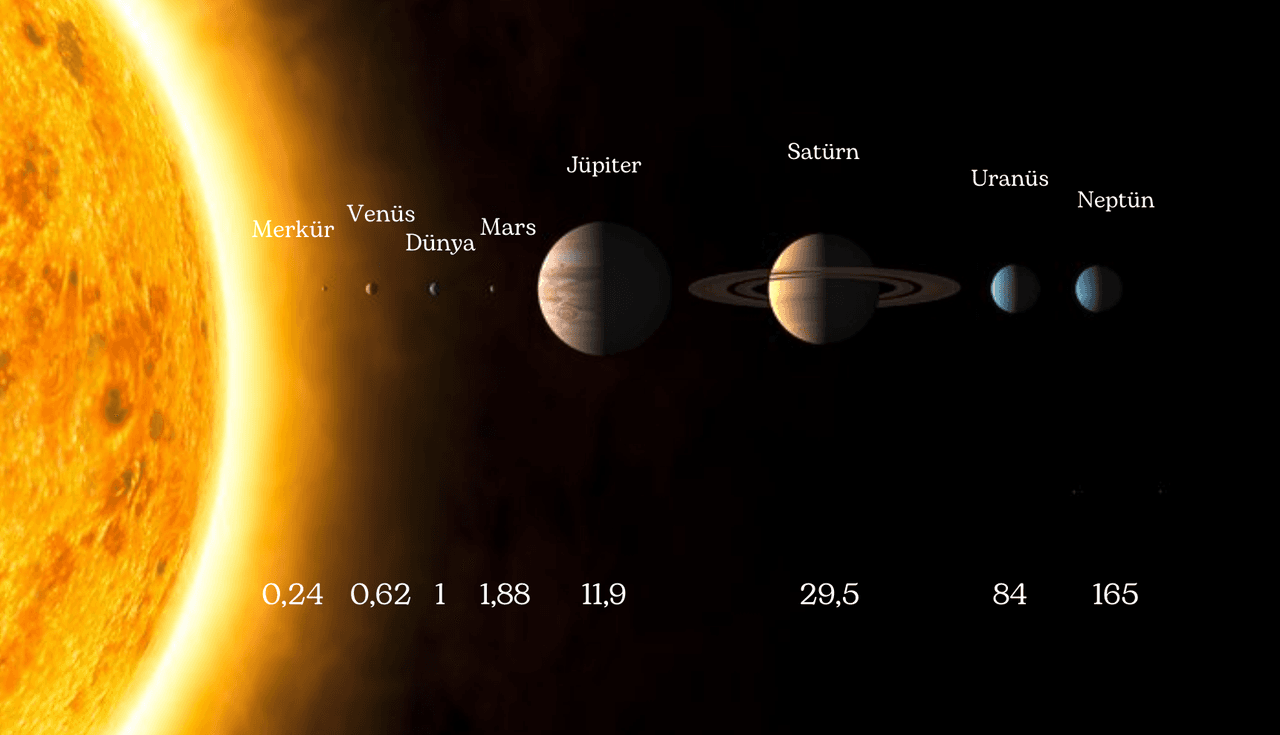
Figure 1: Orbital Periods (in Earth Years) (Source: Visual)
The duration of a “day” and a “year” on each planet varies according to its rotational speed around its own axis and its orbit around the Sun.
The concepts of time in astronomy are detailed in Schema 1.

Schema 1: Astronomical Time Periods
The vastly different orbital periods of planets are not only due to the size of their orbits but also influenced by their orbital speeds. As planets move farther from the Sun, their orbital velocities decrease. These effects are explained by Kepler’s Third Law.
Kepler’s Third Law, discovered by Johannes Kepler in 1619, is a fundamental astronomical law describing the motion of planets around the Sun. Law establishes a relationship between the orbital periods of planets and the sizes of their orbits. Kepler’s Third Law is expressed as follows:
"The cube of the semi-major axis of a planet’s orbit is proportional to the square of the time it takes to complete one complete orbit around the Sun."

In the formula, T represents the orbital period of the planet (in years), and a represents the semi-major axis of its orbit (in astronomical units). The law uniformly governs the motion of all planets and demonstrates a clear relationship between the size of a planet’s orbit and its orbital period within the Solar System.
Kepler’s Third Law reveals that planets farther from the Sun take longer to complete their orbits, while those closer take less time. This principle also applies to planets orbiting stars outside the Solar System.
According to calculations, this law remains valid not only for planets but also for asteroids, comets, and space probes. Objects in the inner regions of the Solar System complete their orbits in a few months, while those in the outer regions may take hundreds of years. For example, space missions to Mars reach their targets in a few months, whereas missions to Jupiter or more distant planets can last several years.
The primary cause of seasons on Earth is the tilt of its axis (23.5°) and its orbit around the Sun. However, seasons on other planets manifest differently:
Time in the Solar System is not limited to daily or annual cycles. Much larger-scale processes also operate over extended periods.
Precession is the phenomenon in which the rotational axis of a planet or satellite changes direction over time. For Earth, precession involves a slow conical wobble of its rotational axis, completing one full cycle approximately every 26,000 years. This motion causes the planet’s poles to gradually shift position. Precession affects the timing of seasons and plays a significant role in climate change.

Figure 2: Precession (Wobbling Motion) (Source: Britannica)
Due to this wobbling motion, Polaris will, in approximately 12,000 years, relinquish its position as the North Star to Vega【2】
elliptic or more circular, altering the distance between Earth and the Sun.
3. Axial Precession: The change in direction of Earth’s rotational axis affects the timing of the seasons.
These cycles occur over time intervals ranging from approximately 20,000 to 100,000 years, and their combined effects have been identified as one of the primary causes of ice ages and climate change.
Gravitational resonances occur when two or more celestial bodies synchronize their orbital motions due to mutual gravitational influences. Interaction leads to regular intervals of approach and separation between the bodies in their orbits. Gravitational resonances can stabilize the orbits of celestial bodies and generate long-term regular motion patterns.
For example, the gravitational resonance between Neptune and Pluto ensures synchronized motion in their orbits. For every three orbits Neptune completes, Pluto completes two Türkiye, preventing the two planets from coming too close while maintaining their orbital shapes through mutual gravitational forces. Scientists have identified such resonances as a key factor in ensuring long-term stability in the orbits of planets and moons【3】
The galactic year describes the motion of the Solar System around the center of the galaxy. This movement occurs at a specific velocity due to the gravitational influence of stars, gas, and other matter concentrated in the galactic center. The galactic year is a crucial reference for astronomical timescales and is used to understand galactic dynamics and the evolution of the Solar System.
The Solar System is estimated to have begun forming approximately 4.6 billion years ago. This age is closely related to the formation process of all objects in the Solar System, particularly the Sun and the orbiting planets. The age of the Solar System is typically calculated using radioactive dating methods, confirmed by studies of Earth’s oldest rocks and month samples.
The formation of the Solar System began with the collapse of a massive dust and gas cloud, during which small bodies known as planetesimals【4】 coalesced to form planets, asteroids, and other celestial bodies. The completion of this process resulted in the Solar System’s current structure.
According to research, in approximately 5 billion years, the Sun will enter the red giant phase, beginning with the depletion of hydrogen (H) fuel in its core and the accumulation of helium (He).

Figure 3: The Sun in the Red Giant Phase (Source: Generated with AI assistance)
During this phase, the Sun will expand significantly, potentially engulfing the orbits of Mercury and Venus. In the red giant phase, the Sun will shed its outer layers, forming a structure known as a planetary nebula. After completing the red giant phase, the remaining core of the Sun will fuse helium and oxygen to become a white dwarf.

Figure 4: The Sun in the White Dwarf Phase (Source: Generated with AI assistance)
A white Dwarf is the final evolutionary stage of a low-mass star. The Sun will no longer generate energy through nuclear fusion, but will continue to emit heat and light, gradually cooling and darkening over time. After evolving further in its white dwarf state, the Sun is predicted to eventually become a black black dwarf, ceasing to emit any light. Scientists believe this process will cause dramatic changes in the evolution of all planets and other bodies in the Solar System.
"Güneş Sistemi'ni Tanıyalım," *Bilim Genç*, Accessed March 6, 2025, https://bilimgenc.tubitak.gov.tr/makale/gunes-sistemini-taniyalim-dunya.
"Helium," *Encyclopaedia Britannica,* Accessed March 6, 2025, https://www.britannica.com/science/helium-chemical-element.
"Precession of the Equinoxes," *Encyclopaedia Britannica,* Accessed March 6, 2025, https://www.britannica.com/science/precession-of-the-equinoxes.
"Solar System," *Encyclopaedia Britannica,* Accessed March 6, 2025, https://www.britannica.com/search?query=solar+sistem.
"Solar System," Hubble Space Telescope, Accessed March 6, 2025, https://esahubble.org/images/solar_system_b/.
"Very Long Timescales in Astronomy," *Elementy*, Accessed March 6, 2025, https://elementy.ru/time/very-long/very-long-1.html.
Perelman, Yakov. Zanimatelnaya Astronomiya (Moscow: 1953).
[1]
Time is a fundamental concept that determines the sequential flow of events and measures processes of change. In physics, it is studied within the frameworks of absolute (Newtonian) or relativistic (Einstein’s Theory of Relativity) time. In daily life, time is measured in units such as hours, days, and years, while in astronomy it is assessed through broader processes such as planetary orbital periods, stellar evolution, and cosmic time scales.
[2]
Vega is a supergiant star located in the constellation Lyra and is one of the brightest stars in the night sky. Approximately 25 light-years away, Vega is currently the fifth brightest star in the Northern Hemisphere and has historically served as an important navigational aid. Vega is also known as Alpha Lyrae and is a blue-white star with a spectral type of A0V.【2】.
[3]
Stability refers to the ability of a system or structure to maintain its equilibrium state against external influences or internal changes. In physics and astronomy, stability is used in various contexts such as a planet's orbit, a star's evolution, or a structure's mechanical balance. Generally, a system is considered stable if, after any small perturbing influence, it returns to its initial state. LINK[roljsgd8l].
Cosmic Time of the Solar System
When considering astronomical timescales, the age and evolution of the Solar System are also worth examining.
Galactic Year
A galactic year refers to the time it takes for Earth to complete one full orbit around the center of the Milky Way Galaxy. The Solar System, orbiting the galactic center, travels approximately 220 million years to complete one revolution along the galaxy’s edge. This
[4]
Protoplanet is the term given to small celestial bodies that existed during the early stages of the Solar System, before the formation of planets, and that were growing and colliding with one another. Protoplanets are composed of interplanetary dust and gas and constitute a crucial stage in planet formation. These bodies form through the accretion of smaller objects known as planetesimals, which originated from the collapse of interstellar dust and gas clouds.
Protoplanets are typically larger than 1,000 km in diameter and, over time, grow into larger structures by gravitationally accumulating most of the material in their vicinity. This process is one of the fundamental mechanisms responsible for the formation of planets and moons. Many protoplanets transformed into planets during the early period of the Solar System, forming the planets we observe today. However, some failed to become major planets and instead evolved into smaller celestial bodies such as asteroids and comets.

No Discussion Added Yet
Start discussion for "Astronomical Time in the Solar System" article
Durations of Day and Year on Planets
Seasonal Cycles on Planets
Large Cycles: Long-Term Timescales in the Solar System
Precession (Wobbling Motion)
Gravitational Resonances
Age of the Solar System
Future