


This article was automatically translated from the original Turkish version.
+1 More
Pascal’s Wager is a pragmatic argument advanced by 17th-century French mathematician and philosopher Blaise Pascal in his work Pensées (Thoughts), asserting that believing in God or acting as if God exists is a rational choice. This approach treats the question of belief not as an epistemic problem of proof but as a decision-making process under uncertainty, based on the premise that theoretical reason cannot definitively prove or disprove God’s existence. Recognized as a pivotal moment in the historical development of decision theory, Pascal’s Wager is among the first systematic applications of the expected value concept in philosophical and theological contexts.
Pascal’s Wager is grounded in a cost-benefit analysis between two options under epistemic uncertainty about God’s existence: “believe” (or move toward belief) or “disbelieve.” Pascal argues that while reason cannot reach a definitive conclusion about God’s existence, one must make a choice because every individual is already embedded in this existential “game.”
Ian Hacking identifies three distinct forms of argument in Pascal’s text: “Dominance,” “Expectation,” and “Dominating Expectation.”
If God exists and one believes, the gain is infinite (salvation); if one does not believe, the loss is infinite (damnation). If God does not exist, the cost of belief (renunciation of worldly pleasures) is finite. In this case, believing is a dominant strategy compared to the alternative.
Regardless of how low the probability of God’s existence may be—as long as it is not zero—the expected utility becomes infinite when multiplied by infinite gain. Mathematically, if is the probability of God’s existence and represents infinite happiness, then the expected value of belief is .
Pascal’s framework can be expressed in modern decision theory terminology as a matrix:
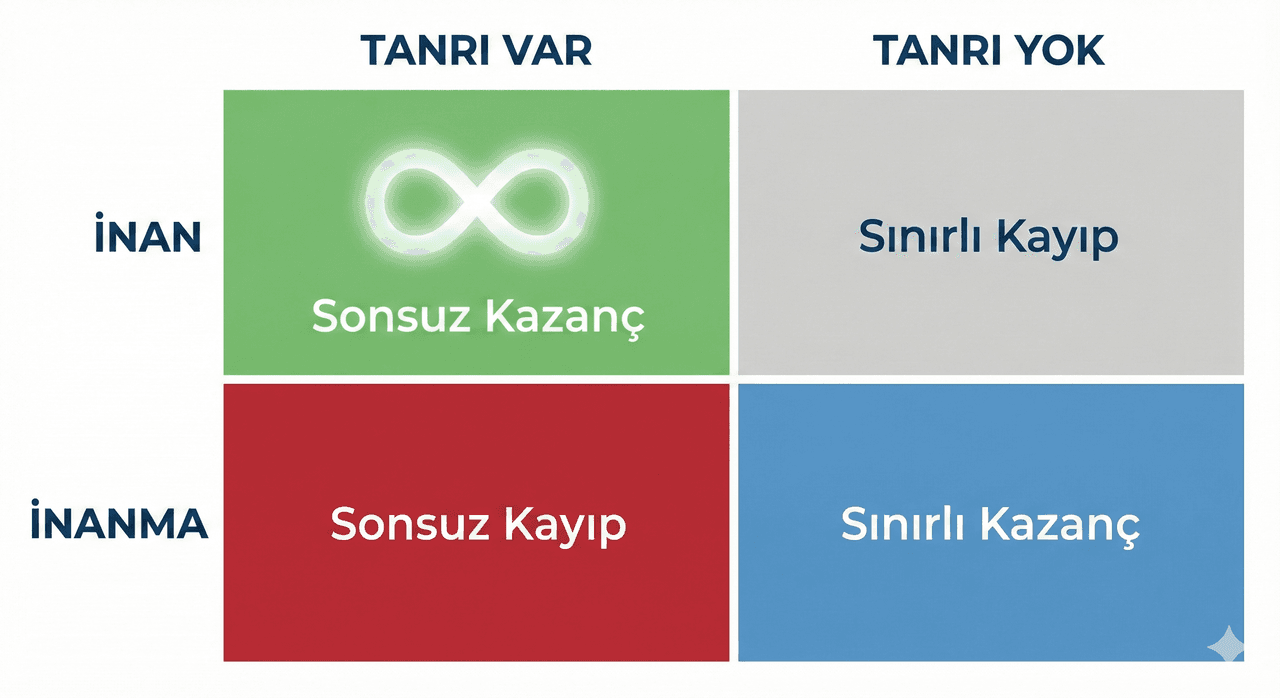
2x2 Decision Table Showing Possible Outcomes of Belief and Disbelief Under the Conditions of God’s Existence or Non-Existence. (Generated by Artificial Intelligence)
According to Pascal, “entering the wager on God” is not merely an immediate declaration of belief but entails adopting a lifestyle that cultivates belief—through rituals, use of holy water, and similar practices.
The core of the argument rests on the concept of infinite utility. Pascal asserts that, by the nature of infinity, adding any finite quantity does not alter it . This mathematical property ensures that even if the probability of God’s existence () is extremely small—such as the odds of a coin toss or even smaller—the expected outcome still favors belief.

Balance Illustration Representing the Imbalance Between Finite Worldly Pleasures and Infinite Happiness. (Generated by Artificial Intelligence)
However, this structure raises the problem of “mixed strategies.” Alan Hájek and Antony Duff argue that if any action that raises the probability of believing in God above zero yields infinite expected utility, then even random decisions—such as flipping a coin to decide whether to believe, or even attempting to disbelieve while leaving open the possibility of future belief—would also yield infinite expected value. This implies that all options become equally valuable (infinite), thereby undermining the distinctive rationality of Pascal’s specific recommendation to believe.
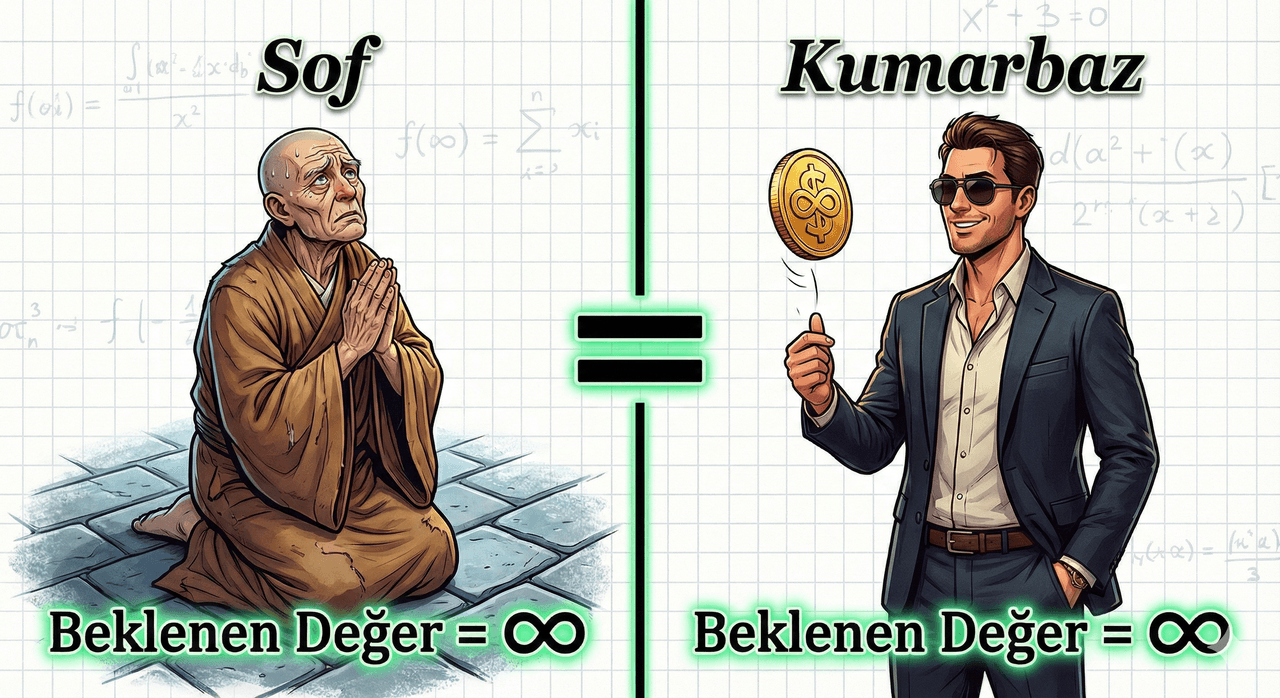
Comparison Illustrating the Mathematically Equal Expected Value of a Sufi Who Seeks Inner Transformation and a Gambler Who Leaves Belief to Chance. (Generated by Artificial Intelligence)
Pascal’s Wager has been subject to various criticisms in the history of philosophy and theology:
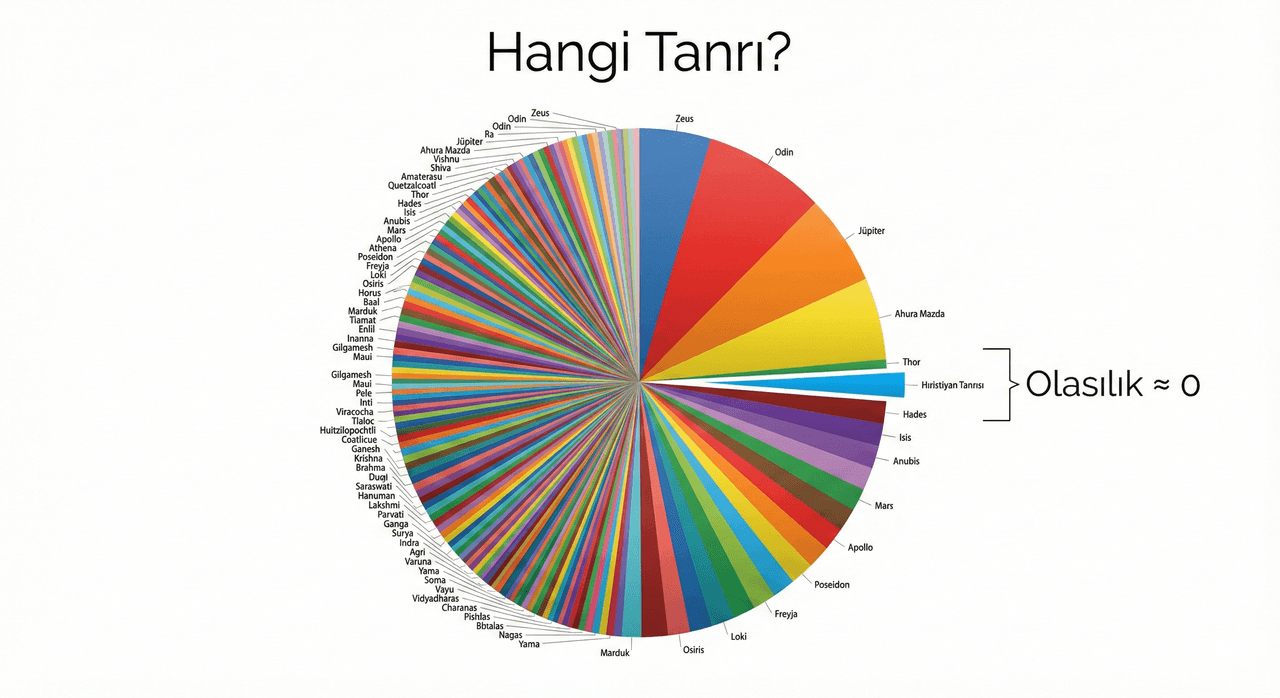
Pie Chart Showing How the Probability Assigned to a Particular God Is Diminished Among an Infinite Number of Possible God Scenarios. (Generated by Artificial Intelligence)
Diderot and other critics note that Pascal restricts the probability space to only two options: the Christian God and no God. Yet, an infinite number of possible gods with different promises and punishments can be conceived—for example, Odin, Zeus, or other logically possible deities. If there are infinitely many possible gods, the probability of any one specific god—such as the Christian God—becomes infinitesimal.
If the probability of God’s existence is not a standard real number but an infinitesimal value—such as —then multiplying it by infinite utility () may yield a finite result. In this case, the expected value of believing in God could be lower than the finite worldly gains of disbelief.
William James and others have questioned whether a belief formed purely on utilitarian grounds and the logic of a “hired soldier” would be acceptable to God. It has also been argued that belief is not an act of will and thus cannot be chosen merely for the sake of the wager. Pascal anticipated this objection and advised individuals to cultivate belief through imitation—by performing rituals and developing habits that gradually internalize faith.
Various reformulations have been proposed to address the logical gaps in Pascal’s argument, particularly those related to mathematical issues of infinity:
The argument has been salvaged by using Conway’s system of surreal numbers, which can distinguish between different magnitudes of infinity (e.g., ), or by treating the utility function as a two-dimensional vector (worldly and otherworldly). In the vector approach, the otherworldly dimension (second component) is always dominant over the worldly dimension (first component), following a lexicographic ordering.
To avoid the paradoxes introduced by infinity, some models propose that salvation does not yield infinite utility but rather an extremely large finite one—such as an immensely long duration of happiness. In such cases, the probability of God’s existence must exceed a certain threshold for belief to be rational.
At the conclusion of his argument, Pascal offers a psychological prescription for those who rationally accept the logic of the wager but still cannot bring themselves to believe. Even if belief cannot be chosen directly by an act of will, one can prepare oneself for belief by engaging in actions that foster it—such as using holy water, attending rituals, and participating in religious practices. Pascal describes this process as a form of self-conditioning, in which habits gradually internalize belief and diminish competing passions.
Graham Oppy has drawn attention to Rescher’s distinction between “non-zero probability” and “finite probability.” For an atheist or skeptic, the probability of God’s existence may not be zero but rather an imperceptibly small infinitesimal. In such cases, standard expected utility calculations fail, and the argument becomes valid only for those who already assign a finite probability to God’s existence.
Today, Pascal’s Wager continues to be examined in debates on philosophy of religion as the clearest example of the distinction between “evidentialism” and “pragmatism” in the justification of belief.
Accessed December 10, 2025. http://www.jstor.org/stable/20009437
Accessed December 10, 2025. http://www.jstor.org/stable/3595561
Accessed December 10, 2025. http://www.jstor.org/stable/40024757
Accessed December 10, 2025. https://doi.org/10.2307/3328185
Duff, Antony. "Pascal’s Wager and Infinite Utilities." Analysis 46, no. 2 (1986): 107–109.
Hacking, Ian. "The Logic of Pascal’s Wager." American Philosophical Quarterly 9, no. 2 (1972): 186–192.
Hájek, Alan. "Waging War on Pascal’s Wager." The Philosophical Review 112, no. 1 (2003): 27–56.
Oppy, Graham. "On Rescher on Pascal’s Wager." International Journal for Philosophy of Religion 30, no. 3 (1991): 159–168.

Logical Structure and Decision Matrix
Dominance Argument
Expectation Argument
Decision Matrix
The Concept of Infinite Utility and Mathematical Analysis
Critiques and Counterarguments
Many Gods Objection
Infinitesimal Probabilities
Moral and Theological Objections
Reformulation Efforts
Surreal Numbers and Vector Values
Finite Utility Models
Epistemological and Psychological Dimensions