

badge icon

This article was automatically translated from the original Turkish version.

Article

Pathfinder Explorer

Quote

Mars Pathfinder is the first mission under NASA’s Discovery Program, which followed the “faster, better, cheaper” philosophy. This robotic mission was the first spacecraft to successfully land on Mars since the Viking program of the 1970s, two decades earlier. The mission, which landed on Mars on July 4, 1997, consisted of two main components: the Pathfinder landing platform, later renamed the Carl Sagan Memorial Station, and the wheeled micro-rover Sojourner carried by the platform. Mars Pathfinder was designed both as a technology demonstration to test innovative engineering solutions and as a scientific mission to collect valuable data. The mission is historically significant for its pioneering airbag landing system and for deploying Sojourner, the first mobile rover to operate on the Martian surface.


Pathfinder Rover (NASA JPL)

Program Objectives and the “Faster, Better, Cheaper” Philosophy

Mars Pathfinder is a product of NASA’s Discovery Program, a series of focused, lower-cost, and rapidly developed missions designed as alternatives to the large-budget “flagship” missions. The program’s core objectives are both engineering and science oriented:


  1. Technology Demonstration: To validate the feasibility of a low-cost, innovative airbag landing system and direct atmospheric entry technique for delivering scientific payloads to Mars.
  2. Rover Capability Testing: To demonstrate the mobility, utility, and autonomous navigation capabilities of a small-scale micro-rover on the Martian surface.
  3. Scientific Data Collection: To analyze the structure of the Martian atmosphere, surface climate and weather conditions, local geomorphology, and the elemental composition of Martian rocks and soil.
  4. Engineering Data Acquisition: To gather engineering data on spacecraft performance during descent, landing, and surface operations.

Spacecraft and Systems

The Mars Pathfinder spacecraft consisted of a cruise module for the journey to Mars and an entry capsule that descended through the Martian atmosphere. The entry capsule included a heat shield, parachute, solid-fuel rockets, airbags, and the main landing platform.

Entry, Descent, and Landing System (EDL)

The most innovative aspect of Pathfinder was its EDL process, developed as an alternative to the complex and expensive powered descent systems used in the Viking program:


  1. Atmospheric Entry: The spacecraft entered the Martian atmosphere at approximately 26,000 kilometers per hour. The heat shield protected the vehicle from the intense frictional heating generated during entry.
  2. Supersonic Parachute: Once the speed had decreased sufficiently, a supersonic parachute with a diameter of about 24 meters deployed to further slow the descent.
  3. Airbag Inflation: At approximately 300 meters above the surface, four multi-layered airbags made of Vectran fibers were inflated, completely surrounding the spacecraft.
  4. Retro-Rocket Firing: Seconds before impact, three solid-fuel retro-rockets fired to reduce the vehicle’s vertical velocity to nearly zero.
  5. Landing and Bouncing: The airbag-encased landing platform struck the surface at approximately 80 kilometers per hour and bounced like a basketball, reaching heights of up to 15 meters on its first bounce and rebounding at least 15 more times before coming to rest. After the airbags deflated, the platform autonomously opened to reveal the rover and its solar panels.


Pathfinder Rover (

Pathfinder Landing Platform (Carl Sagan Memorial Station)

The landing platform, designed in a tetrahedral shape with triangular petals, served both as a base for Sojourner and as a fixed scientific station. Its primary scientific instruments include:


  • IMP (Imager for Mars Pathfinder): A color and stereoscopic (3D) camera system mounted on a deployable mast. This camera transmitted iconic panoramic images of the Martian surface back to Earth.
  • ASI/MET (Atmospheric Structure Instrument/Meteorology Package): Sensors that measured atmospheric pressure, temperature, and wind data during descent and on the surface.


Sojourner Rover is named after Sojourner Truth, a 19th-century abolitionist and women’s rights activist. It is the first successful robotic vehicle to move across the Martian surface.
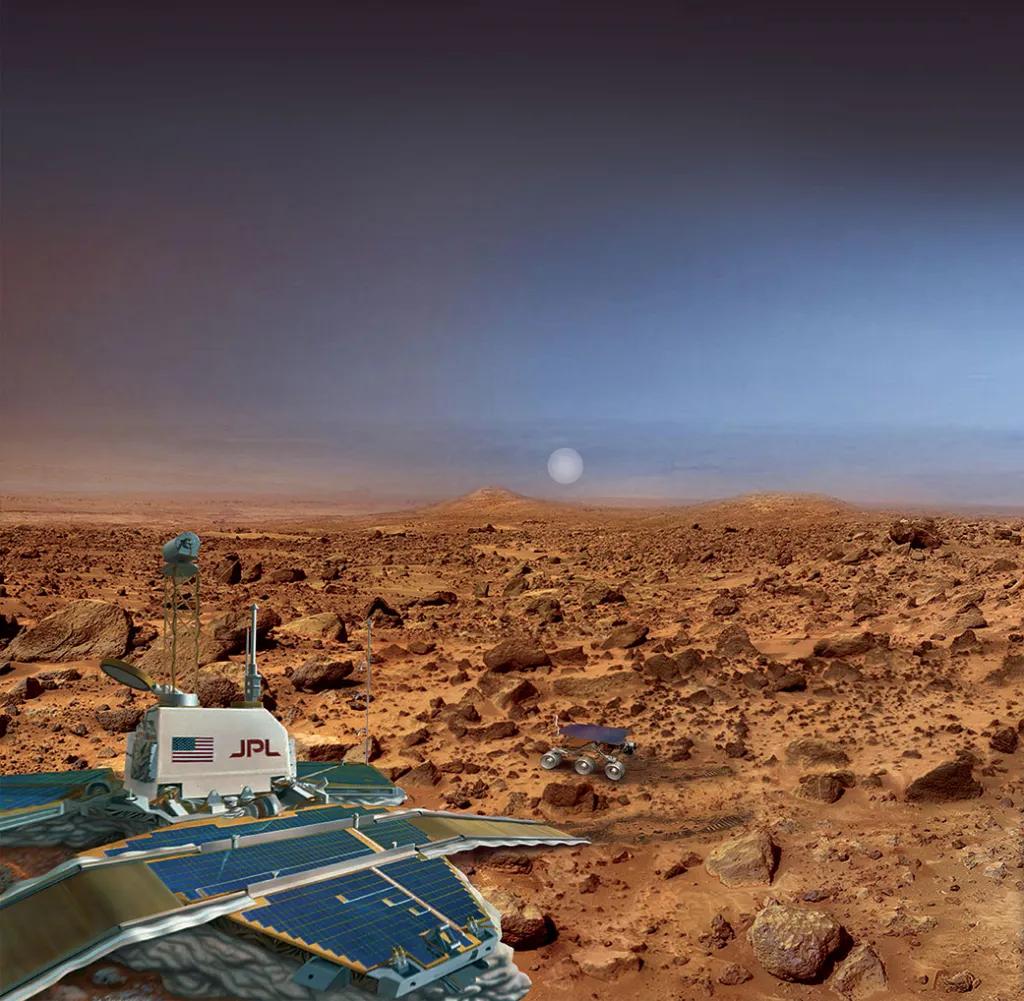

  • Design and Mobility: Sojourner, roughly the size of a microwave oven (65 cm long and weighing 11.5 kg), derived its power from a small solar panel. Its most significant feature was the six-wheeled “rocker-bogie” suspension system. This design enabled the wheels to climb over large rocks while maintaining continuous contact with the terrain, providing exceptional mobility. This suspension system became the standard for all subsequent NASA Mars rovers: Spirit, Opportunity, Curiosity, and Perseverance.
  • Scientific Payload: Sojourner’s primary scientific instrument was the Alpha Proton X-ray Spectrometer (APXS), mounted on the front of the rover. The rover would approach a rock or soil sample and press the APXS against it to analyze the elemental composition of the surface. Each analysis took approximately 10 hours. It also carried cameras for navigation and hazard detection.


Pathfinder Rover (NASA JPL

Mission Timeline and Surface Operations

Mars Pathfinder landed on July 4, 1997, in the Ares Vallis region of Mars’s northern hemisphere. This area is believed to have been carved by a massive flood billions of years ago. Scientists hoped that the flood had transported a wide variety of rock types from different regions of Mars to this location.


During surface operations, the landing platform acted as a relay station for all communications with Earth. The rover departed from the platform to analyze nearby rocks, which were given names such as “Barnacle Bill,” “Yogi,” and “Scooby-Doo,” using the APXS instrument. Over the course of 83 Martian days (sols), Sojourner traveled approximately 100 meters and completed chemical analyses of more than 15 rocks and soil samples.


The last communication from the mission was received on September 27, 1997. The primary cause of mission termination is believed to be the failure of the landing platform’s battery due to repeated charge-discharge cycles during Mars’s extremely cold nights. It is presumed that Sojourner was still operational at the time of communication loss but fell silent because it depended on the platform to communicate with Earth.

Scientific Results and Program Legacy

Despite its short duration, Mars Pathfinder was an exceptionally successful mission.


  • Scientific Results: The mission provided strong evidence supporting the hypothesis that Mars once had a warmer and wetter climate. The diversity of analyzed rocks revealed that Mars’s geological history was more complex than previously expected. It also became the first continuous meteorological station to collect data on the Martian atmosphere and weather.
  • Technological and Cultural Legacy: Pathfinder’s greatest legacy is both technological and cultural. The success of the airbag landing system provided a low-cost landing method for future missions, including Spirit and Opportunity. Sojourner’s success demonstrated the immense value of mobile rovers in planetary exploration and established the “rocker-bogie” suspension system as the standard. The mission also coincided with the rise of the internet and generated widespread public interest by sharing daily images via NASA’s website, rekindling global enthusiasm for Mars exploration.

Author Information

Avatar
AuthorErhan ŞencanDecember 3, 2025 at 9:33 AM

Tags

Discussions

No Discussion Added Yet

Start discussion for "Pathfinder Explorer" article

View Discussions

Contents

  • Program Objectives and the “Faster, Better, Cheaper” Philosophy

  • Spacecraft and Systems

    • Entry, Descent, and Landing System (EDL)

    • Pathfinder Landing Platform (Carl Sagan Memorial Station)

    • Mission Timeline and Surface Operations

  • Scientific Results and Program Legacy

Ask to Küre