This article was automatically translated from the original Turkish version.
Extend your hand into a thought experiment: You hear a bell ring, and suddenly a sweetness appears in your mouth. What happened? Could you have imagined that the sound of a bell alone could trigger a physical response? This is the striking idea at the heart of Pavlov’s famous dog experiment.
What then is Pavlov’s Dog Experiment?
Behavioral psychology is built on the systematic study of how individuals respond to environmental stimuli. Pavlov’s dog experiment is regarded as one of the scientific foundations of this understanding.
Pavlov’s work made significant contributions to psychology and neurophysiology by demonstrating how learning is shaped through environmental stimuli.

A Visual Representing Pavlov’s Dog. (Generated by Artificial Intelligence.)
Pavlov initially conducted research on digestive physiology. He observed that dogs secreted saliva not only when they ate food but also in response to environmental cues associated with food, such as the approach of a laboratory assistant. This led Pavlov to hypothesize that the digestive process was not purely biological but also linked to learned behaviors. Guided by these observations, he decided to systematically test whether a neutral stimulus—such as the sound of a bell—could, through repeated pairings, come to elicit a natural response—salivation.
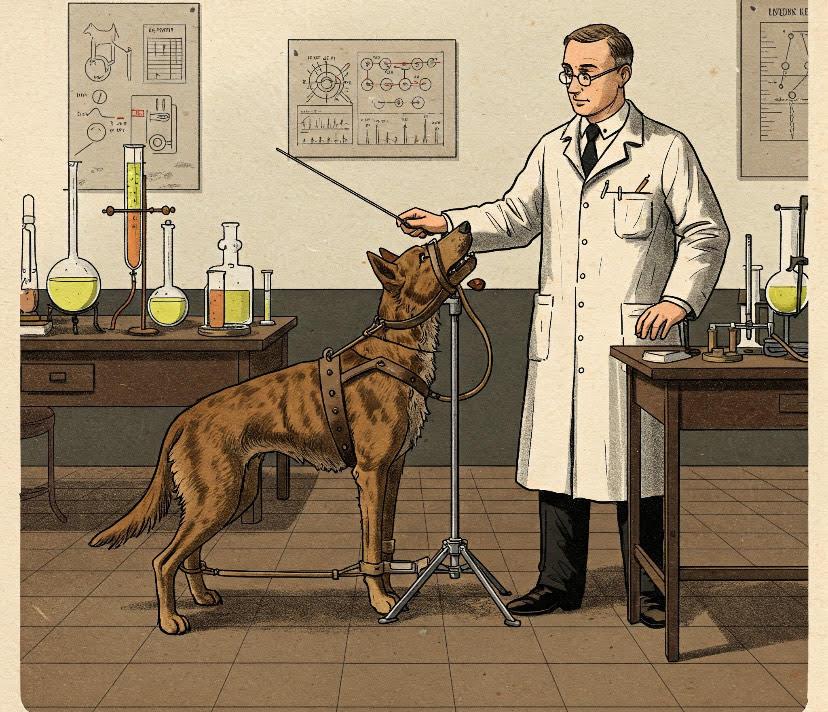
A Representative Visual of Pavlov’s Dog Experiment. (Generated by Artificial Intelligence.)
Pavlov’s experiment proceeded as follows:
• In the initial stage, food was presented to the dogs, and the natural salivary response (unconditioned response) was observed.
• Subsequently, a neutral stimulus—the sound of a bell—was introduced just before the food was presented.
• After several pairings of the bell sound with food, it was recorded that the dogs began to salivate even when only the bell was sounded.
The key concepts in Pavlov’s experiment are:
1. Unconditioned Stimulus: A stimulus that naturally and automatically triggers a response without prior learning. In Pavlov’s experiment: Food causes the dog to salivate naturally. The dog does not need prior training or experience to produce this response.
2. Unconditioned Response: The automatic, innate reaction to the unconditioned stimulus. This response is not learned. In Pavlov’s experiment: Salivation in response to food is the unconditioned response. It is a purely natural reflex.
3. Conditioned Stimulus: A stimulus that initially has no effect on the organism but, through repeated associations, acquires the ability to trigger a response. In Pavlov’s experiment: The bell sound initially means nothing to the dog and does not cause salivation. However, after being paired several times with food, the bell comes to signify food and triggers salivation. Thus, the bell becomes a conditioned stimulus.
4. Conditioned Response: The learned response to the conditioned stimulus. This response is acquired through experience, not innate. In Pavlov’s experiment: Salivation triggered by the bell alone is now a conditioned response. It emerges as a result of association with food.

In Pavlov’s Experiment: Dogs Salivating Upon Seeing Food. (Generated by Artificial Intelligence.)
Naturally, this experiment did more than explain animal behavior; it also provided a model for understanding human learning, the development of emotional responses, and therapeutic interventions. Following Pavlov’s work, behaviorist psychologists such as John B. Watson applied the concept of classical conditioning to human behavior and developed new ideas such as “emotional conditioning.”
John B. Watson applied Pavlov’s concept of conditioning to human behavior, particularly developing new concepts such as emotional conditioning and generalization. Watson tested Pavlov’s findings in human psychology and made significant contributions to the field. His work played a crucial role in the emergence of behaviorism, one of the foundational schools of learning theory.
Here are some of the key concepts and applications developed by Watson:
1. Emotional Conditioning: Watson applied Pavlov’s conditioning experiments to human behavior, particularly examining emotional responses. His most famous example is the Little Albert experiment. In this experiment, Watson presented a young child with a harmless rabbit (neutral stimulus) while simultaneously producing a loud noise (unconditioned stimulus). The loud noise triggered fear in the child; after repeated pairings, the rabbit alone began to elicit fear. Thus, the rabbit, originally a neutral stimulus, became a conditioned stimulus, and fear became the conditioned response.

A Representative Visual of the Little Albert Experiment. (Generated by Artificial Intelligence.)
2. Generalization: Watson and other behaviorist psychologists discovered the principle of generalization in conditioning. Generalization occurs when a conditioned stimulus elicits the same response when presented with similar stimuli. For example, the fear Little Albert developed toward the rabbit extended to other furry animals such as cats or cotton balls. This shows that learned responses are not limited to the original stimulus but can be triggered by similar ones.
3. Discrimination: Discrimination is the process by which an organism responds only to a specific conditioned stimulus and not to similar but distinct stimuli. For example, a person may respond only to a particular bell sound and not to a different bell tone. This occurs when the learned response is associated exclusively with a specific stimulus.
Finally, as a result of Pavlov’s dog experiment:
Pavlov’s dog experiment demonstrated that learning occurs not only through active experience but also through associations formed between environmental stimuli. These findings have found applications in numerous fields today, including phobia treatment, habit modification, and advertising.
Pavlov’s methodological approach and his findings, supported by objective measurements, marked one of the key steps in transforming psychology into a more scientific discipline.

A Representative Visual of Pavlov’s Experimental Work. (Generated by Artificial Intelligence.)
Pavlov, I. P. Conditioned Reflexes: An Investigation of the Physiological Activity of the Cerebral Cortex. Oxford: Oxford University Press, 1927.