


This article was automatically translated from the original Turkish version.
+1 More
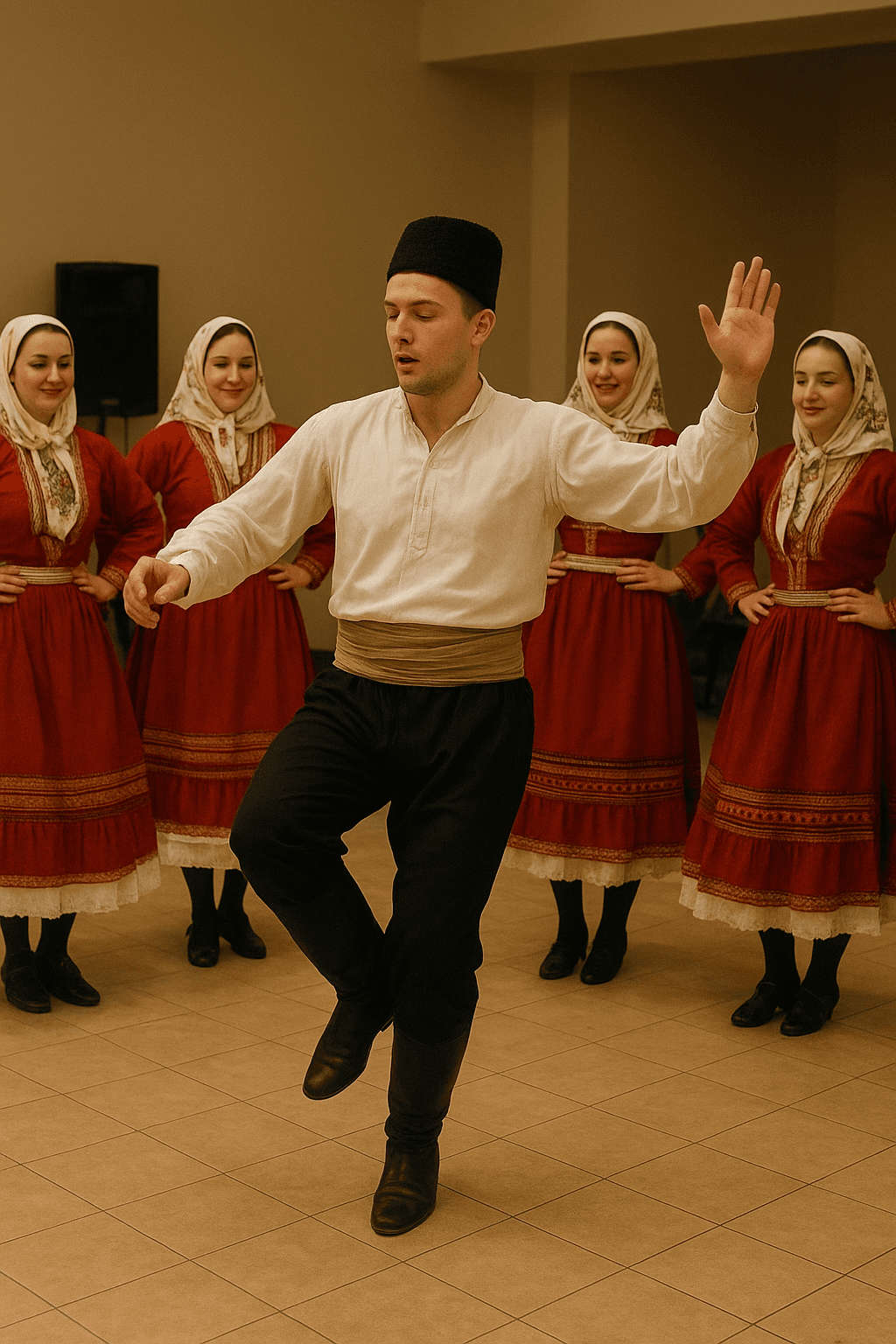
Payduşka Dansı (Yapay Zeka ile Oluşturulmuştur)
Payduşka Dance is a general term used by choreographers and dance researchers to refer to various dance types characterized by a “short-long” rhythm. This dance family encompasses a range of chain dance forms united by dancers’ use of two-beat asymmetric rhythms. For Payduşka, this rhythm is interpreted as “short-long” and is most commonly approximated musically as a 5/16 meter. However, some local musicians have been recorded performing this rhythm in 3/8 meter.
Several theories exist regarding the etymological origin of the dance’s name. One widely held view suggests that the term “Payduşko” derives from the Turkish word “paytak,” which conveys meanings such as “inward-turned leg” or “to walk with a swaying motion.” In the Topolovgrad (Kavakli) region of Bulgaria, Greek communities used two names for this dance: transliterated as “Μπαϊντούσκα” and possibly “Κουτσός” (Koutsós), a word meaning “lame” or “one who cannot walk properly due to a problem with the foot or leg.”

A Visual of the Payduşka Dance (Generated by Artificial Intelligence.)
The classic Payduşka dance has a stable structure composed of fundamental movement motifs generally categorized as “limping steps,” “optional steps,” “jumping steps,” and “transitions.” The “limping step” is frequently referred to by Bulgarian dancers as the Payduşko step. When performed to the left, this step is defined by crossing the right foot over the left on the first beat, followed by a slight downward motion as the right foot is drawn back on the second beat. The “jumping step” is typically executed in place or to the right, involving a jump on the short beat and a step on the long beat. There are two main types of “classic” Payduşka:
While choreographers distinguish between these two versions based on three or four limping steps, different “transition” steps appear to be more defining. Since the length of the dance phrase is not culturally bound to the music, the selection of movement motifs determines its structure. Nevertheless, some adaptations have been made to preserve the popular 10- or 12-measure phrases.
The popular form of Payduşka (Type 1) spread into the dance repertoires of Albania, Greece, Serbia, North Macedonia, and Türkiye during the late 20th century. Nevertheless, the geographical distribution of dances with this rhythm suggests they are endemic to the Lower Danube region. Payduşka variations recorded in the Sredna Gorna region represent the versions most closely aligned with the dance’s likely “original” source. These variations conform to the classic form, combining limping steps to the left with jumping steps to the right.
Green, Nick. "Paydushka: Structure, Variation and Dance Phrases." Eliznik Articles, 2025. Accessed https://eliznik.me.uk/wp-content/uploads/articles/Nick-Green-ELIZNIK-Pajdushka-structure-2025.pdf.
Sakar, Mümtaz Hakan. “Makedonya Göçmenleri Dernek Geceleri ve Kültürel Kimliğin Müzik ve Dans Yoluyla İnşası.” The Journal of Academic Social Sciences 9, no. 123 (December 2021): 42–59. Accessed https://doi.org/10.29228/ASOS.54179.

Payduşka Dansı (Yapay Zeka ile Oluşturulmuştur)
Etimological Origin
Classic Payduşka Dance