
This article was automatically translated from the original Turkish version.
Adhesion | Humerus (intertubercular sulcus) | ||||||||
|---|---|---|---|---|---|---|---|---|---|
Innervation | Lateral pectoral nerve (C5-C6) Medial pectoral nerve (C8-T1) | ||||||||
Function(s) | Elbow flexion internal rotation Scapular stabilization adduction | ||||||||
Pectoralis Major Muscle is the largest and most superficial muscle of the human chest. Also known as the "chest muscle," it plays a significant role in arm movements (flexion, adduction, internal rotation).
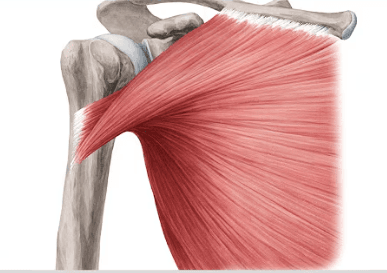
The Pectoralis Major Muscle is a thick, fan-shaped muscle located on the anterior thoracic wall. It consists of three main parts: the clavicular head, the sternocostal head, and the rarely present abdominal head. The clavicular head originates from the medial half of the clavicle. The sternocostal head arises from the anterior surface of the sternum (approximately at the level of the 2nd to 6th ribs), the costal cartilages of the first to sixth ribs, and the aponeurosis of the external oblique muscle. The abdominal head, present in some individuals, has an anatomical relationship with the abdominal muscles. The muscle formed by the union of these three heads inserts onto the lateral lip of the intertubercular sulcus (bicipital groove) of the humerus. The tendon of the muscle is divided into two laminae: the anterior lamina contains fibers from the clavicular and upper sternal portions; the posterior lamina contains fibers from the lower sternal and costal portions. The tendon also gives off extensions to the shoulder joint capsule and the fascia of the arm.
The Pectoralis Major Muscle develops embryologically from the ventrolateral mesoderm and is classified among the muscles of the upper limb. It is grouped within the superficial chest muscles and serves as an important structure supporting both postural and motor functions of the anterior body wall. Fiber differentiation originates from the ventral muscle mass of the limb bud.
The muscular innervation is provided by two distinct nerves arising from the brachial plexus. The clavicular head is innervated by the lateral pectoral nerve, which originates from spinal segments C5–C6; the sternocostal head is innervated by the medial pectoral nerve, which arises from segments C8–T1. Blood supply is primarily provided by the pectoral branch of the thoracoacromial artery. Additionally, perforating branches of the internal thoracic artery contribute to vascular support. This rich vascular network enables the muscle’s hypertrophic development.
The Pectoralis Major Muscle actively participates in most movements of the upper limb. The clavicular head facilitates flexion of the arm. The sternocostal head contributes to adduction of the arm toward the trunk and medial rotation of the arm. It also assists in stabilizing the scapula against the thoracic wall. These functions are particularly evident in movements such as pushing, swimming, boxing, and weightlifting. During horizontal adduction, all muscle portions work synergistically. Clinically, the pectoralis major may exhibit variations. The most common variation is partial or complete absence of the sternocostal head. Poland syndrome is a congenital anomaly characterized by unilateral absence of the pectoralis major and hypoplasia of the mammary tissue. Rare accessory muscle extensions, such as the chondroepitrochlearis, may show different insertions on the humerus. In surgical procedures, particularly breast surgery or aesthetic operations, this muscle serves as an important anatomical landmark. Furthermore, strengthening this muscle is critical during rehabilitation following shoulder dislocation or upper limb surgeries.
Accessed November 26, 2025.
Accessed November 26, 2025.
Karayol, Uğur Gültekin, Sercan Aksoy, Serkan Hekimoğlu, and Murat Bozkurt. “Evaluation of Pectoralis Major Muscle Using Shear Wave Elastography in Patients with Shoulder Impingement Syndrome.” *The Journal of Sports Medicine and Physical Fitness* 63, no. 4 (2023): 537–544. Accessed July 26, 2025. https://journalofsportsmedicine.org/full-text/713/eng.
Kenhub. "Pectoralis Major Muscle." Kenhub Anatomy Library. Accessed July 26, 2025.
Zhang, Ruixue, Wei Li, and Jianguo Zhao. "Anatomical Study of the Pectoralis Major and Its Application in Breast Reconstruction." Anatomy Research International 2019 (2019): Article ID 6212039. Accessed July 26, 2025.

Adhesion | Humerus (intertubercular sulcus) | ||||||||
|---|---|---|---|---|---|---|---|---|---|
Innervation | Lateral pectoral nerve (C5-C6) Medial pectoral nerve (C8-T1) | ||||||||
Function(s) | Elbow flexion internal rotation Scapular stabilization adduction | ||||||||
No Discussion Added Yet
Start discussion for "Pectoralis Major Muscle" article
Anatomical Structure
Embryological Origin and Classification
Innervation and Vascular Supply
Function and Clinical Relevance