

This article was automatically translated from the original Turkish version.
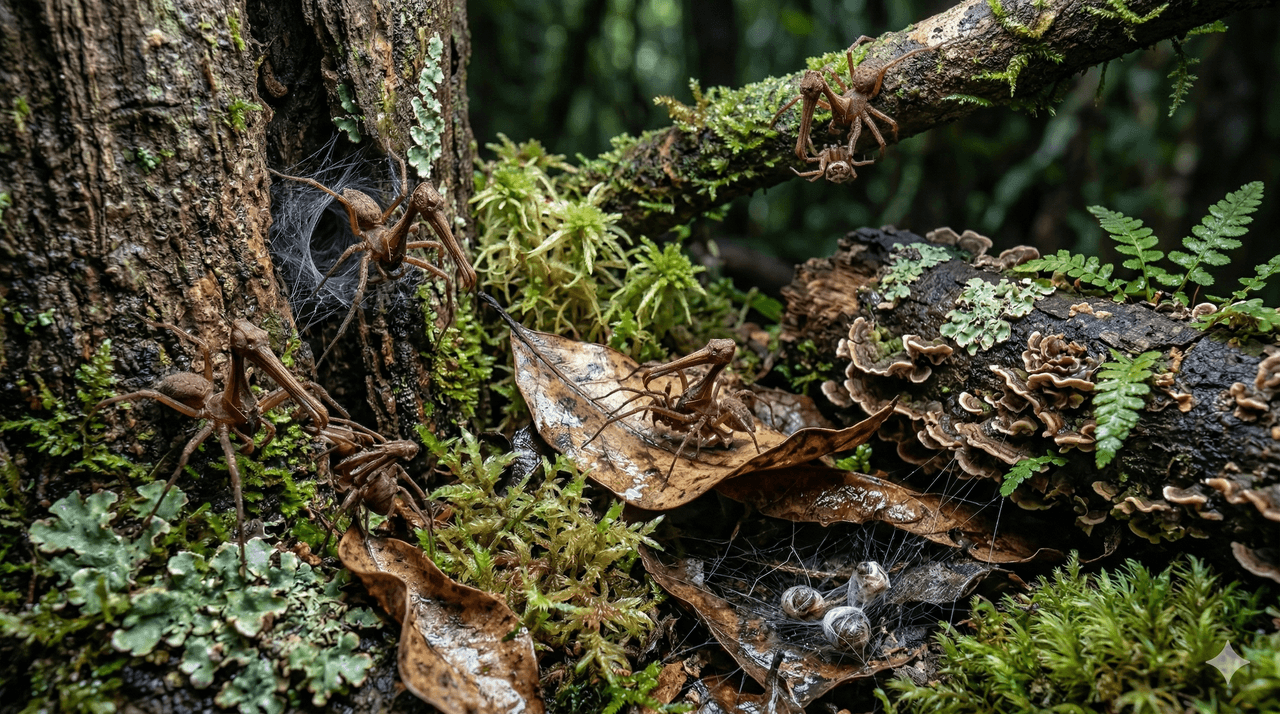
Pelican Spider (Archaeidae) (generated by artificial intelligence)
Important Fossil Genera | Myrmecarchaea Burmesarchaea Baltarchaea Archaea | ||||||||
|---|---|---|---|---|---|---|---|---|---|
Historical (Fossil) Distribution | Eurasia (Burma Baltic and France/Oise amber) | ||||||||
Physical Characteristics | Elongated "neck" (head-thorax) prominent petiole very long legs | ||||||||
Current Distribution | Only in the southern hemisphere: South Africa Madagascar and Australia | ||||||||
The family Archaeidae, known as pelican spiders or assassin spiders, is a group of spiders characterized by long legs and a distinct neck-like structure of the cephalothorax that projects at a pronounced angle from the body.
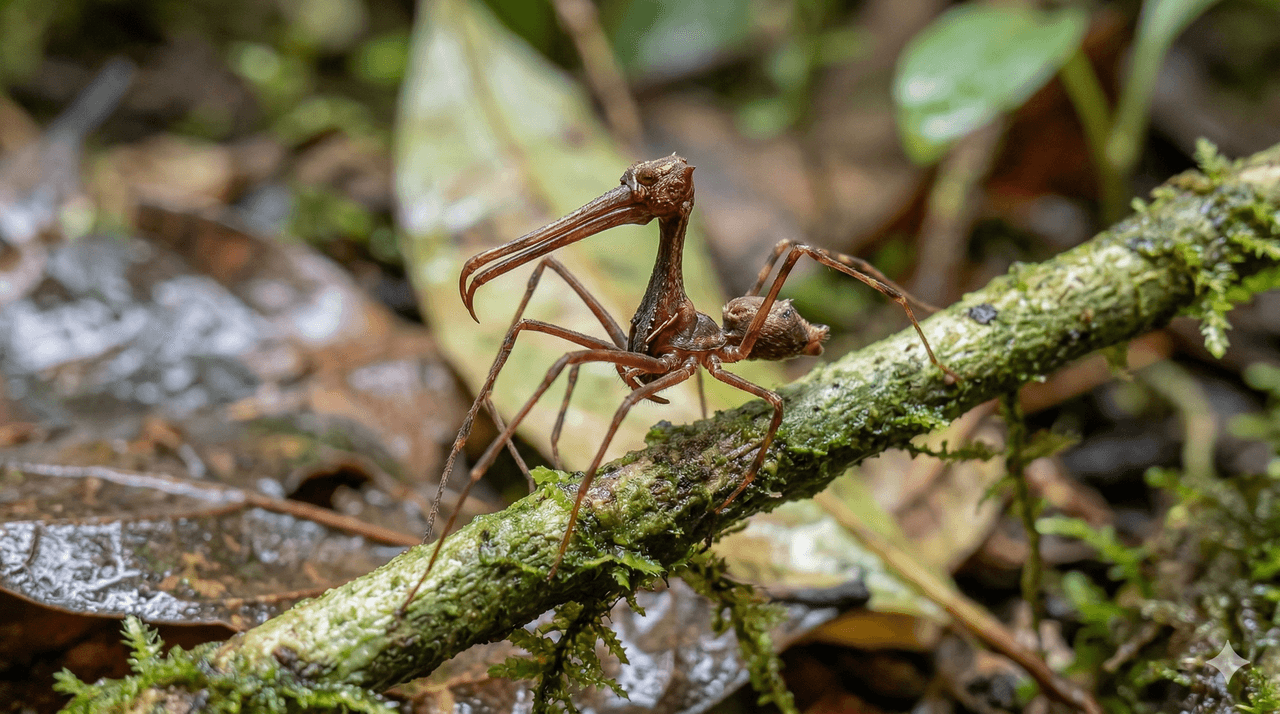
Image of a Pelican Spider—Visual generated by artificial intelligence.
Although modern Archaeidae exhibit a strictly austral distribution, they were also present across the Eurasian continent during the Mesozoic and Cenozoic eras. This is evidenced by fossil specimens found in Cretaceous-era Burmese amber and Eocene-era European amber deposits. Fossil genera within the family include Archaea, Baltarchaea, Burmesarchaea, and Myrmecarchaea.
Particularly significant are the fossils from the Oise amber deposits in northern France, dated to the Ypresian (Early Eocene, approximately 55–53 million years ago). The species Myrmecarchaea antecessor, discovered in this deposit, holds major scientific value as the first and exceptionally well-preserved nearly complete adult male fossil of the genus Myrmecarchaea. Measurements of the fossil reveal a body length of 5.0 mm excluding chelicerae, a carapace length of 3.0 mm, and a remaining posterior abdominal segment of 2.0 mm.
M. antecessor differs from other Myrmecarchaea species found in Baltic amber (M. petiolus and M. pediculus) by its notably robust pedicel and a distinctly elongated cephalothorax that tapers posteriorly. The discovery of M. antecessor represents the first record of this genus outside the Baltic amber and extends its geographic range into western Europe, indicating faunal affinities between the Oise and Baltic amber deposits.
Living Archaeidae species are exclusively restricted to the Southern Hemisphere and are found only in Madagascar, South Africa, and Australia. This stark contrast between the current southern hemisphere distribution and the northern hemisphere fossil record provides important biological evidence of ancient biogeographic connections among the southern continents.
In Australia, the family Archaeidae is represented by the endemic genus Austrarchaea. To date, the main described species include A. nodosa and A. daviesae from Queensland, A. hickmani from Victoria and New South Wales, and A. mainae and A. robinsi from Western Australia.
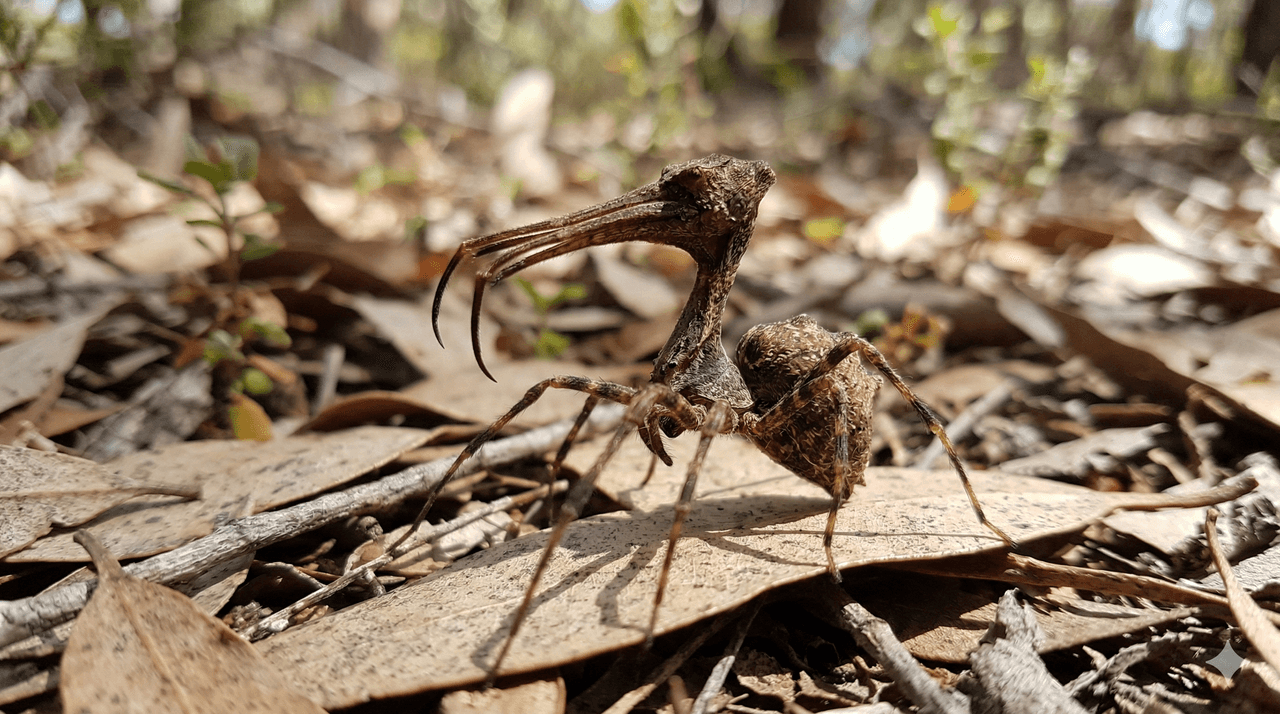
Image of Austrarchaea mainae—Visual generated by artificial intelligence.
Described from the Torndirrup National Park habitat in Western Australia, A. mainae is characterized by three pairs of tubercles on the posterior surface of the abdomen, with the central pair being the largest. This morphological feature readily distinguishes it from A. hickmani and A. daviesae, while anatomically resembling A. nodosa. The total length of males is 3.66 mm; the cephalothorax and chelicerae are dark reddish-brown, the abdomen is pale brown, and bears black reticulate markings along with five transverse rows of circular, orange sclerotized plates and a prominent scutum. The anterior median eyes are wider than the other eyes of equal size and are spaced nearly three times their own diameter apart.
Another Western Australian species described from the Stirling Range National Park, A. robinsi is distinguished from A. mainae, A. nodosa, and A. daviesae by the absence of abdominal tubercles. It also differs from the tubercle-free A. hickmani by possessing tubercles with setae along the posterior and lateral margins of the carapace and a sclerite that does not fully encircle the pedicel. The carapace is chestnut brown with black markings, the legs are brown with dark bands at the joints, and the eyes are arranged in two rows: the anterior median eyes are black, while the others are white.
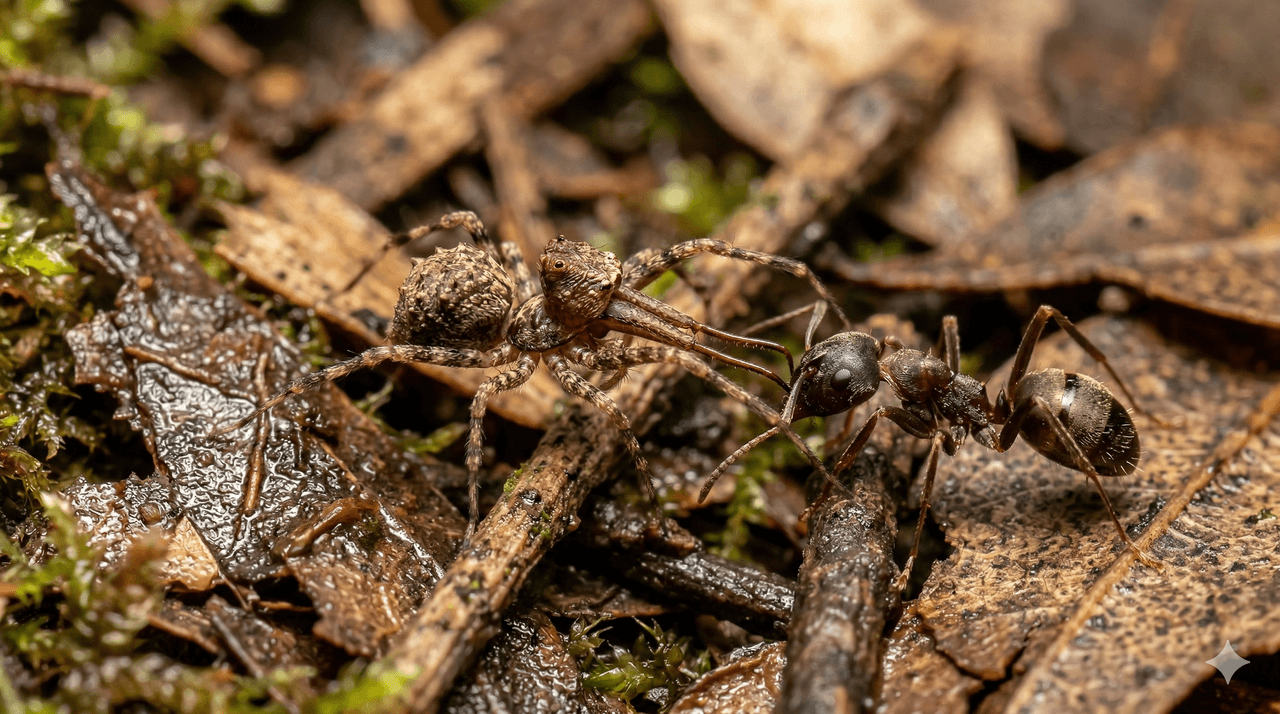
Image of Austrarchaea robinsi—Visual generated by artificial intelligence.
A. robinsi and A. mainae females exhibit a distinctive anatomical feature: elongated spermathecae spreading fan-like on either side of the genital opening, a trait not found in eastern Australian members. This shared structure indicates that the two species are sister taxa and have undergone an isolated evolutionary radiation from a common ancestor in Western Australia.
Carbuccia, Benjamin, Hannah M. Wood, Christine Rollard, Andre Nel, and Romain Garrouste. "A new *Myrmecarchaea* (Araneae: Archaeidae) species from Oise amber (earliest Eocene, France)." *BSGF - Earth Sciences Bulletin* 191, no. 24 (2020). Accessed March 25, 2026. https://pdfs.semanticscholar.org/93d0/898f356a40e1e806fbe5c250896f020016ed.pdf
Harvey, Mark S. "A new species of Austrarchaea (Araneae: Archaeidae) from Western Australia." Records of the Western Australian Museum 21 (2001): 35-37. Accessed March 25, 2026.
Platnick, Norman I. "On Western Australian Austrarchaea (Araneae, Archaeidae)." Bulletin of the British Arachnological Society 8, no. 8 (1991): 259-261. Accessed March 25, 2026.
https://britishspiders.org.uk/system/files/library/080806.pdf
https://museum.wa.gov.au/sites/default/files/A%20NEW%20SPECIES%20OF%20AUSTRARCHAEA%20(%20ARANEA%20ARCHAEIDAE)%20FROM%20WESTERN%20AUSTRALIA.pdf

Pelican Spider (Archaeidae) (generated by artificial intelligence)
Important Fossil Genera | Myrmecarchaea Burmesarchaea Baltarchaea Archaea | ||||||||
|---|---|---|---|---|---|---|---|---|---|
Historical (Fossil) Distribution | Eurasia (Burma Baltic and France/Oise amber) | ||||||||
Physical Characteristics | Elongated "neck" (head-thorax) prominent petiole very long legs | ||||||||
Current Distribution | Only in the southern hemisphere: South Africa Madagascar and Australia | ||||||||
No Discussion Added Yet
Start discussion for "Pelican Spider (Archaeidae)" article
Evolutionary History and Fossil Records
Geographic Distribution
Modern Species in Australia: The Genus Austrarchaea
Austrarchaea mainae
Austrarchaea robinsi