


This article was automatically translated from the original Turkish version.
+1 More

The Compass Galaxy, a spiral galaxy, stands out due to its asymmetric structure shaped by strong gravitational interactions.
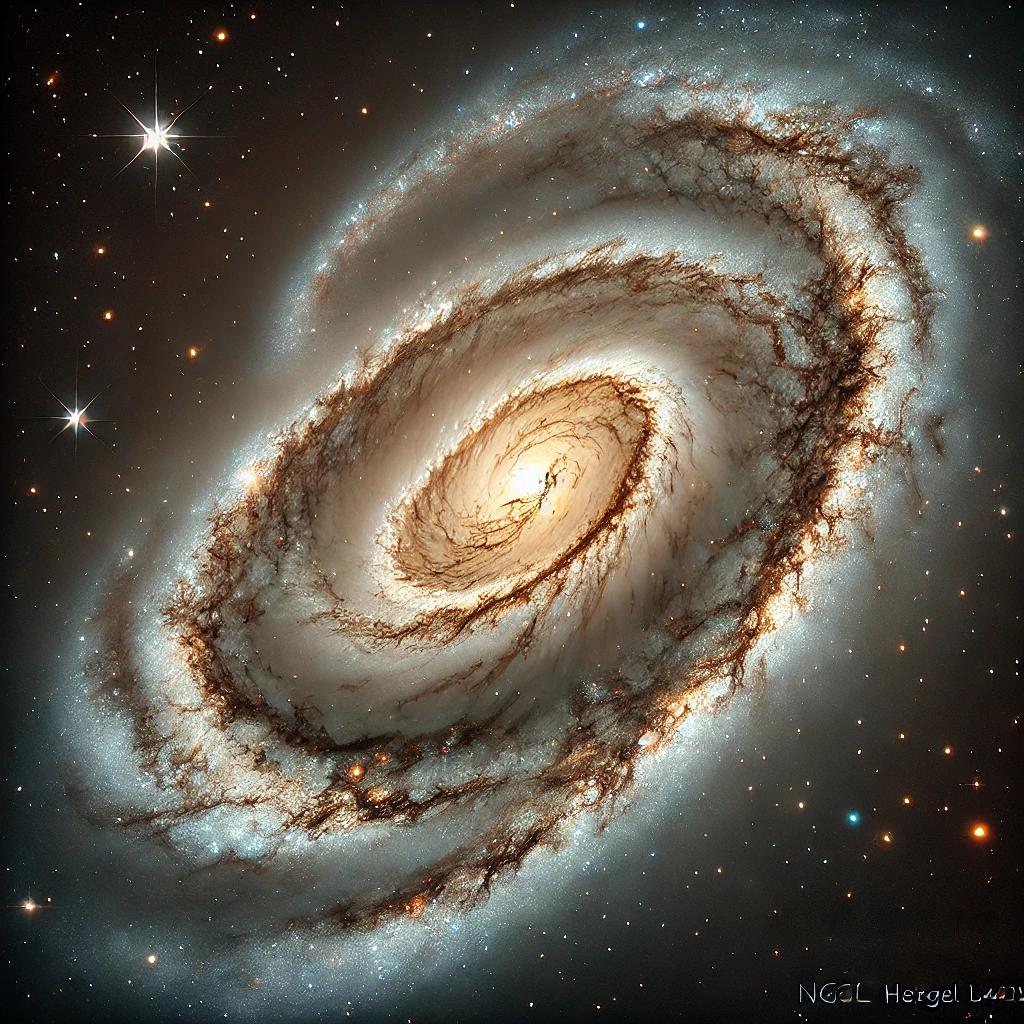
Artificial Intelligence-Generated Visualization of the Pergel Galaxy.
The Pergel Galaxy is located approximately 50 million light-years away within the Sail constellation, at place. Its asymmetric structure makes it particularly notable, especially as a important work region for studying gravitational interactions and star formation processes. This study examines the fundamental characteristics and scientific significance of the Pergel Galaxy.
The Pergel Galaxy is an irregular spiral galaxy of type Sbc, featuring distinctly distorted spiral arms. This disrupted structure indicates a past interaction with another galaxy. The galaxy’s mass is estimated at about 100 billion Sun masses, with active star formation observed in its central region.
Star formation in the Pergel Galaxy continues in association with dense gas and dust clouds. Observations have revealed the presence of young star clusters along its spiral arms. Additionally, it is believed that gravitational interactions with nearby galaxies have significantly influenced the galaxy’s morphology.
The Pergel Galaxy serves as an important example for understanding the evolution of irregular spiral galaxies. It is also regarded as a critical target for studying the impact of gravitational interactions on star formation. Furthermore, studies based on optical and radio observations have detailed the galaxy’s dense gas structure and magnetic fields.

Artificial Intelligence-Generated Visualization of the Pergel Galaxy.
The Pergel Galaxy is a galaxy notable for its asymmetric structure and active star-forming regions. The gravitational interactions it has undergone are key factors shaping its morphological and chemical evolution. Future higher-resolution observations will enhance our understanding of the galaxy’s dynamic processes.

Physical and Chemical Properties
Star Formation and Gravitational Interactions
Scientific Significance