


This article was automatically translated from the original Turkish version.
+1 More
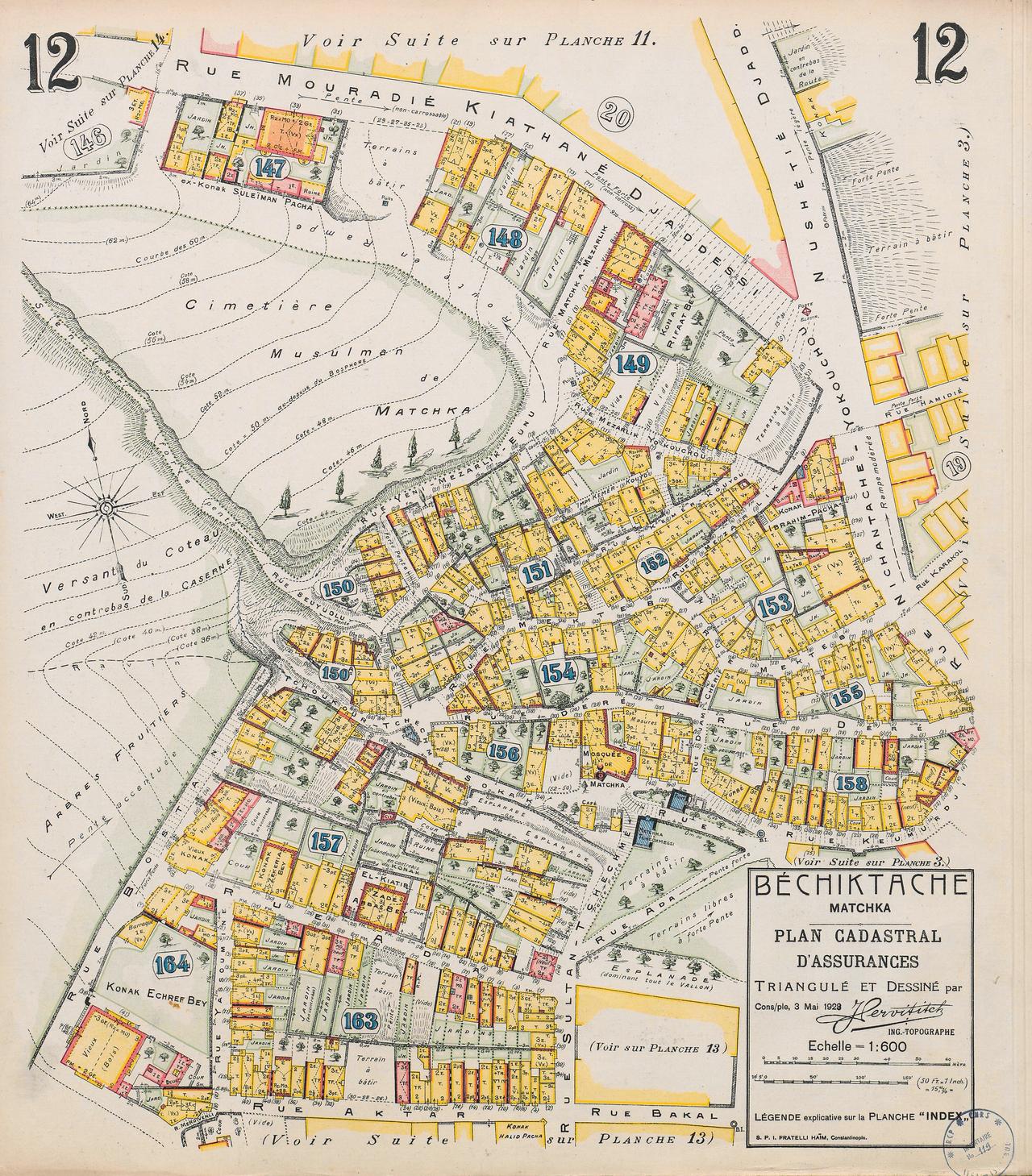
Pervititch Maps are insurance maps that meticulously documented Istanbul’s urban fabric during the first half of the 20th century. Prepared by Croatian cartographer Jacques Pervititch between 1922 and 1945, these maps were originally created for insurance companies to assess fire risks. Over time, however, they became an invaluable source of information on Istanbul’s architectural structure, street layout, and social life.
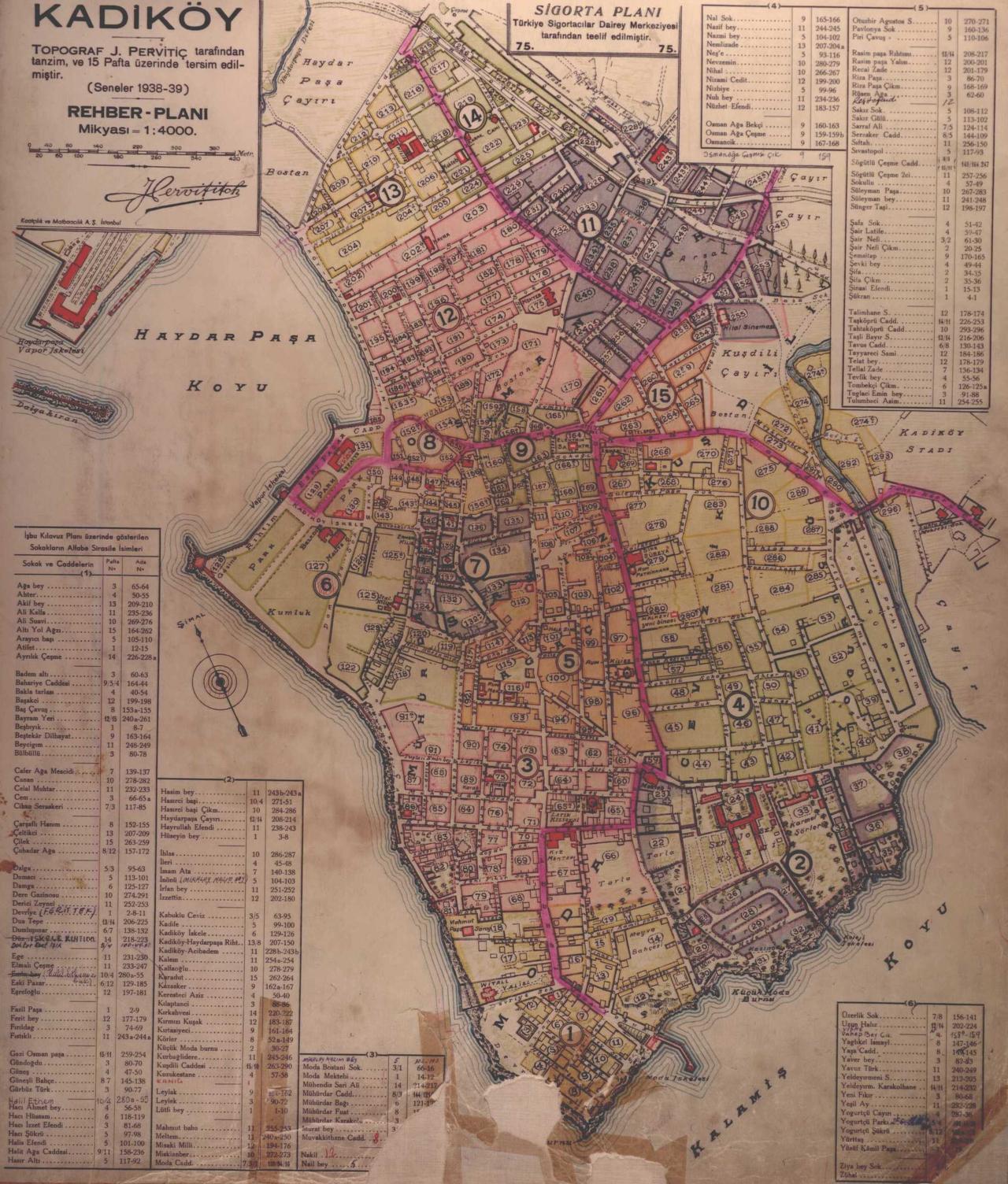
Kadıköy Guide Plan (Salt Research Archive)
The Pervititch Maps are the product of a deliberate research effort aimed at identifying, evaluating, and calculating the risk levels of built property stocks, and establishing long-term measures to mitigate these risks. The maps are highly detailed. For instance, on Map No. 76 depicting Üsküdar, even the small hill formed by soil excavated during the construction of an electricity plant and garage opposite the cemetery is accurately recorded.
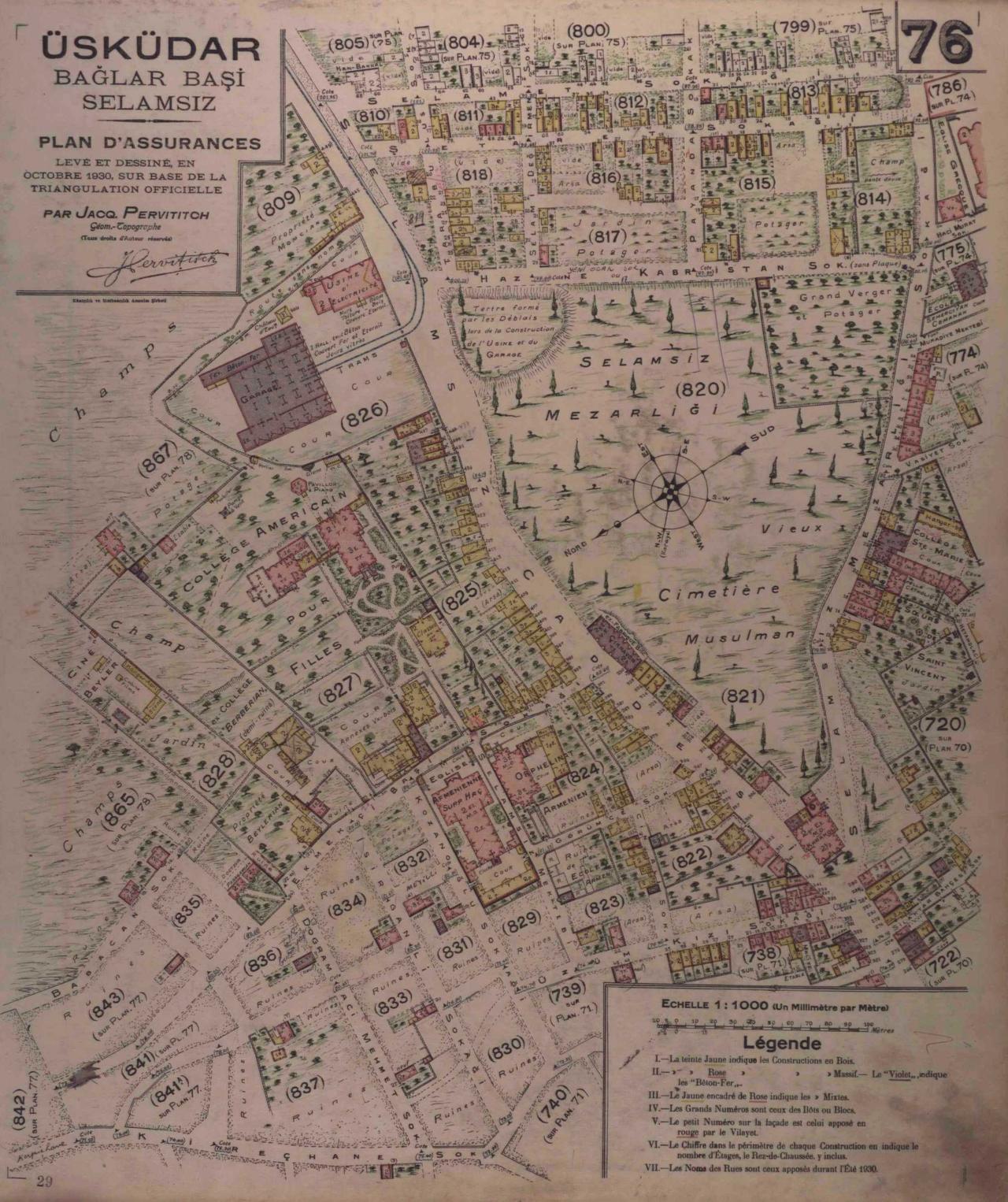
Insurance Plan No. 76, Üsküdar (Salt Research Archive)
These maps document every detail that positively or negatively influenced fire risk, including tobacco warehouses, factories, open-air cinemas, kiosks, gardens, vegetable plots, banks, schools, hospitals, police stations, pavilions, and various water structures. Even remnants of demolished buildings are recorded. The maps also contain detailed information on building materials and construction techniques for property stocks dating from 1920 to 1950, alongside physical environmental features such as wooded areas and beaches. Place names used during the 1930s are consistently marked on each map sheet.
It is possible to trace the paths of streets that no longer exist and neighborhoods whose names have changed using the Pervititch Maps. In this sense, the Pervititch Maps hold the status of an important historical document that sheds light on their era. As primary sources documenting Istanbul’s architectural and cultural heritage—much of which has been severely damaged or lost over time—the Pervititch Maps have become an essential component of scholarly research.
The Pervititch Maps provide an infrastructure for identifying and transmitting Istanbul’s cultural and architectural heritage. Different building colors were used on the maps to classify building types within Istanbul’s architectural plan. Information on floor heights and topography is also included. The maps reveal Istanbul’s architectural heritage as it existed before it was largely altered or nearly erased in the present day.
The extensive damage caused by fires in Istanbul—particularly the 1856 Aksaray fire, the 1865 Hocapaşa fire, and the 1870 Pera fire, one of the greatest disasters of the period—marked a turning point in the development of fire insurance. Numerous companies began operations on Ottoman territory to offer fire insurance.【1】 From the 1870s onward, the Ottoman insurance market was dominated by foreign insurance companies, especially British ones.
In the late 19th century, Europeans who came to Istanbul for trade brought their own insurance systems with them. These institutions expanded by appointing agents for foreign nationals. The first indigenous insurance company in the Ottoman Empire was established during the reign of Sultan Abdülhamid II under the name ‘‘Osmanlı Umum Sigorta Şirketi’’.【2】 By 1910, Istanbul had 52 fire insurance companies; by 1922, this number had risen to 92 with the participation of companies capitalised by the United States, Poland, Hungary, Denmark, and Australia. Additionally, two local companies—Constantinople (Istanbul) General Insurance Company and Türkiye Milli Sigorta Şirketi—were established during this period, bringing all insurance firms under their umbrella.【3】
The increasing frequency and severity of fires made it essential for insurance companies to monitor regional risk levels. As a result, maps illustrating fire risks based on the city’s built environment became critically important. The first such maps, the Goad Maps, were prepared by British construction engineer C. E. Goad between 1904 and 1906 and covered only a limited portion of the city. Subsequently, maps prepared by Jacques Pervititch on behalf of Türkiye Sigortacılar Daire-i Merkeziyesi were far more detailed and encompassed nearly all areas of Istanbul.【4】
The Pervititch Maps are insurance maps funded by private insurance companies, depicting fire risks at the cadastral parcel level. Although limited information exists about the life and identity of the maps’ creator, topographer and engineer Jacques Pervititch, much of what is known has been uncovered through the efforts of Müsemma Sabancıoğlu.
Jacques Pervititch was born in 1877 near Cavtat, south of Dubrovnik within the present-day borders of the Republic of Croatia. He came from a Catholic family. His father, a seafarer, moved with his wife and children to Istanbul in 1880. Pervititch began his education at Saint Pierre Primary School and later continued his studies on scholarship at the French Saint Joseph High School. He graduated with distinction from Saint Joseph in 1894, though it remains unknown where he received his training in cartography. The year 1945, when he completed his final map, was also the year of his sudden death.【5】
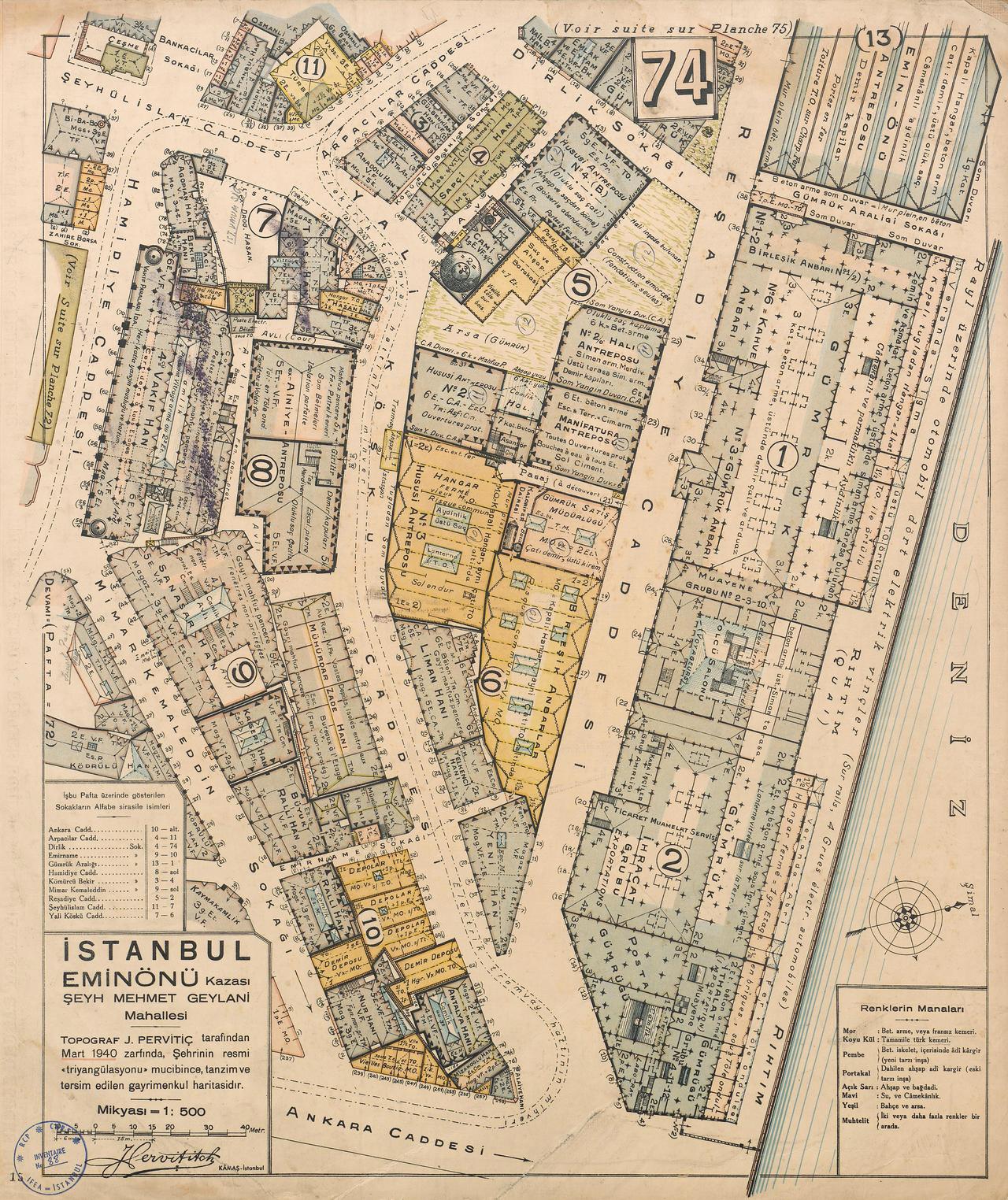
Insurance Plan No. 74, Eminönü (Salt Research Archive)
The Pervititch Maps consist of a total of 243 sheets covering various districts of Istanbul. These 1:500 scale maps include details such as building materials (wooden or masonry), number of floors, usage purposes, and fire risk levels. Street names, significant structures, and green spaces are also clearly marked.
As primary sources, the Pervititch Maps are widely used in historical, urban planning, and architectural studies for their detailed documentation of 20th-century street patterns. Although direct studies specifically focused on the Pervititch Maps are limited, the first scholarly research on Jacques Pervititch’s maps began in the early 2000s through the joint efforts of the History Foundation and Axa Oyak Insurance Company to publish the complete collection of maps.
Following her research, Müsemma Sabancıoğlu published the book ‘‘İstanbul Jacques Pervititch Sigorta Haritalarında’’. The book compiles over 200 maps created by Pervititch and includes comprehensive analytical essays by İlhan Tekeli, Murat Güvenç, and Müsemma Sabancıoğlu, alongside a complete compilation of existing map sheets.
Following these three key articles on fire insurance and the Pervititch Maps, the maps were organized by district. Istanbul’s districts—Beyazıt, Beyoğlu, Taksim, Eminönü, Fatih, Kadıköy, Şişli, and Üsküdar—were each introduced with a brief text, followed by the relevant map sheets. Another major source used in this study is Müsemma Sabancıoğlu’s article ‘‘Jacques Pervititch and His Insurance Maps of Istanbul’’, published in the Duvrovnik Journal. Additionally, an article on the Pervititch Maps by Ayla Ödekan and Afife Batur appeared in the book supplement of Cumhuriyet Newspaper. Beyond these sources, no direct scholarly studies on Jacques Pervititch or his maps exist.
A large portion of the Pervititch Maps has been digitized and made accessible through the Salt Research Archive. Furthermore, through a joint project of the History Foundation and Axa Oyak Insurance, the maps have been published in book form. The digitization and publication of these maps contribute significantly to the preservation of Istanbul’s historical and cultural heritage.
Güvenç, Murat. "Pervititch Haritaları: İstanbul için Bitmemiş Bir Araştırma Projesi." Jacques Pervititch Sigorta Haritalarında İstanbul, 14. Tarih Vakfı Yurt Yayınları, 1999.
Kılıç, Rabia. "Pervititch Haritaları Üzerinden Üsküdar Kent Dokusunda Çeşmeler." Master's thesis, Süleyman Demirel Üniversitesi, 2022.
Sabancıoğlu, Müsemma. "Jacques Pervititch and His Insurance Maps of Istanbul." *Dubrovnik Annals* 7 (2003): 89-98.
Salt Araştırma. "Plan Cadastral d’assurances. Béchiktache. No: 12." Salt Research. Accessed May 13, 2025. https://archives.saltresearch.org/handle/123456789/126285
Salt Araştırma. "Plan d'assurances. Üsküdar. Bağlarbaşı. Selamsız." Salt Research. Accessed May 13, 2025. https://archives.saltresearch.org/handle/123456789/93779
Salt Araştırma. "Rehber planı. Kadıköy." Salt Research. Accessed May 13, 2025. https://archives.saltresearch.org/handle/123456789/121086
Salt Araştırma. "Sigorta Planı. Eminönü. Şeyh Mehmet Geylani. No: 74." Salt Research. Accessed May 13, 2025. https://archives.saltresearch.org/handle/123456789/93765
Tekeli, İlhan. "İnsanın Çevresini Bilme, Denetleme ve Yorumlama Aracı Olarak Haritalar." Jacques Pervititch Sigorta Haritalarında İstanbul, 9. Tarih Vakfı Yurt Yayınları, 1999.
Ödekan, Ayla. "Kent İçi Çeşme Tasarımında Tipolojik Çözümleme." Semavi Eyice Armağanı: İstanbul Yazıları, 281–297. İstanbul: Türkiye Turing ve Otomobil Kurumu Yayını, 1992.
Özger, Yunus. "Osmanlı’dan Cumhuriyet’e İlk Yerli Sigorta Şirketi." *Uluslararası Sosyal Araştırmalar Dergisi* 9, no. 47 (2016): 280. Accessed adresi
[1]
Ödekan, Ayla. "Kent İçi Çeşme Tasarımında Tipolojik Çözümleme." Semavi Eyice Armağanı: İstanbul Yazıları, 281–297. İstanbul: Türkiye Turing ve Otomobil Kurumu Yayını, 1992.
[2]
Özger, Yunus. "Osmanlı’dan Cumhuriyet’e İlk Yerli Sigorta Şirketi." Uluslararası Sosyal Araştırmalar Dergisi 9, no. 47 (2016): 280.
[3]
Güvenç, Murat. "Pervititch Haritaları: İstanbul için Bitmemiş Bir Araştırma Projesi." In Jacques Pervititch Sigorta Haritalarında İstanbul, 14. İstanbul: Tarih Vakfı Yurt Yayınları, 1999.
[4]
Tekeli, İlhan. "İnsanın Çevresini Bilme, Denetleme ve Yorumlama Aracı Olarak Haritalar." In Jacques Pervititch Sigorta Haritalarında İstanbul, 9. İstanbul: Tarih Vakfı Yurt Yayınları, 1999.
[5]
Sabancıoğlu, Müsemma. "Jacques Pervititch and His Insurance Maps of Istanbul." Dubrovnik Annals 7 (2003): 96–97.

Pervititch Maps
Historical Development of Insurance Maps
Publication of the Maps
Current Status