


This article was automatically translated from the original Turkish version.
+1 More
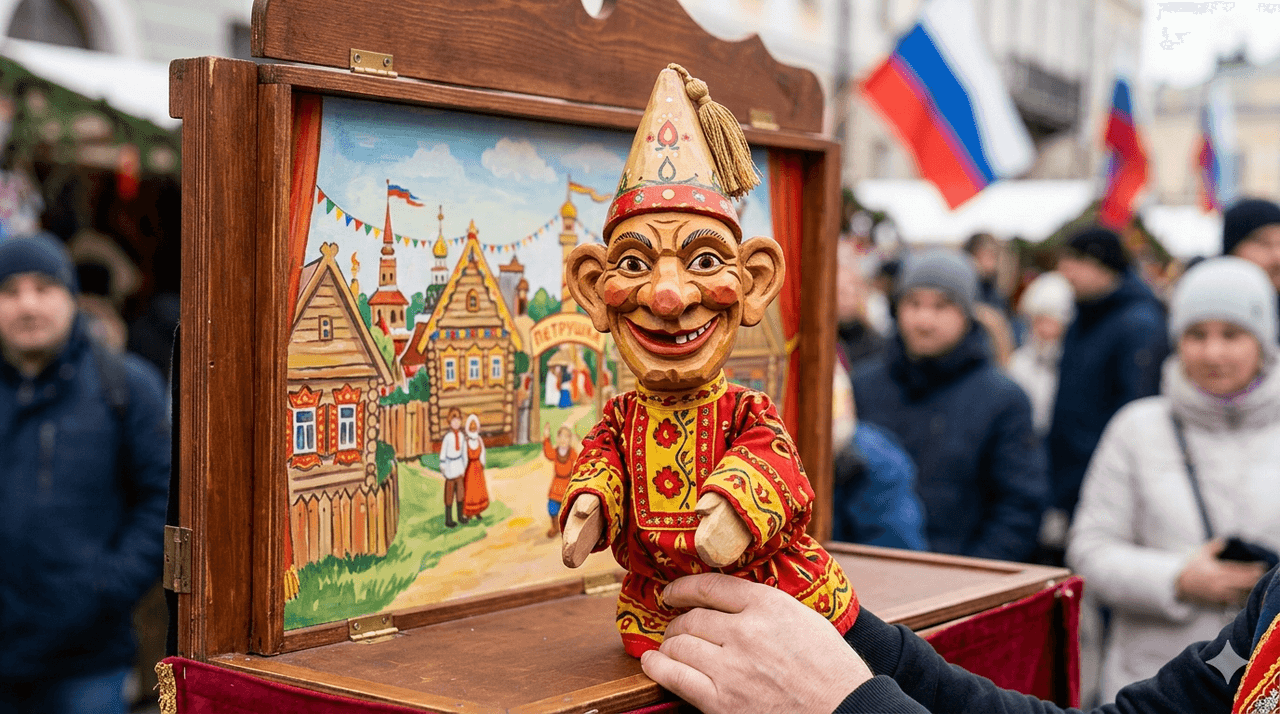
Kukla Petruşka (Yapay Zeka ile Oluşturulmuştur.)
Petruška, is a symbolic character of Russian glove puppet theater, characterized by prominent physical features such as a pumpkin-shaped head, a pointed hat with tassels, large ears, and a prominent nose. Similar puppets appear in other cultures: Pulcinella in Italy, Punch in France and England, Kasper in Germany, Guignol or Keçel Pehlivan in Central Asia, and İbiş in Türkiye, and they continue to live on in puppet theaters today.
The origins of the Russian glove puppet Petruška parallel various European puppet traditions. Performances such as Vertep in Ukraine and Russia, Betleyka in Belarus, and Szopka in Poland share similarities with Kašparek, a character that emerged in Czech theater at the end of the eighteenth century. In Austria and Germany, characters known as Kašperl were long beloved by the public and featured in professional puppet theaters.
The spread of puppet shows in Russia began with Vertep performances, influenced by folk humor. These shows were performed in connection with school and church theater. Puppets were typically mounted on wooden rods or sticks, and the puppeteer operated them from behind a curtain.

Puppet Petruška (Generated by Artificial Intelligence.)
In the first half of the seventeenth century, German diplomat and traveler Adam Olearius, who arrived in Moscow, recorded Russian puppet shows through sketches and notes. According to Olearius, puppet comedians wore bear or clown costumes and enacted religious themes.【1】
Skomorokhi, itinerant street artists who acted as musicians, dancers, and singers, entertained urban crowds. These artists staged Petruška performances in the form of theater, creating scenes featuring four main characters and dancing musicians. Some performances were condemned by the church on grounds of moral impropriety, but later gained popularity.
In the nineteenth century, Petruška performances split into two main branches: technically complex tuluat theater and folk-based daily theater. In tuluat theater, puppets depicted extraordinary events and exotic characters, while daily theater presented simple, repetitive plots that appealed to the public.

Petruška Ballet (Picryl)
The historical and folkloric background of the traditional Russian glove puppet Petruška served as inspiration for a major artistic work that emerged in the early twentieth century. In 1911, Igor Stravinsky composed the Petruška Ballet, staged by Sergei Diaghilev’s Ballets Russes company, which fused the crude outlines and tragicomic spirit of the street puppet with high art.
In the ballet, the traditional glove puppet’s physical structure—pumpkin head, drooping arms, and tasseled hat—was translated into the dancers’ movements by choreographer Michel Fokine. Ballerinas and dancers embodied the mechanical yet emotionally rich drama of a puppet, transforming this ancient figure from folk theater into a symbol of modernism. Thus, the traveling “Petruška” of fairs became the hero of a universal tragedy, where music and dance intertwine, spanning from the winter atmosphere of St. Petersburg to the stages of Paris.
Petruška performances typically consist of a collapsible curtain, a few puppets, a lantern or violin, the puppeteer, and an assistant musician. These shows traveled from town to town, reaching diverse segments of the public.
The protagonist Petruška enters the stage wearing a red shirt, plush trousers, elegant boots, and a hat. In some variants, he has two humps on his back. The performances include improvisational elements. Scenes include Petruška’s entrance, the arrival of his intended bride, the purchase of a horse, falling ill and recovering, receiving military training, and the final scene. In the finale, Petruška is typically pulled under the curtain by a dog or household spirit, symbolically dying and then reviving. This structure emphasizes the character’s cheerful, combative, and audience-oriented nature.
Musicians do not merely accompany the performance with music; they often assume the role of Petruška’s conversational partner. Performances are enriched by pantomime and the inclusion of puppets from different cultures. The audience spontaneously participates, and their reactions influence the flow of the performance.

Theater Petruška (Generated by Artificial Intelligence.)
Petruška performances are closely linked to the Maslenitsa carnival and fair atmosphere. Fair stalls, merry-go-rounds, masked performers, and puppets bring this festive energy to the stage. The puppet’s drooping, loose form symbolizes the farewell to winter and the revival of spring. The motifs of death and rebirth on stage reflect Slavic beliefs in the soul’s existence independent of the body.
Petruška performances incorporate elements of demonism, witchcraft, and magic. In stage designs, witches and demons move beneath a night-blue sky. The figure of Baba Yaga, representing both malevolent and benevolent traits in Slavic mythology, adds grotesque and humorous qualities to the performances while bringing folk beliefs to life.
[1]
Esra Elmacıoğlu, “Rus Kuklası Petruška,” In Rus Tiyatrosu Gelenekselden Moderne, Edited by Gamze Öksüz, p. 163. https://www.academia.edu/34806213/RUS_EL_KUKLASI_PETRU%C5%9EKA

Kukla Petruşka (Yapay Zeka ile Oluşturulmuştur.)
Historical Origins and Development
Petruška: From Fair Booth to Modern Ballet Stage
Structure of the Performance and Characters
Petruška and Fair Culture
Supernatural and Mythological Elements