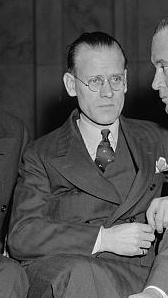



Philo Taylor Farnsworth (August 19, 1906, Beaver, Utah, USA – March 11, 1971, Salt Lake City, Utah, USA) was an American inventor and pioneer of telecommunications. He is best known for inventing the world’s first fully electronic television system and is therefore regarded as one of the “fathers of television.” Throughout his life, he obtained more than 300 U.S. and foreign patent for electronic and mechanical devices.
Philo Taylor Farnsworth was born on August 19, 1906, in a log cabin in Beaver City, Utah, built by his grandfather, Mormon leader Brigham Young. From an early age, he developed a passion for science and read Popular Science magazine and science books. His primary interests included molecular theory and motors. He was also intrigued by new devices popular in the 1920s such as the Bell telephone, Edison gramophone, and Nipkow disk-based mechanical television.
When he was twelve years old, his family moved to a farm near Rigby, Idaho, and his first encounter with electricity there became a turning point. Driven by curiosity about electricity, by the time he reached high school he had successfully modified most of the household electrical appliances to operate on electric power. Even while in high school, he conducted advanced studies on topics such as the molecular theory of matter, electrons, and Einstein’s theories.
At the age of fifteen in 1922, Farnsworth conceived the idea for a fully electronic television system after recognizing the limitations of existing mechanical systems. He sketched for his high school chemistry teacher the concept of a “Image Dissector” vacuum tube that would convert images into electrical signals by controlling the speed and direction of fast-moving electrons. This drawing later served as critical evidence in his patent dispute with RCA, proving he was the original inventor of the idea.
In 1924, he enrolled at Brigham Young University but was forced to drop out at the end of his second year after his father’s death, to help support his family. He then established a radio repair business in Salt Lake City. There, while working on donation campaigns, he met business partners George Everson and Leslie Gorrell, whom he convinced to invest in his vision of electronic television. With this financial backing, Farnsworth took his first step toward realizing his invention by establishing his own research laboratory in San Francisco in 1926.
At the age of fifteen, Philo Taylor Farnsworth designed the world’s first fully electronic television system to overcome the limitations of the mechanical television systems of his time. In those years, mechanical scanning television systems, such as those used by John Logie Baird, relied on rotating perforated disks (Nipkow disks) and were severely limited in image transmission speed and resolution, producing small and flickering images on screens.
Farnsworth’s insight came to him at age fourteen while plowing a field on the farm: just as the furrows created by plowing formed orderly rows, he realized that an image could be transmitted by scanning it with a stream of electrons arranged in horizontal lines. This concept envisioned completely electronic image scanning using an electron beam instead of mechanical parts.
To bring this vision to life, in 1922 he drew for his high school chemistry teacher Justin Tolman a schematic of a camera tube called the “Image Dissector” that would convert optical images into patterns of electrical charges. In 1926, with financial support from investors George Everson and Leslie Gorrell, Farnsworth began working at the Crocker Research Laboratories in San Francisco.
The historic milestone occurred on September 7, 1927. At the age of twenty-one, Farnsworth successfully produced the world’s first fully electronic television image using two key electronic components: the “Image Dissector” (camera tube) and the “Oscillite” (picture tube). Initially, the system could only transmit simple shapes, but Farnsworth continued refining it to achieve sharper images.
In 1930, he received a patent for the fully electronic television system. That same year, Vladimir Zworykin, head of RCA’s television project, visited Farnsworth’s laboratory. Although Zworykin had developed his own “Iconoscope,” Farnsworth’s Image Dissector proved more effective. RCA’s president David Sarnoff immediately recognized the technology’s potential and offered $100,000 to purchase all of Farnsworth’s patents, but Farnsworth rejected the offer.
This refusal led RCA to file a patent infringement lawsuit against Farnsworth in 1932, claiming his patent violated Zworykin’s earlier application. However, Farnsworth won the case in 1935 by presenting as evidence the original 1922 schematic drawn by his high school teacher, Justin Tolman. Although RCA lost the patent battle, it recognized the future of Farnsworth’s technology and, contrary to its corporate policy, agreed in 1939 to pay him royalties for television patents covering scanning, focusing, synchronization, contrast, controls, and power. This agreement provided Farnsworth with approximately one million dollars in income.

George Everson, Richard C. Patterson and Philo Taylor Farnsworth (center) (Library of Congress)
Philo Taylor Farnsworth’s inventions extended beyond modern television and paved the way for electronic advancements enabling satellite broadcasts and images transmitted from the Moon. Throughout his life, he obtained more than 300 U.S. and foreign patent for electronic and mechanical devices.
His innovations beyond television include:
Philo Taylor Farnsworth laid the foundations of television and modern electronics but died before completing all his work, on March 11, 1971, due to pneumonia. At the time of his death, he held more than 300 U.S. and foreign patents for electronic and mechanical devices.
Even after his death, Farnsworth was honored nationally for his pivotal role in the development of television:
Knudsen, Bent. "Philo Taylor Farnsworth." Lex.dk. Accessed October 19, 2025. https://lex.dk/Philo_Taylor_Farnsworth
Lemelson-MIT. “Philo Farnsworth.” Lemelson-MIT. Accessed October 19, 2025. https://lemelson.mit.edu/resources/philo-farnsworth
Library of Congress. "Television Inventor Tells Economic Committee of Difficulties in Getting Patents JPG." Accessed October 19, 2025. https://www.loc.gov/pictures/resource/hec.25858/
Linda Hall Library. “Philo Farnsworth.” *Linda Hall Library*. Accessed October 19, 2025. https://www.lindahall.org/about/news/scientist-of-the-day/philo-farnsworth/
Louisiana Tech University. "Philo Farnsworth." *Louisiana Tech University Journal of Engineering Sciences*. Accessed October 19, 2025. https://digitalcommons.latech.edu/cgi/viewcontent.cgi?article=1011&context=engineering-science-magazine
National Inventors Hall of Fame. “Philo Taylor Farnsworth.” *National Inventors Hall of Fame*. Accessed October 19, 2025. https://www.invent.org/inductees/philo-taylor-farnsworth

Early Life and Education
Philo Taylor Farnsworth and the Invention of Electronic Television
Other Inventions and Later Work
Death and Legacy