

This article was automatically translated from the original Turkish version.
+1 More
Location | Göreme Türkiye Nevşehir | ||||||||
|---|---|---|---|---|---|---|---|---|---|
Length(s) | Approximately 4 km | ||||||||
Historical Function | Agricultural fertilizer production since the 19th century | ||||||||
Geomorphology | Fairy chimneys formed from tuff rock and arid climate vegetation | ||||||||
Protection Status | Located within Göreme National Park and listed on the UNESCO World Heritage List | ||||||||
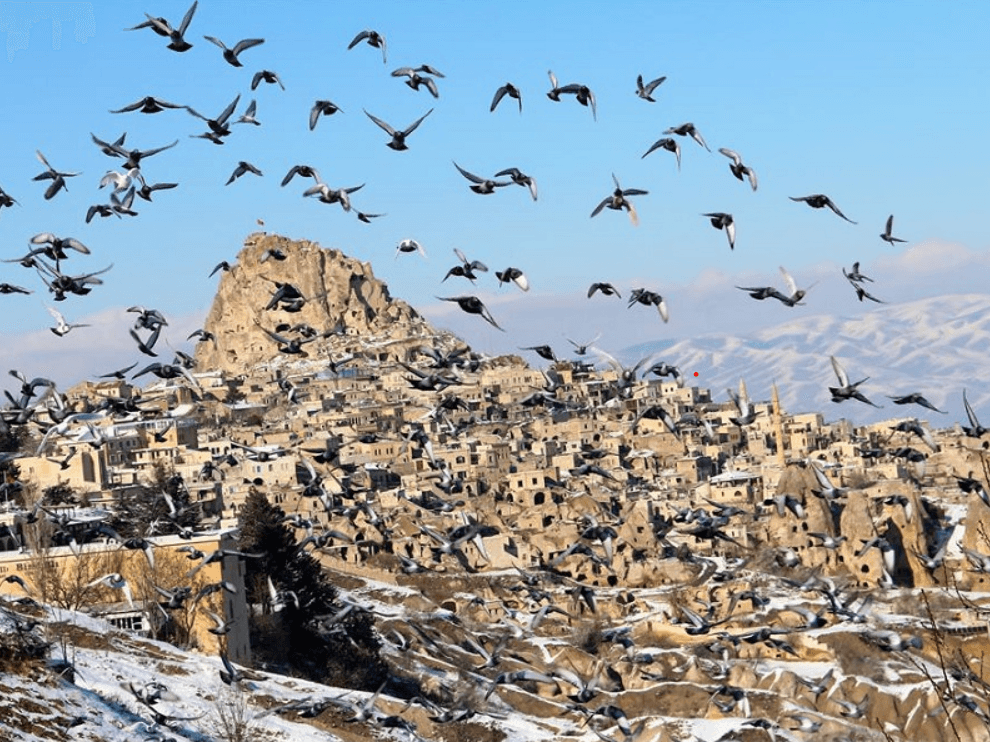
Güvercinlik Vadisi is a natural valley approximately 4 kilometers long, stretching between the towns of Göreme and Uçhisar in Nevşehir province, Türkiye. The valley derives its name from the hundreds of rock-carved pigeonhouses (pigeonhouse) found within it.
The pigeonhouses in the valley were specifically designed by the local population from the 19th century onward for use in organic farming practices. Pigeon droppings, due to their high nitrogen content, served as a fertile fertilizer for grapevines and cereal fields. Consequently, these pigeonhouses functioned not only as architectural structures but also as systems that ensured the sustainability of agricultural production.
Some of the pigeonhouses feature frescoes adorned with Christian iconography, demonstrating that the valley served not only an economic but also a religious and cultural function. Additionally, the internal designs of these niches were planned with symmetrical compartments to facilitate the nesting and breeding of pigeons.

Güvercinlik Vadisi (Nevşehir Governorate)
Güvercinlik Vadisi reflects the typical geomorphological and biological diversity of Cappadocia, characterized by fairy chimneys, soft tuff rock formations, and arid-climate vegetation. The bird species inhabiting the valley, particularly pigeons, constitute an essential component of the local ecosystem. At the same time, tourists walking through the valley enjoy a rich ecotourism experience, accompanied by rock churches, pigeonhouses, and natural formations.
Güvercinlik Vadisi lies within the boundaries of Göreme National Park and is protected under the UNESCO World Heritage List. Traditional structures in the valley are being restored, particularly to prevent damage, and are presented to visitors in harmony with nature. Furthermore, the surrounding area is managed under sustainable tourism policies that support nature walks, photography, and cultural exploration.
Nevşehir Hacı Bektaş Veli Üniversitesi. "Kapadokya’da Kaya Oyma Güvercinliklerin Mimari Özellikleri." Master's thesis, 2021. Accessed June 14, 2025.
Nevşehir Valiliği. "Güvercinlik Vadisi." Accessed June 14, 2025.
UNESCO World Heritage Centre. "Göreme National Park and the Rock Sites of Cappadocia." Accessed June 14, 2025.

Location | Göreme Türkiye Nevşehir | ||||||||
|---|---|---|---|---|---|---|---|---|---|
Length(s) | Approximately 4 km | ||||||||
Historical Function | Agricultural fertilizer production since the 19th century | ||||||||
Geomorphology | Fairy chimneys formed from tuff rock and arid climate vegetation | ||||||||
Protection Status | Located within Göreme National Park and listed on the UNESCO World Heritage List | ||||||||
Historical and Cultural Significance
Natural Structure and Ecosystem
Conservation and Current Status