

This article was automatically translated from the original Turkish version.
+1 More
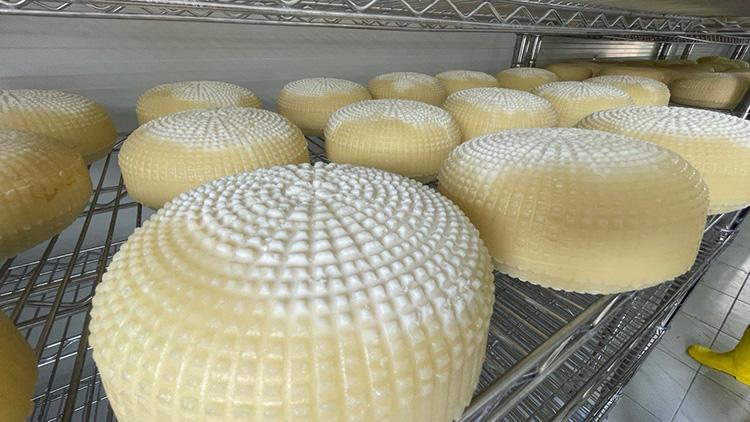
Pınarbaşı Uzunyayla Çerkes Peyniri is a traditional semi-hard cheese with long shelf life, produced in the geographical region of the Uzunyayla plateau, which belongs to the Pınarbaşı district of Kayseri, using full-fat cow or sheep milk. It was officially registered as a geographical indication by the Turkish Patent and Trademark Office on 14 April 2021.

Pınarbaşı Uzunyayla Çerkes Peyniri (Anadolu Agency)
This cheese was first produced by Circassians (Adiges; Kabarday, Hatkoy, Abzah) who migrated from the Caucasus after 1850 and has preserved its authenticity to the present day through adaptation to the region’s geographic conditions since 1864. The Uzunyayla plateau is a vast, elongated, and flat highland area extending from Pınarbaşı district in Kayseri to villages and neighborhoods in Kangal and Şarkışla districts of Sivas. This region lies at the intersection of Eastern Anatolia and Central Anatolia. In the Circassian language, this cheese variety is called only “Koypıtlıj” (red cheese) in Uzunyayla, while Circassians living in the rest of Türkiye and the Adyghe Republic refer to similar cheeses as “Adige Koaye” (Circassian cheese) or “Mate Koaye” (basket cheese). Due to the high altitude of the Uzunyayla plateau, significant temperature differences between day and night, and the absence of trees, the local population has traditionally matured and stored their cheeses not by processing but by placing them in areas of their homes exposed to the northeastern (Poyraz) wind. This method ensured long-term preservation and became one of the distinguishing features of Pınarbaşı Uzunyayla Çerkes Peyniri compared to other Circassian cheeses produced elsewhere.

Cheese Salting Stage (Anadolu Agency)
Pınarbaşı Uzunyayla Çerkes Peyniri is produced using traditional methods in villages and highland pastures of the Uzunyayla plateau, from the full-fat milk of sheep or cows grazing freely on open meadows (cow and sheep milk are never mixed). Production begins in April and May and continues until November.
The main production stages are as follows:
After this 15-day pre-drying period, the cheese may be consumed fresh. For long-term storage, it can be wrapped in cloth or vacuum-packed and stored at +4°C for up to six months to one year.

Production Stage (Anadolu Agency)
The factors that distinguish Pınarbaşı Uzunyayla Çerkes Peyniri from other Circassian cheeses are:
The chemical properties of Pınarbaşı Uzunyayla Çerkes Peyniri, based on analyzed samples, are presented as average ranges:
Studies have shown differences in dry matter, salt, fat, total nitrogen, protein content, pH, and lactic acid percentage between fresh (day 1) and ripened (day 30) cheeses, with higher values observed in ripened cheeses. The primary reason for these variations is the absence of a standardized production process in Circassian cheese making. The ripening index (Soluble Nitrogen/Total Nitrogen ratio) remains a key criterion for evaluating the degree of ripeness.
Monitoring of Pınarbaşı Uzunyayla Çerkes Peyniri is conducted regularly (April–October) by a supervisory body composed of Pınarbaşı Municipality, Pınarbaşı District Directorate of Agriculture and Forestry, Pınarbaşı Chamber of Agriculture, Pınarbaşı Chamber of Trades and Crafts, and the United Caucasus Association, under the coordination of Pınarbaşı Municipality. Monitoring includes compliance with geographic sourcing of milk, ripening stage, sensory characteristics (color and taste), production method, storage conditions, and proper use of the geographical indication.
Anadolu Ajansı. "Tescilli Çerkez Peyniri, Kalkınma Ajansı Desteğiyle Kurulan Tesiste Üretiliyor." Accessed October 13, 2025. https://www.aa.com.tr/tr/ekonomi/tescilli-cerkez-peyniri-kalkinma-ajansi-destegiyle-kurulan-tesiste-uretiliyor/2901871.
Turk Patent and Trademark Office. "Pınarbaşı Uzunyayla Çerkes Peyniri." Geographical Indications. Accessed October 13, 2025. https://ci.turkpatent.gov.tr/cografi-isaretler/detay/1636.
Turkish Patent and Trademark Office. "Geographical Indication Registration Certificate (Pınarbaşı Uzunyayla Çerkes Peyniri)." Registration No: 724. Accessed October 13, 2025. https://ci.turkpatent.gov.tr/Files/GeographicalSigns/10e6332b-e30f-4dd1-aa9d-64313b3f0841.pdf.
Yerlikaya, Oktay, Cesur Mehenktaş, Ecem Akan, and Prof. Dr. Harun Raşit Uysal. “Pınarbaşı Uzunyayla Bölgesi Çerkes Peynirlerinin Bazı Fizikokimyasal ve Duyusal Özellikleri Üzerine Bir Araştırma.” Adnan Menderes Üniversitesi Ziraat Fakültesi Dergisi 20, no. 1 (June 2023): 43–53. https://dergipark.org.tr/tr/download/article-file/2688718

No Discussion Added Yet
Start discussion for "Pınarbaşı Uzunyayla Circassian Cheese" article
History and Geographic Location
Production Method
Distinguishing Characteristics
Physical, Sensory, and Chemical Properties
Physical and Sensory Properties
Chemical Properties
Monitoring