


This article was automatically translated from the original Turkish version.
+1 More
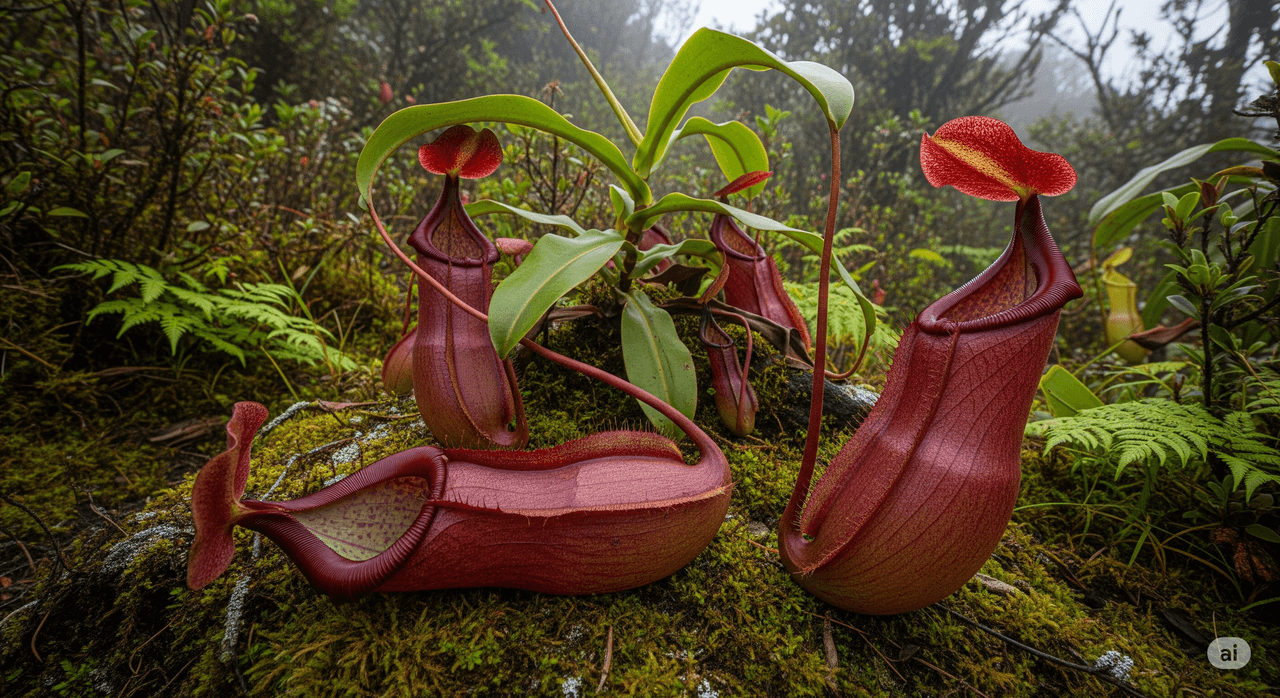
Nepenthes Rajah
Scientific Name(s) | Nepenthes | ||||||||
|---|---|---|---|---|---|---|---|---|---|
Family | Nepenthaceae | ||||||||
Region(s) | Borneo | ||||||||
Habitat | Mountainous | ||||||||
Food | Insect | ||||||||
Trap | Pitfall | ||||||||
Mutualist | Tupaia | ||||||||
Conservation | Danger | ||||||||
Taxonomist | Hooker | ||||||||
Year of Discovery | 1859 | ||||||||
Nepenthes rajah is a carnivorous plant belonging to the Nepenthaceae family and is endemic to the island of Borneo, possessing some of the largest pitcher traps in the world. It typically grows in a limited area in northern Borneo, especially on Mount Kinabalu and Mount Tambuyukon in the state of Sabah. It thrives in moist, high-altitude soils, often composed of serpentine substrates. The species was discovered in 1858 by Hugh Low and Spenser St. John and scientifically described by Joseph Dalton Hooker in 1859. The Latin specific epithet rajah, meaning "king", refers to the plant’s large size. According to the IUCN Red List, it is classified as "Endangered".
Nepenthes rajah is a climbing plant with a relatively thick stem and spiral arrangement of leaves. It typically grows close to the ground but can reach heights of up to 6 meters. The leaves are usually thick and leathery, lance-shaped, and measure 30–80 cm in length. The most distinctive feature of the species is the pitcher traps formed at the tip of a descending tendril extending from each leaf.
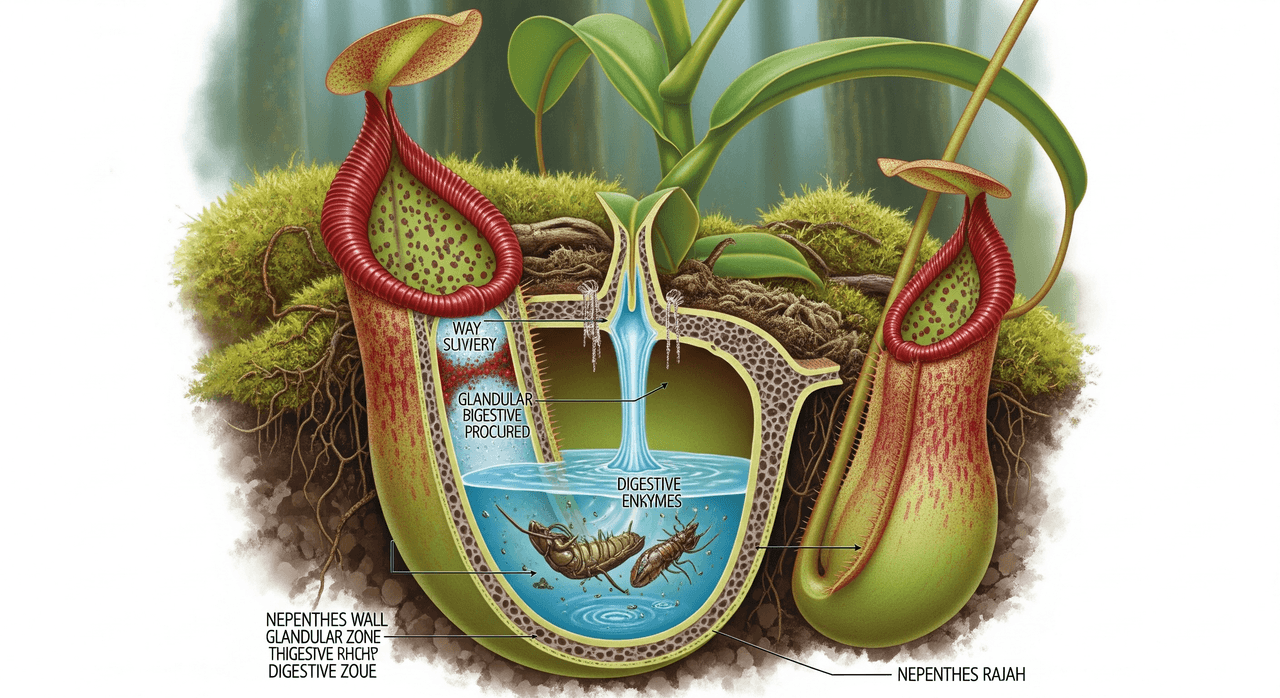
Internal Structure (Generated by Artificial Intelligence)
The pitcher traps of this species are among the largest in the world. Each can reach up to 35 cm in length, hold up to 3.5 liters of liquid, and contain as much as 150 ml of digestive fluid. These traps typically form near ground level and function as lethal traps for insects and small animals through a combination of internally secreted fluid and a slippery inner surface. The broad, glossy, waxy rim at the top prevents prey from escaping.
Nepenthes rajah is a carnivorous plant that operates via a passive trapping system. The pitcher fluid contains protein-digesting enzymes and bacteria. Although the plant primarily captures insects, especially ants and flies, documented cases also include digestion of frogs, bird chicks, and even rodents. However, such larger prey are exceptional and do not play a significant role in the plant’s ecology.
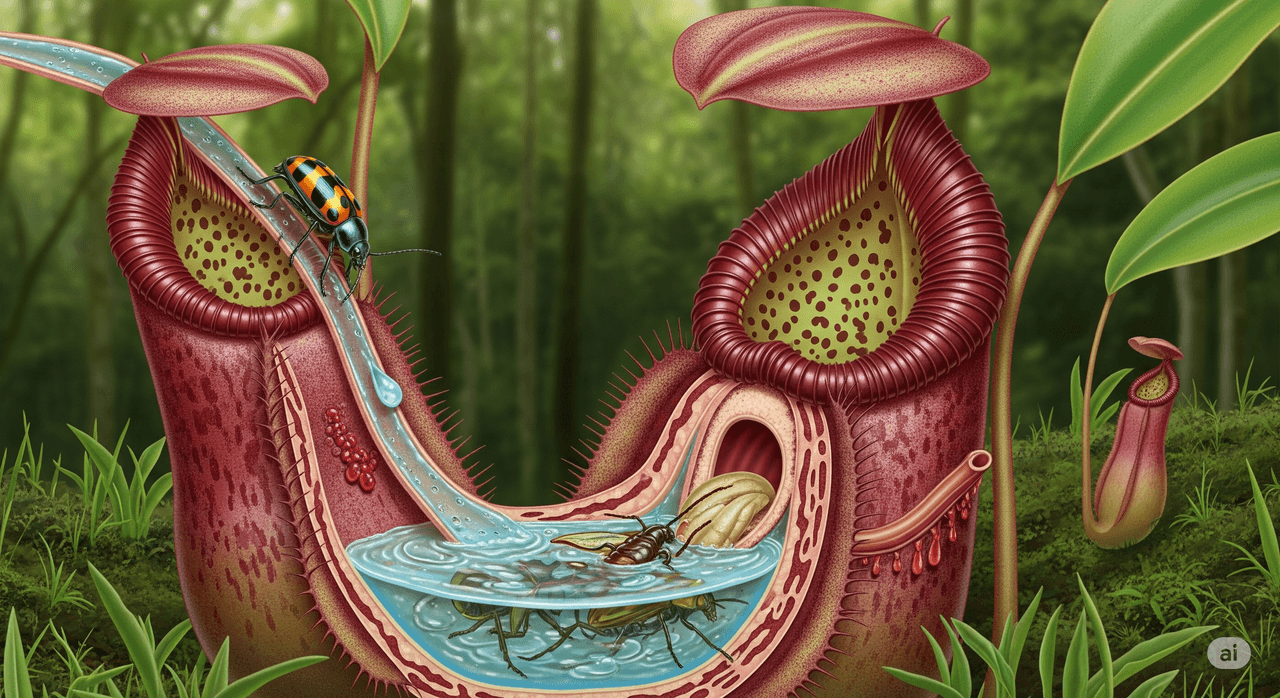
Digestive System and Hunting Strategy (Generated by Artificial Intelligence)
Nepenthes rajah grows at elevations between 1500 and 2650 meters on the island of Borneo, particularly around Mount Kinabalu. The soils in this region are typically serpentine and rich in heavy metals. Soil pH is very low and nutrient content is poor. These conditions have driven the evolution of Nepenthes rajah’s carnivorous lifestyle.
The plant inhabits a tropical montane climate characterized by consistent rainfall throughout the year and large daily temperature fluctuations. Its habitat is often shrouded in dense morning mist and exhibits very high humidity levels, reaching up to 90%. This cool, moist climate helps the plant maintain water balance and ensures the stability of its digestive fluid.
Nepenthes rajah occurs naturally only in a narrow geographic range on Mount Kinabalu and Mount Tambuyukon. As such, it is considered highly endemic from a biogeographical perspective. Its restricted distribution increases its vulnerability and exposes it to environmental threats.
The pitcher traps of Nepenthes rajah serve not only to capture prey but also foster mutualistic relationships with certain invertebrate and vertebrate species. For example, some mosquito larvae develop within the pitcher fluid, while species such as Tupaia montana (the mountain treeshrew) feed on nectar secreted at the pitcher rim and defecate into the trap. This fecal matter serves as an additional nutrient source for the plant. Such mutualistic interactions illustrate the complex role of Nepenthes rajah within its trophic network.
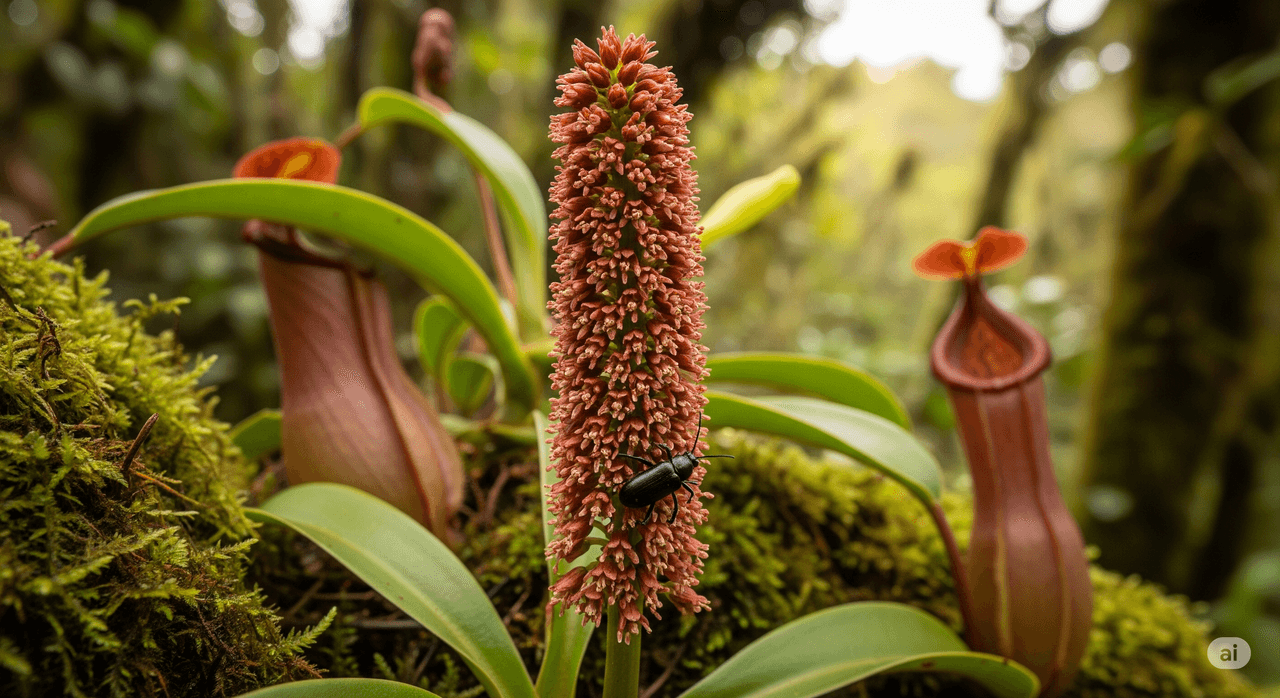
Reproduction and Flowering (Generated by Artificial Intelligence)
Amorphophallus Brachyphyllus Hett. (n.d.). Accessed May 22, 2025. https://www.gbif.org/species/2871625.
Biswal, D. K., Debnath, M., Konhar, R., Yanthan, S., & Tandon, P. (2018). Phylogeny and biogeography of carnivorous plant family Nepenthaceae with reference to the Indian pitcher plant Nepenthes Khasiana reveals an Indian subcontinent origin of nepenthes colonization in South East Asia during the Miocene epoch. Frontiers in Ecology and Evolution, 6. Accessed May 22, 2025. https://doi.org/10.3389/fevo.2018.00108.
Nepenthes of Borneo - Natural History Publications (Borneo). Accessed May 22, 2025. https://www.nhpborneo.com/Nepenthes-of-Borneo.
Redfern Natural History. *Field Guide to the Pitcher Plants of Borneo*. Accessed May 22, 2025. https://www.redfernnaturalhistory.com/product/field-guide-to-the-pitcher-plants-of-borneo.
Robinson, A. S., Fleischmann, A. S., McPherson, S. R., Heinrich, V. B., Gironella, E. P., & Peña, C. Q. (2009). A spectacular new species of Nepenthes L. (Nepenthaceae) pitcher plant from central Palawan, Philippines. Botanical Journal of the Linnean Society, 159(2), 195–202. Accessed May 22, 2025. https://doi.org/10.1111/j.1095-8339.2008.00942.x.

Nepenthes Rajah
Scientific Name(s) | Nepenthes | ||||||||
|---|---|---|---|---|---|---|---|---|---|
Family | Nepenthaceae | ||||||||
Region(s) | Borneo | ||||||||
Habitat | Mountainous | ||||||||
Food | Insect | ||||||||
Trap | Pitfall | ||||||||
Mutualist | Tupaia | ||||||||
Conservation | Danger | ||||||||
Taxonomist | Hooker | ||||||||
Year of Discovery | 1859 | ||||||||
No Discussion Added Yet
Start discussion for "Pitcher Plant (Nepenthes rajah)" article
Morphological Characteristics
General Structure
Pitcher Traps
Digestive System and Hunting Strategy
Ecological Characteristics and Habitat
Habitat Conditions
Climate and Microclimate
Endemism and Distribution
Ecological Interactions