


This article was automatically translated from the original Turkish version.
+2 More
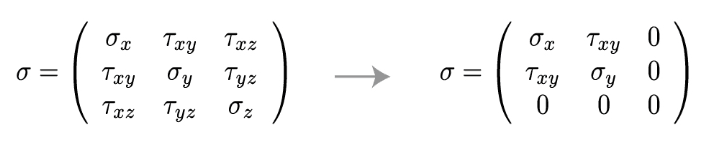
Plane stress describes the condition in which stresses are zero along one plane of the material. This situation typically applies to thin plates. Because the thickness direction of the material is much small compared to other directions, no significant stress develops in this direction and it is assumed to be zero (σz = σxz = σyz = 0). Thus, only the stresses in the x and y directions (σx, σy, τxy) are considered. only
In theoretical and numerical calculations, an increase in the number of equations leads to longer computation times. When plane stress is assumed, the dimensions of the stress tensor and matrix are reduced. Normally, the stress state is represented by a three-dimensional matrix (3x3) matrix, but under the plane stress assumption, it becomes a two-dimensional matrix (2x2). This reduces the number of equations in the problem and shortens the solution time.

【1】
【2】
Boston University. "Mechanics of Materials: Stress Transformation." Accessed October 19, 2023. https://www.bu.edu/moss/mechanics-of-materials-stress-transformation/.
Madier, Dominique. Practical Finite Element Analysis for Mechanical Engineers. 2021.
Meyers, Marc A., and Krishan K. Chawla. Mechanical Behavior of Materials. Upper Saddle River, NJ: Prentice Hall, 1999.
[1]
Mechanics of Materials: Stress Transformation. Boston University. Accessed October 19, 2023. https://www.bu.edu/moss/mechanics-of-materials-stress-transformation/.
[2]
Mechanics of Materials: Stress Transformation. Boston University. Accessed October 19, 2023. https://www.bu.edu/moss/mechanics-of-materials-stress-transformation/.

Importance of Plane Stress
Applications
Thin Plates and Sheets
Surface Structures
Aerospace and Automotive Industries
Composite Materials