This article was automatically translated from the original Turkish version.
+2 More
Registration Number | 1390 | ||||||||
|---|---|---|---|---|---|---|---|---|---|
Registration Date | 19.06.2023 | ||||||||
Application Number | C2022/000307 | ||||||||
Application Date | 22.09.2022 | ||||||||
Name of the Geographical Indication | Polat Kınalı Ekmek | ||||||||
Product / Product Group(s) | Bread / Bakery and Confectionery Products Desserts Dough Products | ||||||||
Type of Geographical Indication | Certification Mark | ||||||||
Applicant/Registrant(s) | Malatya Industry and Technology Provincial Directorate | ||||||||
Address of the Registrant | Vilayet Building 1 Yeşilyurt MALATYA | ||||||||
Geographical Boundary | Polat Neighborhood Malatya Province Doğanşehir District | ||||||||
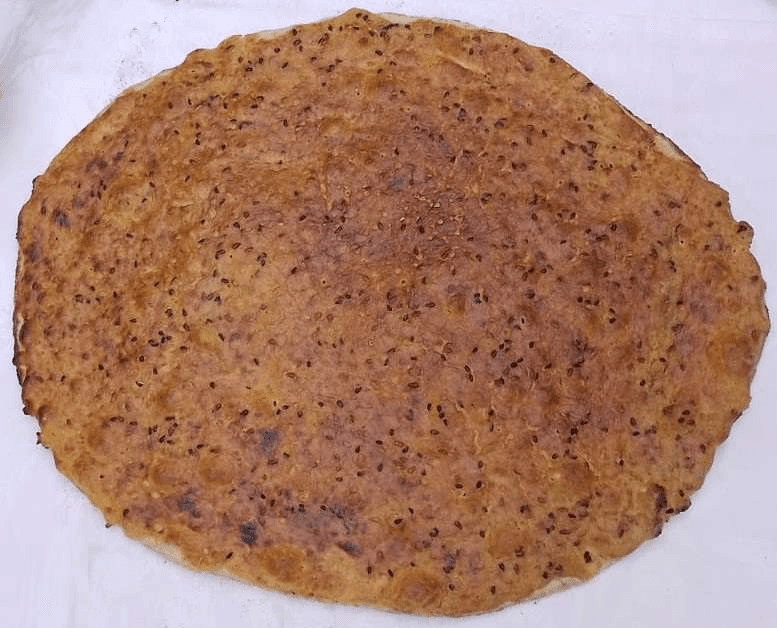
Polat Kınalı Ekmek is a traditional bread unique to Polat Village in the Doğanşehir district of Malatya Province, made from a dough prepared with whole wheat flour, water, salt, and yeast. The dough is rolled out thinly and coated on its surface with a mixture known locally as “kınalı harç,” composed of milk, egg, butter, anise seed, sesame, sodium bicarbonate, and whole wheat flour. Due to the presence of sodium bicarbonate, the upper surface of the bread turns a distinctive reddish-brown color resembling henna. The bottom of the bread is baked on a metal griddle, while the top is cooked on a flat stone known locally as “süğe taşı.” The product measures approximately 25–30 cm in diameter and 0.4–0.5 cm in thickness and holds a geographical indication registration; all stages of its production take place exclusively within Polat Village.
Polat Kınalı Ekmek is produced by rolling out a dough made primarily from whole wheat flour, water, salt, and yeast to a diameter of 25–30 cm. The dough has a thickness of 0.4–0.5 cm and a weight ranging between 170 and 175 grams. The bread’s defining feature is the surface coating known locally as “kınalı harç,” which, due to its sodium bicarbonate content, causes the upper surface to develop a pronounced reddish-brown hue reminiscent of henna.
The bread undergoes a two-stage baking process. First, the underside is baked on a metal griddle heated by burning wood—typically pine, oak, or apricot wood. Subsequently, the bread is transferred onto a flat stone called “süğe taşı,” positioned opposite the fire, where the coated upper surface is baked. Traditionally, these stones were carved from black stones brought from nearby mountains; today, they are manufactured from food-safe materials.
Polat Kınalı Ekmek has a long-standing tradition within the culinary culture of Polat Village and is consumed at every meal of the day, particularly during morning breakfasts. In this regard, the product is intrinsically linked to its geographical origin.
All whole wheat flour used in the production of Polat Kınalı Ekmek is sourced exclusively from within the geographical boundary of Polat Village. The production process consists of the following stages:
The ingredients required to produce 25 loaves of Polat Kınalı Ekmek are as follows:
These ingredients are mixed in a container to form a soft dough. The prepared dough is then covered with a food-safe cloth or tray known locally as “hıla” and left to ferment for 7–8 hours.
The kınalı harç applied to the surface of the bread is prepared using the following ingredients:
The harç is prepared by mixing the other ingredients into melted butter at room temperature, then allowing the mixture to rest for 30 minutes before use.
Portions of the fermented dough weighing 170–175 grams are cut and flattened on a bread board using a rolling pin, then further extended with a rolling pin to achieve a diameter of 25–30 cm and a thickness of 0.4–0.5 cm. A 70–75 gram portion of kınalı harç is spread evenly over the dough, and a pattern is created using a fork.
The baking process occurs in two stages:
Once baked, the bread is removed from the süğe taşı and left to cool. It is then packaged in food-safe materials for market distribution. The product can be stored for up to one week in a cool environment and is recommended to be reheated before consumption.
Due to the historical significance of Polat Kınalı Ekmek and its integral role in the culinary heritage of Polat Village, the whole wheat flour used in its production must be sourced exclusively from within the geographical boundary of Polat Village. All stages of production must be carried out solely within Polat Village, Doğanşehir District, Malatya Province.
Production, processing, and packaging of Polat Kınalı Ekmek are regularly monitored under its geographical indication protection. Monitoring activities are coordinated by the Malatya Directorate of Industry and Technology and conducted by a three-member inspection body:
This inspection body conducts at least one routine inspection per year. Additional inspections may be carried out in response to complaints or specific needs. Key criteria for inspection include:
The inspection body may utilize experts from public institutions or private organizations, or procure services from them as needed. The responsibility for initiating and conducting any necessary legal procedures to protect the geographical indication rights of the product lies with the registering authority.
Turk Patent and Trademark Office. "Polat Kınalı Ekmek (PDF)." Accessed July 14, 2025. https://ci.turkpatent.gov.tr/Files/GeographicalSigns/42c8ca25-4e9e-444e-b251-615d548d3176.pdf.
Turk Patent and Trademark Office. "Polat Kınalı Ekmek." Accessed July 14, 2025. https://ci.turkpatent.gov.tr/cografi-isaretler/detay/7563.

Registration Number | 1390 | ||||||||
|---|---|---|---|---|---|---|---|---|---|
Registration Date | 19.06.2023 | ||||||||
Application Number | C2022/000307 | ||||||||
Application Date | 22.09.2022 | ||||||||
Name of the Geographical Indication | Polat Kınalı Ekmek | ||||||||
Product / Product Group(s) | Bread / Bakery and Confectionery Products Desserts Dough Products | ||||||||
Type of Geographical Indication | Certification Mark | ||||||||
Applicant/Registrant(s) | Malatya Industry and Technology Provincial Directorate | ||||||||
Address of the Registrant | Vilayet Building 1 Yeşilyurt MALATYA | ||||||||
Geographical Boundary | Polat Neighborhood Malatya Province Doğanşehir District | ||||||||
Distinguishing Characteristics
Recipe/Production Method
Dough Preparation
Kınalı Harç Preparation
Shaping and Baking
Requirement for Production Within the Geographical Boundary
Monitoring