This article was automatically translated from the original Turkish version.
+1 More
Constellation | Ursa Minor | ||||||||
|---|---|---|---|---|---|---|---|---|---|
Type(s) | Super Giant Cepheid Variable Star | ||||||||
Distance(s) | Approximately 433 light years | ||||||||
Brightness | About 2,500 times that of the Sun | ||||||||
Mass | About 5 times that of the Sun | ||||||||
The star known as the North Star, Polaris, is a bright star located very close to Earth’s north celestial pole, causing it to appear nearly stationary in the night sky. At a distance of approximately 433 light years, this star is one of the most reliable indicators for determining direction in the northern hemisphere. Because Polaris lies almost directly along Earth’s rotational axis, its position in the sky remains unchanged throughout the year and consistently points north. This characteristic has made it indispensable for sailors, explorers, and astronomers throughout history.
Polaris is a yellow supergiant star of spectral type F7 Ib. It has a mass about five times that of the Sun and a luminosity 2,500 times greater. It is a classical Cepheid variable star, meaning its brightness changes periodically. This variation is used by astronomers as a “standard candle” for measuring cosmic distances. Polaris has a brightness variation period of approximately four days, providing valuable insights into its structure and internal dynamics.
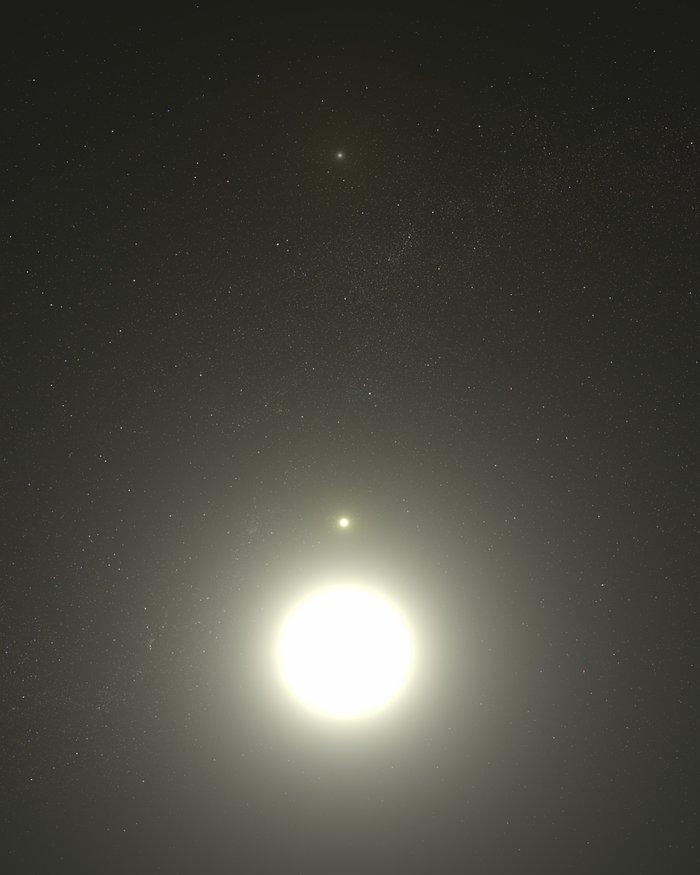
Polaris is not a single star but the central component of a multiple star system. The primary star, Polaris Aa, is accompanied by a much less massive white dwarf companion, Polaris Ab, and a more distant stellar companion, Polaris B. High-resolution observations by the Hubble Space Telescope have revealed the detailed structure of this system. These observations have provided critical data on the stars’ orbits, masses, and mutual interactions.
NASA’s Hubble Space Telescope has examined Polaris and its surrounding stellar system in great detail. These high-resolution observations have yielded comprehensive information about Polaris’s multiple star structure and the interstellar environment around it. The European Space Agency (ESA) has also published images from Hubble, enabling observations of the star’s structure across different wavelengths of light. These data offer significant insights into stellar evolution and the structure of our galaxy.
Polaris’s fixed position in the night sky has been used by various civilizations throughout history for navigation. Sailors and explorers could easily determine north by locating the North Star, especially during nighttime travel. Additionally, in many cultures, the North Star holds mythological meanings and has acquired symbolic importance.
In conclusion, Polaris is a yellow supergiant star with variable brightness, located at the center of a multiple star system and of great importance in both astronomy and culture. Due to its proximity to the celestial north pole relative to our solar system, it appears as a fixed point in the sky and serves as an indispensable guide for navigation.

Hubble Images Polaris’s Companion (ESA Hubble)
ESA Hubble Image Archive, "Polaris," Accessed June 28, 2025. https://esahubble.org/images/opo0602e/?utm_source
Evrim Ağacı. "Kutup Yıldızı Polaris Nedir, Kutup Yıldızı Nasıl Bulunur ve Neden Hep Sabittir?" Accessed June 28, 2025. https://evrimagaci.org/kutup-yildizi-polaris-nedir-kutup-yildizi-nasil-bulunur-ve-neden-hep-sabittir-12958?utm_source
Webtekno. "Kutup Yıldızı Polaris." Accessed June 28, 2025. https://www.webtekno.com/kutup-yildizi-polaris-h108314.html?utm_source

Constellation | Ursa Minor | ||||||||
|---|---|---|---|---|---|---|---|---|---|
Type(s) | Super Giant Cepheid Variable Star | ||||||||
Distance(s) | Approximately 433 light years | ||||||||
Brightness | About 2,500 times that of the Sun | ||||||||
Mass | About 5 times that of the Sun | ||||||||
No Discussion Added Yet
Start discussion for "Pole Star (Polaris)" article
Astronomical Properties
Multiple Star System
Observational Data and Technology
Navigation and Cultural Significance