

This article was automatically translated from the original Turkish version.
Scientific Name(s) | Epipremnum aureum | ||||||||
|---|---|---|---|---|---|---|---|---|---|
Origin(s) | Southeast Asia and New Guinea | ||||||||
Family | Araceae (Arum family) | ||||||||
Plant Type | Climbing-trailing, evergreen indoor ornamental plant | ||||||||
Leaf Characteristics | Heart-shaped, waxy, variegated (in green-white-yellow tones) | ||||||||
Size(s) | Can be maintained at controlled sizes indoors in nature it can grow up to 6–12 meters | ||||||||
Pothos (Epipremnum aureum) is a tropical, multi-purpose climbing vine belonging to the Araceae (arum) family and commonly known as “Devil’s Ivy,” “Golden Pothos,” “Indoor Ivy,” or “Money Plant.” Although it was formerly classified under the name Scindapsus aureus, this designation is now considered a synonym, and the plant is currently classified within the genus Epipremnum. It is widely favored due to its ease of cultivation as an indoor ornamental plant and its low maintenance requirements. Under suitable conditions, it can grow in either trailing or climbing forms.
In addition, its ability to adapt to partial shade and tolerate a wide range of light conditions enables it to be cultivated across a broad geographic range. Evidence suggesting its capacity to filter certain volatile organic compounds from the air highlights that this plant offers not only aesthetic value but also notable environmental benefits.
The natural habitat of this plant is Southeast Asia and New Guinea. In tropical forest understories, it grows in a sprawling form and possesses the ability to climb tree trunks by attaching itself with aerial roots. In such natural environments, it can develop larger leaves. Indoors, with appropriate support, it grows vertically; when suspended, it develops a decorative trailing form.
In its native range, constant temperatures and high humidity throughout the year are the primary environmental factors supporting its growth rhythm. Under these conditions, photosynthetic efficiency increases and internode spacing becomes significantly elongated. However, outside its natural habitat, these developmental traits are often limited; leaf size, color intensity, and overall growth rate vary depending on environmental conditions.
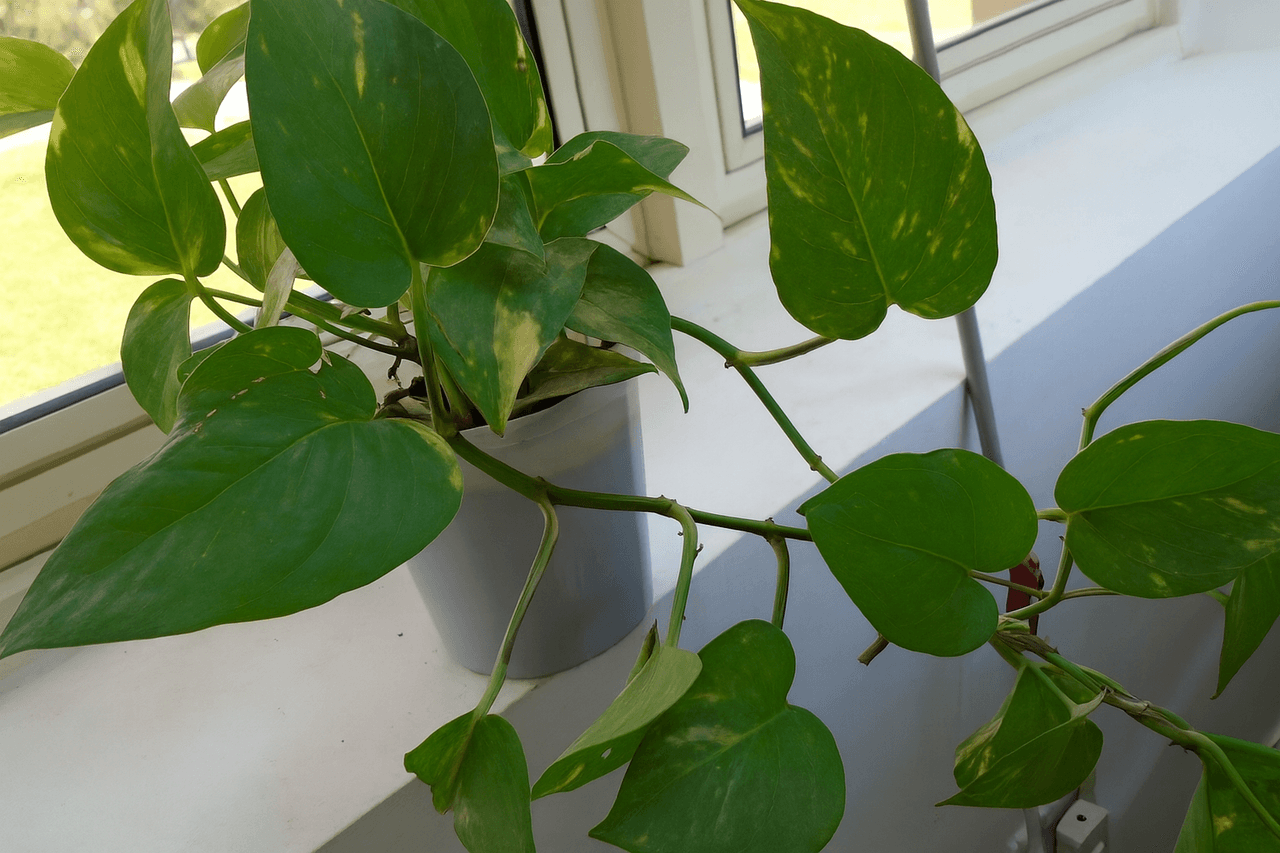
Pothos is characterized by heart-shaped, waxy leaves often displaying variegated patterns. Leaf colors may range from light green to yellow and white. The extent and density of variegation vary according to light exposure: in bright conditions, leaf patterns become more pronounced, while in low light, variegation may fade and leaves may turn entirely green. Brown tips on leaves may occasionally occur, typically associated with irregular watering or low humidity.

Pothos (Pexels)
The stems are flexible and capable of rooting at nodes, a feature that facilitates easy propagation both in soil and in water. Furthermore, variations in leaf size and elongation of internodes during development demonstrate the plant’s morphological flexibility, indicating a high capacity for environmental adaptation.
The vine thrives best in bright, indirect light without direct sun exposure. While it can survive in low light, growth slows and variegation may diminish. Excessive light, however, can cause leaf scorching.
1. Soil: Well-draining, organic-rich soil mixes are preferred. The pH should range between 6.1 and 6.8.
2. Temperature: The optimal growth temperature is 18–24 °C. Temperatures below 10 °C may cause yellowing and damage to leaves.
3. Humidity: Moderate to high humidity is ideal. The plant is tolerant of dry air but grows more vigorously in humid environments.
4. Watering: Water when the top layer of soil has dried out. Overwatering can lead to root rot. Wilting leaves serve as a visual indicator of water stress.
5. Propagation: Pothos is easily propagated by stem cuttings placed in water or directly into soil. Each cutting must include at least one leaf and one node.
Spring and summer are the most favorable seasons for rooting. Rooting typically occurs within a few weeks. Environmental conditions during propagation directly influence rooting success; adequate humidity and stable temperature are particularly important for healthy development of young plants. Additionally, the use of rooting hormones, especially in commercial propagation, is considered an effective means of accelerating the process.
All parts of the plant contain calcium oxalate crystals. These crystals can cause irritation to the skin and mucous membranes upon contact. If ingested, they may lead to symptoms such as burning sensation in the mouth and throat, increased salivation, difficulty swallowing, and stomach upset. The plant is also considered toxic to pets, particularly cats and dogs, which may exhibit signs such as vomiting, loss of appetite, and oral irritation. Therefore, it is recommended to keep the plant out of reach of children and pets. Toxic effects vary depending on the amount ingested and individual sensitivity. While serious systemic effects in humans are rare, caution is advised, especially for children and companion animals.
Epipremnum aureum is a species enriched by numerous cultivars, which differ in leaf shape, pattern, and color tones. Each cultivar is defined by distinct light tolerance and care requirements:
1. Marble Queen: Features dense white and green variegation and requires high light levels to maintain its variegation.
2. Neon: Displays vibrant fluorescent yellow-green leaves and retains its visibility even under low light conditions.
3. Silver Satin (Epipremnum pictum): Distinguished by gray-green mottled leaves and a matte, velvety texture.
4. Pearls and Jade: A decorative variety with white edges and green-gray interior patterns.
Each cultivar may have different light and care needs; therefore, selection should consider the environmental conditions of the intended growing location. Some of these cultivars are registered varieties and may be subject to commercial licensing. Genetic variations based on leaf pigmentation have been the subject of research in plant breeding and have become a key factor in expanding diversity within the indoor ornamental plant market. This has enhanced the popularity of Epipremnum aureum among both amateur growers and professional landscapers.
Meshram, Anju, and Nidhi Srivastava. “Epipremnum Aureum (Jade Pothos): A Multipurpose Plant with Its Medicinal and Pharmacological Properties.” Journal of Critical Reviews 2, no. 2 (2015): 21–25. Accessed July 30, 2025. https://d1wqtxts1xzle7.cloudfront.net/57602177/EA_Review_2015-libre.pdf.
Pexels. “Vazolardaki Bitkiler.” Pexels. Accessed August 5, 2025. https://www.pexels.com/tr-tr/fotograf/vazolardaki-bitkiler-2069425/.
University of Wisconsin-Madison Division of Extension. “Pothos, Epipremnum aureum.” Horticulture. Accessed July 30, 2025. https://hort.extension.wisc.edu/articles/pothos-epipremmum-aureum/.

Scientific Name(s) | Epipremnum aureum | ||||||||
|---|---|---|---|---|---|---|---|---|---|
Origin(s) | Southeast Asia and New Guinea | ||||||||
Family | Araceae (Arum family) | ||||||||
Plant Type | Climbing-trailing, evergreen indoor ornamental plant | ||||||||
Leaf Characteristics | Heart-shaped, waxy, variegated (in green-white-yellow tones) | ||||||||
Size(s) | Can be maintained at controlled sizes indoors in nature it can grow up to 6–12 meters | ||||||||
No Discussion Added Yet
Start discussion for "Pothos (Epipremnum Aureum)" article
Origin and Natural Distribution
Morphological Characteristics
Growth Conditions and Propagation
Toxicity
Taxonomic and Cultivar Diversity