


This article was automatically translated from the original Turkish version.
Power factor (Power Factor, PF) is a critical parameter that determines power utilization efficiency in electricity circuits. The power factor is a measure of the ratio between real power and apparent power in a circuit. Efficient use of electrical energy plays a role in reducing energy losses and lowering energy costs important.
The power factor expresses the ratio of real power (P) to apparent power (S) in a circuit. Real power represents the power capable of performing work, that is, the power converted into useful work, while apparent power indicates the total power consumption in the circuit. The power factor is calculated using the following formula:
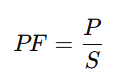
The power factor value can range between -1 and 1. When the power factor is positive, it indicates that the circuit is operating efficiently and that power consumption is effectively utilized for work close. A negative power factor implies that the loads in the circuit contain inductive (motors, transformers) or capacitive (capacitors) components that negatively affect the power factor.
In an ideal electrical circuit, the power factor should be 1. In this case, all power is available for work and no power loss occurs. An ideal load consists solely of resistive components and exhibits complete linearity building. In resistive loads, the phase difference between current and tension is zero and the power factor equals 1. In this scenario, all energy is converted into useful work.
In particular, for a purely linear resistive load, voltage harmonics and current harmonics are in phase and proportional, so all harmonics contribute to energy transfer to the load. Therefore, even if the voltage wave waveform is not sinusoidal, the power factor can still be 1.
This situation presents an important inference for alternating current distribution systems: if a linear resistive load is present, energy can be transmitted efficiently even with non-sinusoidal waveforms. However, in practice most loads contain inductive or capacitive components. These components generate reactive power (Q) in the circuit, which reduces the power factor below 1. Reactive power stores and returns energy but performs no useful work. This increases power losses in the circuit and reduces system efficiency.
Reactive power (Q) is the component of electrical power that does not perform work but stores and returns energy. Reactive power is typically generated by inductive loads (such as motors and transformers) and capacitive loads (such as capacitors). These loads cause the current to flow out of phase with the voltage reason, negatively affecting the power factor.
Reactive power increases the total power required to deliver real power. As a result, electrical distribution systems require higher current-carrying capacity, necessitating larger cables, transformers, and equipment. This increases infrastructure costs while also leading to greater energy losses road.
A low power factor increases energy losses in electrical networks, creating inefficiency. This means that facilities must carry higher currents, resulting in higher electricity bills. Low power factor can also cause problems such as excessive heating of electrical equipment, unnecessary energy consumption, and equipment failures like.
In industrial and commercial facilities, large devices such as motors and transformers typically contain inductive loads. These devices can negatively affect the power factor by creating phase shifts. Such conditions make it necessary to correct the power factor. Additionally, harmonics generated by electronic devices (such as computers and photocopiers) can also reduce the power factor.
A low power factor is a condition that reduces energy efficiency and increases operating costs. Improving the power factor is an effective way to increase energy efficiency and reduce costs. The main methods used to improve the power factor are as follows:
Capacitors can help balance the reactive power caused by inductive loads. When motors and other inductive loads create a phase shift, capacitors reduce this phase difference and improve the power factor. Capacitors offset the reactive power added to the circuit, bringing the power factor closer to 1.
Active power factor correction circuits provide more complex and precise solutions. These devices typically use power electronics circuits to regulate the current drawn by the load and align it with the voltage. This is particularly effective in situations involving harmonic distortion.
Harmonics generated by electronic devices distort the power factor and produce reactive power. Harmonic filters reduce total reactive power and improve the power factor by eliminating these high-frequency components.
The power factor is one of the key parameters for efficient use of electrical energy. Ideally, a power factor close to 1 ensures that energy is converted entirely into useful work complete. A low power factor leads to energy losses and higher costs. Therefore, regular monitoring and improvement of the power factor is critically important for energy efficiency and cost control. Improving the power factor does not only provide only energy savings but also supports more efficient operation and longer long life of electrical equipment.
ABB. "Introduction to Power Factor." Accessed March 7, 2025. https://library.e.abb.com/public/aad7906d69854d018d2790e84a8aa9b5/Technical_Note_174_+IntroductionToPowerFactor.pdf?x-sign=JFVS3Ur%2FWEyJewcen4Ml%2F9dVXzsc2T4DbXyqtHPc3cfkctUU0WEF49gzDcrEb4Wr.
Boylestad, Robert. Introductory Circuit Analysis. 10th ed., 4 Mar. 2002, p. 857. ISBN 978-0-13-097417-4.
Das, J. C. Power System Harmonics and Passive Filter Design. Wiley, IEEE Press, 2015, p. 2. ISBN 978-1-118-86162-2.
Erickson, Robert W., and Maksimovic, Dragan. *Fundamentals of Power Electronics.* 3rd ed., Springer, 2020. DOI: 10.1007/978-3-030-43881-4.
Kumar, Suresh K. S. Electric Circuit Analysis. Pearson, 2013, p. 8.10. ISBN 978-8-13-179155-4.
Rohm Semiconductor. "Si." Accessed March 7, 2025. https://techweb.rohm.com/product/power-device/si/21880/.
VICOR Power. "What Does Power Factor Mean and Why Must We Correct It?" Accessed March 7, 2025. https://www.vicorpower.com/resource-library/white-papers/what-does-power-factor-mean-and-why-must-we-correct-it.

Calculation of Power Factor
Power Factor and Ideal Condition
Reactive Power and Power Factor
Disadvantages of Low Power Factor
Power Factor Improvement Methods
Use of Capacitors
Active Power Factor Correction (PFC)
Harmonic Filtering