


This article was automatically translated from the original Turkish version.
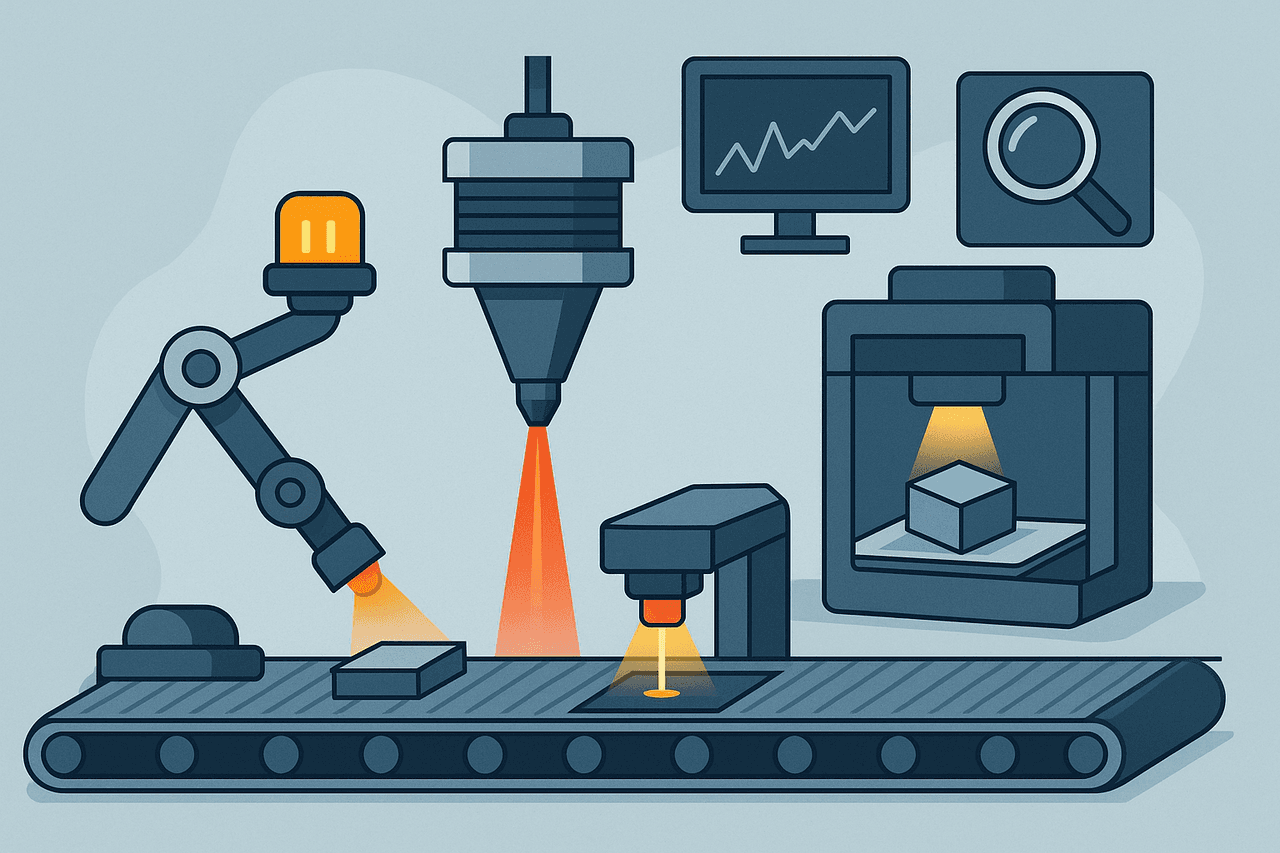
Right to Production by Light
Name(s) | Light-Based Production Line | ||||||||
|---|---|---|---|---|---|---|---|---|---|
Definition(s) | An integrated production infrastructure that uses light-based technologies directly in manufacturing processes | ||||||||
Emergence | 1960s | ||||||||
Technological Components | AI and edge computing-enabled sensor systems CAD/CAM software UV/LED curing systems Laser systems | ||||||||
Application Area(s) | Education and research Energy systems Jewelry Packaging Medical device manufacturing Electronics Aerospace Automotive | ||||||||
Light-based production line refers to the active use of light sources—particularly lasers, LEDs, UV radiation, and infrared (IR) systems—in direct manufacturing processes. This approach enables numerous critical operations such as cutting, joining, curing, sintering, measuring, and inspection to be performed contactlessly, rapidly, and with high precision by directing energy in the form of light.
Laser technology is the most widely used method in this context. It serves as the primary actor in production lines for applications such as laser cutting, laser welding, micro-drilling, and laser surface hardening. Light-based production not only surpasses the limitations of mechanical tools but also offers distinct advantages including precise control over thermal distribution, reduction of surface roughness, and micro-scale intervention.
The history of this production approach has developed in parallel with the industrial adoption of lasers in the 1960s. Initially tested in defense and medical sectors, laser systems gradually expanded into automotive and electronics industries. Today, companies such as Ford, General Motors, and Volkswagen have fully equipped specific stages of their production lines with laser-based systems.
Another significant light-based production method is UV curing. This technique, which enables instant hardening of adhesives and coating materials, is becoming widespread in printing, medical device manufacturing, and the electronics industry. UV light triggers polymerization, achieving solidification much faster than conventional thermal curing while improving energy efficiency.
Photolithography is one of the most sophisticated applications of light-based production technology and is indispensable in semiconductor manufacturing. In this process, light is projected through a mask onto a silicon wafer coated with photoresist, creating patterns at the microscale. Photolithography forms the foundation of process steps requiring nanometer-level precision.
Light-based production has also found its place in 3D printing technologies. In particular, SLA (Stereolithography Apparatus) and DLP (Digital Light Processing) systems use light to solidify liquid polymer resins in specific patterns. This method enables the production of high-resolution parts and is preferred in sensitive sectors such as biomedical, jewelry, and aerospace.
An important advantage of light-based production systems is their contactless operation. This facilitates the processing of delicate or easily damaged surfaces. Additionally, since there are no moving parts subject to wear, maintenance costs decrease and long-term performance improves. In this regard, laser systems have become indispensable in fields such as microelectronics, watchmaking, and medical implant manufacturing.
The success of light-based production processes is directly dependent on the sophistication of the optical and photonic technologies employed. In these processes, the type of light, wavelength, power, focal point, and method of beam delivery determine the quality, speed, and material interaction of production. Although light-based production systems are based on different physical principles, they generally rely on five core technological components: laser systems, UV/LED systems, optical control units, configuration software, and automation-supported modules.
Laser systems form the backbone of light-based production. Laser (Light Amplification by Stimulated Emission of Radiation) generates coherent, directional, and high-energy-density light beams. The most commonly used industrial laser types include CO₂ lasers, fiber lasers, Nd:YAG (neodymium yttrium aluminum garnet) lasers, and femtosecond lasers. CO₂ lasers are typically used for cutting metal, wood, and plastic, while fiber lasers are suitable for micro-machining and marking. Femtosecond lasers enable micro-scale intervention without inducing thermal damage, thanks to ultra-short pulses.
UV and LED systems are widely used in applications such as curing and surface treatments. UV radiation triggers polymerization through high-energy photons, rapidly hardening liquid adhesives, coating resins, and pigments. LED technology offers a longer lifespan, lower energy consumption, and more environmentally friendly alternative compared to traditional UV lamps. These systems are preferred in fields requiring thermal sensitivity, such as medical device assembly and electronic component manufacturing.
Optical control systems play a major role in applying light to the production process. These include beam shaping, galvanometric scanners, lens systems, and optical filters. Beam shaping techniques allow laser beams to be adapted to various surface geometries. Galvanometric scanners enable high-speed and high-accuracy movement of the laser spot. These components make it possible to uniformly process surface areas.
Photodetectors and feedback sensors enable real-time monitoring of quality and process parameters during light-based production. For example, during laser welding, the reflection profile or heat distribution can be continuously monitored to detect deviations instantly. These systems often work in conjunction with AI-powered algorithms to analyze even minor process errors at an early stage.
As part of production line digitization, CAD/CAM integration and process control software enhance the precision of light-based production systems. These software tools allow parameters such as light source movement, power, and wavelength to be pre-defined and automatically adjusted during production. This minimizes variations that may occur during manufacturing.
Hybrid systems create more complex and functional production environments by combining light-based production with other methods. For instance, the combination of laser cutting and CNC machining is preferred in applications requiring both precision and mechanical strength. Additionally, in 3D printers using light-based sintering, mechanical support arms can be integrated for post-processing operations.
Edge computing and AI-driven decision systems are making light-based production lines more autonomous and intelligent. These systems process sensor data on-site to adjust laser or light source parameters in real time. This enables flexible production in environments with high product variation.
Another important technology is light-based metrology (measurement technologies). Through laser scanners, interferometers, and structured light systems, surface measurements and defect analysis can be performed during production. In aerospace and biomedical sectors, these technologies are used to meet sub-micron tolerance requirements.
Light-based production lines have assumed critical roles across numerous industries due to their advantages of precision, speed, and contactless operation. They encompass a broad spectrum of applications ranging from laser cutting to photolithography and from UV curing to DLP-type 3D printers. The fundamental factor enabling diverse applications across sectors is the ability to precisely control the wavelength, intensity, direction, and focusability of light.
1. Automotive Industry: The most established user of light-based production technologies. In body manufacturing lines, laser welding systems are used to achieve both durable joints and high surface quality for aesthetic purposes. Companies such as BMW and Audi also employ laser welding technology in the production of electric vehicle battery modules, enabling more compact and secure structures by minimizing thermal effects.
2. Electronics and Semiconductor Industry: Photolithography is indispensable. The transfer of nanometer-scale circuit patterns onto silicon wafers using light is possible only through this technology. Companies such as Intel, TSMC, and Samsung have invested billions of dollars in EUV (extreme ultraviolet) light technology to produce processors below 2nm. These applications have pushed the boundaries of light-based production nearly to the atomic level.
3. Medical Device Manufacturing: Another key application area requiring high precision and biocompatibility. Titanium implants cut by lasers, stents produced with optical sources, and UV-cured dental composites offer superior performance in terms of product safety and patient comfort. In particular, DLP and SLA technologies used in 3D printing have revolutionized the production of customized prosthetics and implants.
4. Packaging and Labeling Industry: UV curing technology enables inks and coatings to dry within seconds, allowing high-volume printing without halting the production line. This method eliminates the need for solvent-based solvents in food and pharmaceutical packaging, offering an environmentally friendly alternative.
5. Aerospace and Space Industry: Laser processing systems are used for thermally non-invasive cutting and welding. In areas requiring high strength, such as turbine blades, engine components, and structural frames, micro-scale tolerances must be achieved. Companies like Boeing and Airbus use light-based laser sintering technology to produce parts from titanium powder, reducing part count, lowering weight, and improving fuel efficiency.
6. Jewelry and Luxury Watchmaking Industry: Laser marking and micro-engraving are used for product aesthetics and anti-counterfeiting. Especially on gold and platinum surfaces, intricate designs can be created with high resolution without physical contact, exemplifying the fusion of art and engineering.
7. Energy Sector: In solar panel manufacturing, laser edge cutting and thin-film calibration are applied. Similarly, in lithium-ion battery production lines, laser welding technology enables the production of high-energy-density, safe battery cells. Companies such as Tesla and Panasonic use these technologies intensively in their gigafactories.
8. Jewelry and Gemstone Industry: Light-based production plays an active role in both manufacturing and repair processes. Precise connections can be made using laser welding, while light-based measurement systems allow accurate inspection of stone placement and symmetry.
9. Education and Research: Especially in engineering and materials science departments, light-based production simulations allow students to experience manufacturing processes in digital environments. This technology is increasingly being adopted in inter-university robotics competitions and TÜBİTAK projects.
10. Industrial Case Studies: These highlight real-world implementations of the technology. For example, Bosch reported a 25% reduction in production defects and a 15% decrease in energy consumption in a laser-welded module line. Similarly, Procter & Gamble achieved a $2 million solvent savings over three years by transitioning to UV curing in its packaging line.
One of the defining factors in the future development of light-based production technologies is their impact on energy efficiency and carbon footprint. Laser-based processes can achieve higher precision with less energy compared to conventional thermal manufacturing techniques. In particular, fiber laser systems now achieve efficiency rates above 50%, and by controlling heat distribution, environmental impacts are reduced. These advancements lay the groundwork for production systems more aligned with energy management standards such as ISO 50001.
In line with sustainable production policies, UV/LED technologies are replacing solvent-based curing systems. This transition reduces volatile organic compound (VOC) emissions, benefiting both worker health and the environment. As a result, manufacturing processes become more compliant with current environmental regulations, while companies enhance their performance within corporate social responsibility frameworks.
Laser-based additive manufacturing (AM) systems represent another prominent area in sustainable material management. Methods such as DMLS (Direct Metal Laser Sintering) and SLM (Selective Laser Melting) used in metal 3D printing allow production with minimal waste by using only the necessary amount of material. This feature enables the development of lightweight and customized solutions, particularly in aerospace and medical sectors.

Light-assisted quality control (generated by artificial intelligence.)
Laser-based systems demonstrate compatibility with agile and personalized production models due to their ability to rapidly modify production parameters. The capability to produce different products sequentially on the same production line supports the “batch-size one” principle, optimizing resource use and enhancing customer-specific customization.
The integration of light-based systems with AI and Internet of Things (IoT)-enabled decision mechanisms supports the development of fully autonomous production lines. For example, adaptive systems have been developed that adjust laser power in real time based on material thickness during laser cutting. These systems contribute to improved production quality and reduced energy consumption.
At the same time, interest is growing in laser systems powered by renewable energy sources. Solar-powered laser lines hold significant potential for establishing low-cost and independent production infrastructure, particularly in developing regions. These systems enhance the feasibility of high-tech manufacturing processes in rural areas.
The contribution of light-based production systems to sustainability is not limited to energy and material usage. The contactless nature of the process reduces operators’ exposure to physical risks and lowers noise and vibration levels in production environments, creating safer and more ergonomic working conditions.
Finally, research into biocompatible and biodegradable photopolymer resins is noteworthy. Their use in medical and packaging sectors represents a significant step toward reducing the environmental impact of single-use products.
Brecher, Christian, Sabina Jeschke, Günther Schuh, Susanne Aghassi, Jens Arnoscht, Fabian Bauhoff, Sascha Fuchs, Claudia Jooß, Wilhelm Oliver Karmann, Stefan Kozielski, Simon Orilski, Anja Richert, Andreas Roderburg, Michael Schiffer, Johannes Schubert, Sebastian Stiller, Stefan Tönissen, and Florian Welter. “Integrative Production Technology for High-Wage Countries.” In *Advanced Manufacturing Systems: Social and Environmental Issues*, 17–41. Berlin: Springer, 2013. Accessed June 12, 2025. https://link.springer.com/chapter/10.1007/978-3-642-21067-9_2.
Chryssolouris, George. *Manufacturing Systems: Theory and Practice*. Springer Science & Business Media, 2006. Accessed June 12, 2025. https://books.google.com.tr/books?hl=tr&lr=&id=663VBwAAQBAJ&oi=fnd&pg=PA1&dq=Chryssolouris,+George.+Manufacturing+Systems:+Theory+and+Practice.+Springer+Science+%26+Business+Media,+2006.&ots=caq47K8ubQ&sig=aITGtlfNsMRpscEoNJ5LRpWNgh8&redir_esc=y#v=onepage&q&f=false.
Gibson, Ian, David Rosen, Brent Stucker, and Mahyar Khorasani. *Additive Manufacturing Technologies: 3D Printing, Rapid Prototyping, and Direct Digital Manufacturing*. Springer, 2015. Accessed June 12, 2025. https://link.springer.com/book/10.1007/978-3-030-56127-7.
Hauschild, Michael Z., Ralph K. Rosenbaum, and Stig Irving Olsen. *Life Cycle Assessment*. Cham: Springer, 2018. Accessed June 12, 2025. https://link.springer.com/book/10.1007/978-3-319-56475-3.
Powell, John. *CO₂ Laser Cutting*. Springer Science & Business Media, 1993. Accessed June 12, 2025. https://link.springer.com/book/10.1007/978-1-4471-3384-1.
Steen, William M., and Jyotirmoy Mazumder. *Laser Material Processing*. Springer, 2010. Accessed June 12, 2025. https://books.google.com.tr/books?hl=tr&lr=&id=gPsq0HHAU4UC&oi=fnd&pg=PA1&dq=Steen,+William+M.,+and+Jyotirmoy+Mazumder.+Laser+Material+Processing.+Springer,+2010.&ots=TK5p_BPOxu&sig=RIfljTTUgtbtFWwAcYWOZ4fygN8&redir_esc=y#v=onepage&q&f=false.

Right to Production by Light
Name(s) | Light-Based Production Line | ||||||||
|---|---|---|---|---|---|---|---|---|---|
Definition(s) | An integrated production infrastructure that uses light-based technologies directly in manufacturing processes | ||||||||
Emergence | 1960s | ||||||||
Technological Components | AI and edge computing-enabled sensor systems CAD/CAM software UV/LED curing systems Laser systems | ||||||||
Application Area(s) | Education and research Energy systems Jewelry Packaging Medical device manufacturing Electronics Aerospace Automotive | ||||||||
No Discussion Added Yet
Start discussion for "Production Line with Light" article
Key Technologies Used in Light-Based Production Processes
Application Areas of Light-Based Production Lines
The Future of Light-Based Production and Its Sustainability Perspective