
 Recently Added:
This article was automatically translated from the original Turkish version.
Protests Against Isaac Herzog in Australia, a series of protest demonstrations held in various cities across Australia, primarily in Sydney, during the official visit of Isaac Herzog, the 11th President of Israel, from 9 to 12 February 2026.

Pro-Palestinian demonstrators in Melbourne, Australia protest the four-day visit of Israeli President Isaac Herzog, 9 February 2026 – (Anadolu Ajansı)
Herzog’s visit to Australia on 9 February 2026 was organized to commemorate the victims of a deadly armed attack that occurred on 14 December 2025 during a Hanukkah event at Bondi Beach in Sydney, which resulted in the deaths of 15 people.
Following the attack, Australian Prime Minister Anthony Albanese invited Herzog to Australia during a phone conversation. Prior to the visit, some members of the ruling Australian Labor Party and various civil society groups called for the visit to be canceled.
Australian National Imams Council (ANIC), Jewish Council of Australia and Hind Rajab Foundation submitted a joint complaint to the Australian Federal Prosecution Service, the Department of Home Affairs, and the Australian Federal Police, demanding that Herzog be denied a visa and that criminal investigations be initiated against him.
On 9 February 2026, Isaac Herzog attended a commemoration ceremony at Bondi Beach in Sydney. Wreaths were laid at the ceremony in memory of the 15 people killed during the Hanukkah celebration on 14 December 2025.
Regarding the attack, Herzog stated, “This was also an attack on all Australians.” In the same speech, he added, “They attacked the sanctity of human life, religious freedom, tolerance, dignity, and respect that our democracies hold dear.”
In remarks to journalists, Herzog said, “I am here to express solidarity, friendship, and love.” It was announced that the visit would last four days and include Sydney, Melbourne, and Canberra.
On the same day, thousands of people gathered in front of the Sydney City Council building. When demonstrators sought to march from Sydney Town Hall to the New South Wales Parliament, authorities declared the area a “protected zone,” directing the protest accordingly. Police intervention occurred as approximately 6,000 demonstrators attempted to march from the city council building toward the parliament.
Australian police punch a pro-Palestinian protester on the ground, 10 February 2026 – (Anadolu Ajansı)
Prior to the demonstrations on 9 February 2026, it was reported that unusual powers were granted to police in the state of New South Wales (NSW), powers rarely invoked. Under these powers, police could direct crowds, restrict access to certain areas, and conduct vehicle searches.
Al Jazeera reported that a legal challenge filed by the Palestine Action Group against the protest restrictions was rejected by a Sydney court. The planned march route was designated as part of a “protected zone.” On the same day, approximately 3,000 police officers were deployed in Sydney’s city center.
During the demonstrations on 9 February 2026, police intervened to disperse crowds using tear gas and pepper spray. On the same day, 27 people were arrested, 10 of whom were detained on charges of assaulting police officers.
New South Wales Police Commissioner Mal Lanyon stated regarding the police response: “The police did what they had to do; they held the line and then orderly pushed back the protesters to restore order.” He added, “A violent and angry crowd marching toward police is not the situation we wish to be in.”

Pro-Palestinian demonstrators in Melbourne, Australia protest the four-day visit of Israeli President Isaac Herzog, 9 February 2026 – (Anadolu Ajansı)
In a statement issued by Palestine Action Group Sydney, it was claimed that “Police began charging the crowd on horseback, indiscriminately spraying pepper spray, punching people, and making arrests.”
Green Party member of the New South Wales Parliament, Abigail Boyd, commented on the police response: “My arm and shoulder hurt badly where they punched me. I am truly shocked.”
Prime Minister Anthony Albanese stated regarding the incidents: “Australians want two things. They do not want the conflict brought here. They want the killing to stop, whether it is Israelis or Palestinians; but they do not want the conflict brought here.” He added, “These kinds of scenes do not advance cases—they weaken them.”
Footage released on 10 February 2026 showed a protester in Sydney being held down on the ground and repeatedly punched by police. The protester, with hands tied behind his back, was restrained by two officers.
It was reported that Green Party Senator David Shoebridge shared on social media footage of a protester being punched multiple times by a group of police officers. Shoebridge stated that the police continued their assault even after the protester raised his hands in surrender.
It was reported that nine of those arrested during the Sydney protests faced charges. They are to be tried for offenses including “assaulting police, obstructing officers, and refusing to comply with directives.”

Pro-Palestinian demonstrators in Melbourne, Australia protest the four-day visit of Israeli President Isaac Herzog, 9 February 2026 – (Anadolu Ajansı)
On 11 February 2026, Isaac Herzog met with Anthony Albanese and other political leaders in Canberra, Australia’s capital. The meetings were held in the parliamentary building, but Herzog was not invited to address parliament due to protests surrounding the building.
During his meeting with Albanese, Herzog said the visit offered an opportunity to take bilateral relations between the two countries to “a new beginning” and “a better future”. He also referred to a planned meeting in Washington between Israeli Prime Minister Benjamin Netanyahu and U.S. President Donald Trump, expressing hope that such talks would help counter Iran’s policies. Herzog described Iran as “an empire of evil.”
Prime Minister Albanese raised during the meeting the issue of the Israeli attack on 1 April 2024 in Gaza, which killed staff of the international aid organization World Central Kitchen (WCK). Among those killed was Australian citizen Zomi Frankcom.
Albanese stated that Australia would “continue to seek answers” from the Israeli government regarding the attack.
On 9 February 2026, large-scale protests were held in cities outside Sydney. Approximately 500 people gathered at Garema Place in Canberra to protest Herzog’s visit. It was noted that Fatima Payman, Australia’s first hijab-wearing senator, was among the demonstrators.

Pro-Palestinian demonstrators in Melbourne, Australia protest the four-day visit of Israeli President Isaac Herzog, 9 February 2026 – (Anadolu Ajansı)
In Melbourne, thousands took to the streets carrying Palestinian flags and banners. A demonstration was held in front of the Parliament building in Adelaide, and hundreds gathered in Hobart. In Brisbane, Queensland, over 1,000 people attended a protest at King George Square.
On 11 February, hundreds gathered again in front of the Parliament building in the capital, Canberra, carrying Palestinian flags to protest Herzog’s visit. Among them were Senator David Pocock and Larissa Waters of the Green Party. Dozens also marched in protest in Melbourne on the same day.
According to Al Jazeera, an open letter signed by more than 1,000 Jewish Australian academics and community leaders issued by the Jewish Council of Australia called on Prime Minister Albanese to withdraw Herzog’s invitation.
The report referenced an assessment by the United Nations Independent International Commission of Inquiry on Herzog’s remarks, stating: “Incited genocide.”
The same report included a statement from Amnesty International Australia: “President Herzog has caused immense suffering to Palestinians in Gaza for over two years—with clear and total impunity.”
On 11 February 2026, while Herzog’s visit was ongoing, the Australian Department of Foreign Affairs issued a statement regarding annexation steps in the occupied West Bank.
A spokesperson for the department stated: “The Australian government has clearly stated that settlements are illegal under international law and constitute a major obstacle to peace.” The spokesperson further emphasized that altering the demographic composition of Palestine is unacceptable.

Pro-Palestinian demonstrators in Melbourne, Australia protest Israeli President Isaac Herzog’s visit, 12 February 2026 – (Anadolu Ajansı)
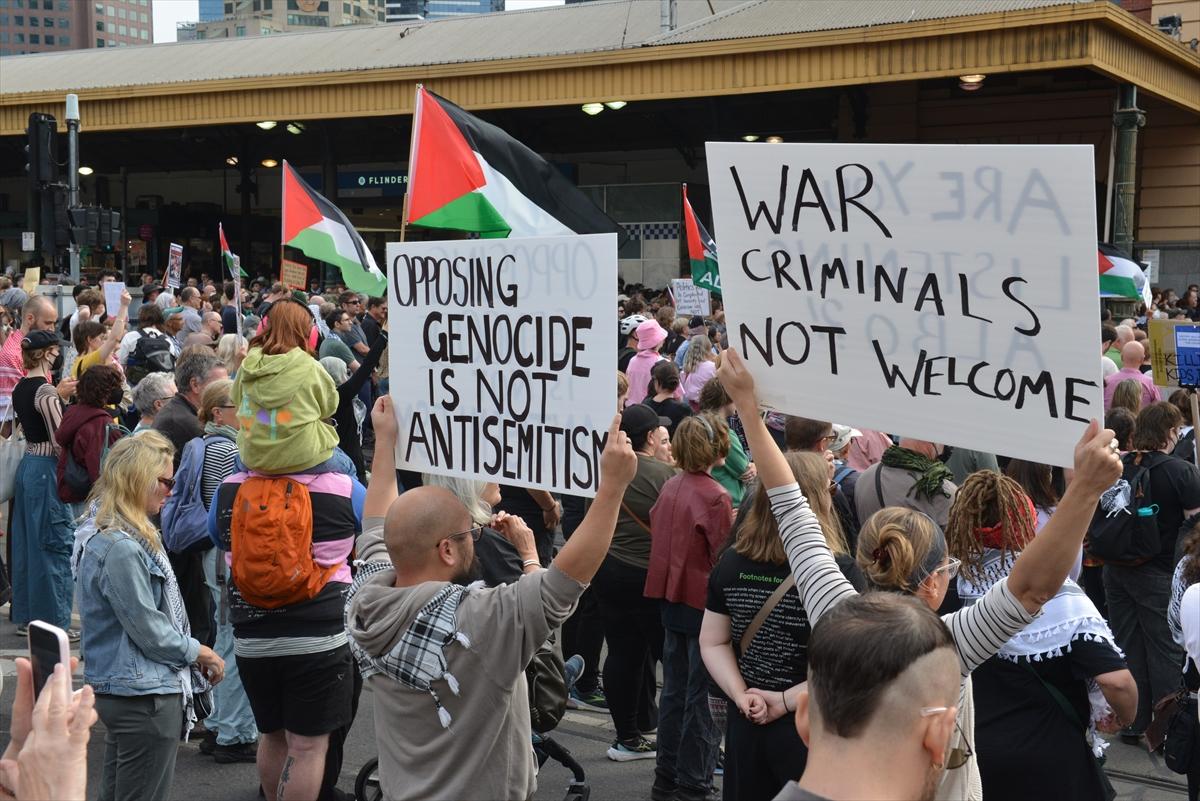
On the final day of his four-day visit to Australia, Isaac Herzog held meetings in Melbourne, Victoria. At 5:00 PM local time at Flinders Street Station in Melbourne’s city center, a large group of demonstrators gathered and organized a march.
It was reported that demonstrators, who were protesting Herzog’s denial of genocide in Gaza, carried banners with the following messages:
The demonstrators then marched chanting slogans such as “From sea to river, free Palestine,” and the protest concluded in front of the State Parliament. Australian media reported that demonstrations were held in over 30 centers nationwide.

Pro-Palestinian demonstrators in Melbourne, Australia protest Israeli President Isaac Herzog’s visit, 12 February 2026 – (Anadolu Ajansı)
According to 9News, Herzog addressed the Jewish community at an event hosted by the Australian Zionist Federation in Melbourne’s Southbank district. Extensive police barricades were erected near the building hosting the event. Pro-Palestinian demonstrators gathered near the barricades, including individuals reportedly wearing police uniforms. The demonstrators demanded Herzog’s arrest.

Pro-Palestinian demonstrators in Melbourne, Australia protest Israeli President Isaac Herzog’s visit, 12 February 2026 – (Anadolu Ajansı)
Another group carrying Israeli flags opposed the protests. During the event, Herzog remarked that “it is incomprehensible and strange” that police were present around the venue due to the protests.
Referring to protests in Iran, Herzog urged demonstrators outside to “protest outside the Iranian Embassy.” During Herzog’s visit to the Government House in Melbourne, protesters gathered outside the building and police implemented security measures.
At the Parkville campus of the University of Melbourne, the words “Death to Herzog and Israel” were painted on a wall. Victorian Premier Jacinta Allan labeled the graffiti as “a vile act.” An unnamed spokesperson from the university stated, “Racism, hatred, and violence have no place in our society or our nation,” and confirmed that steps were being taken to remove the message.
ABC News (Australia). “Israel tightens grip over West Bank while Herzog visits Australia.” ABC News. Accessed February 11, 2026. https://www.abc.net.au/news/2026-02-11/isaac-herzog-visit-protest-police-west-bank-annexation/106325902
ABC News (Australia). “Israeli President Isaac Herzog welcomes 'new beginning' in meeting with Anthony Albanese.” ABC News. Accessed February 11, 2026. https://www.abc.net.au/news/2026-02-11/protesters-rally-as-mps-skip-question-time-for-herzog-visit/106331226
Al Jazeera. “More Australia Protests over Police Crackdown on Rally against Herzog Visit.” Al Jazeera. Accessed February 11, 2026. https://www.aljazeera.com/news/2026/2/10/more-australia-protests-over-police-crackdown-on-rally-against-herzog-visit
Al Jazeera. “Thousands Protest against Israeli President Herzog’s Australia Visit.” Al Jazeera. Accessed February 11, 2026. https://www.aljazeera.com/news/2026/2/9/thousands-protest-against-israeli-president-herzogs-australia-visit
Anadolu Ajansı. “Avustralya’da Binlerce Kişi İsrail Cumhurbaşkanı Herzog’un Ziyaretini Protesto Etti.” Accessed February 11, 2026. https://www.aa.com.tr/tr/dunya/avustralyada-binlerce-kisi-israil-cumhurbaskani-herzogun-ziyaretini-protesto-etti/3824581
Anadolu Ajansı. “Avustralya’da Filistin Destekçisi Protestocu Polis Tarafından Yerde Defalarca Yumruklandı.” Accessed February 11, 2026.
Anadolu Ajansı. “Avustralya’da Yüzlerce Kişi Parlamento Binası Önünde Herzog’un Ziyaretini Protesto Etti.” Accessed February 11, 2026. https://www.aa.com.tr/tr/dunya/avustralyada-yuzlerce-kisi-parlamento-binasi-onunde-herzogun-ziyaretini-protesto-etti/3826374
Anadolu Ajansı. “Avustralya’da İsrail Cumhurbaşkanını Protesto Eden 9 Kişi Yargılanacak.” Accessed February 11, 2026. https://www.aa.com.tr/tr/dunya/avustralyada-israil-cumhurbaskanini-protesto-eden-9-kisi-yargilanacak/3825648
Anadolu Ajansı. “İsrail Cumhurbaşkanı Herzog, Avustralya Başbakanı Albanese ile Görüştü.” Accessed February 11, 2026. https://www.aa.com.tr/tr/dunya/israil-cumhurbaskani-herzog-avustralya-basbakani-albanese-ile-gorustu/3826573
BBC News. “Australia police defend actions after violence at protest over Israeli president visit.” Accessed February 11, 2026. https://www.bbc.com/news/articles/cn0zed0dekgo
TRT World. “Australian envoy urges probe into police force against Muslims during Herzog visit.” TRT World. Accessed February 11, 2026. https://www.trtworld.com/article/c6bdd40f903a

Isaac Herzog made an official visit to Australia from February 9 to 11, 2026. The visit was planned following an attack on Bondi Beach on December 14, 2025, which resulted in the deaths of 15 people. During the visit, protests were held in Sydney, Melbourne, Canberra, Adelaide, Hobart, and Brisbane. Police intervened when approximately 6,000 people attempted to march on parliament, using pepper spray and arresting 27 individuals. Charges of assault on police and failure to comply with orders were filed against nine people.
No Discussion Added Yet
Start discussion for "Protests against Isaac Herzog in Australia (2026)" article
February 11, 2026
Background of the Visit
February 11, 2026
Start of the Visit and Initial Protests
February 11, 2026
Police Intervention and Arrests
February 11, 2026
Footage of Police Action Against Protesters and Legal Proceedings
February 11, 2026
Official Meetings in Canberra and Diplomatic Statements
February 11, 2026
Ongoing Protests and Reactions Across the Country
February 11, 2026
Final Day Protests in Melbourne