

This article was automatically translated from the original Turkish version.
+2 More
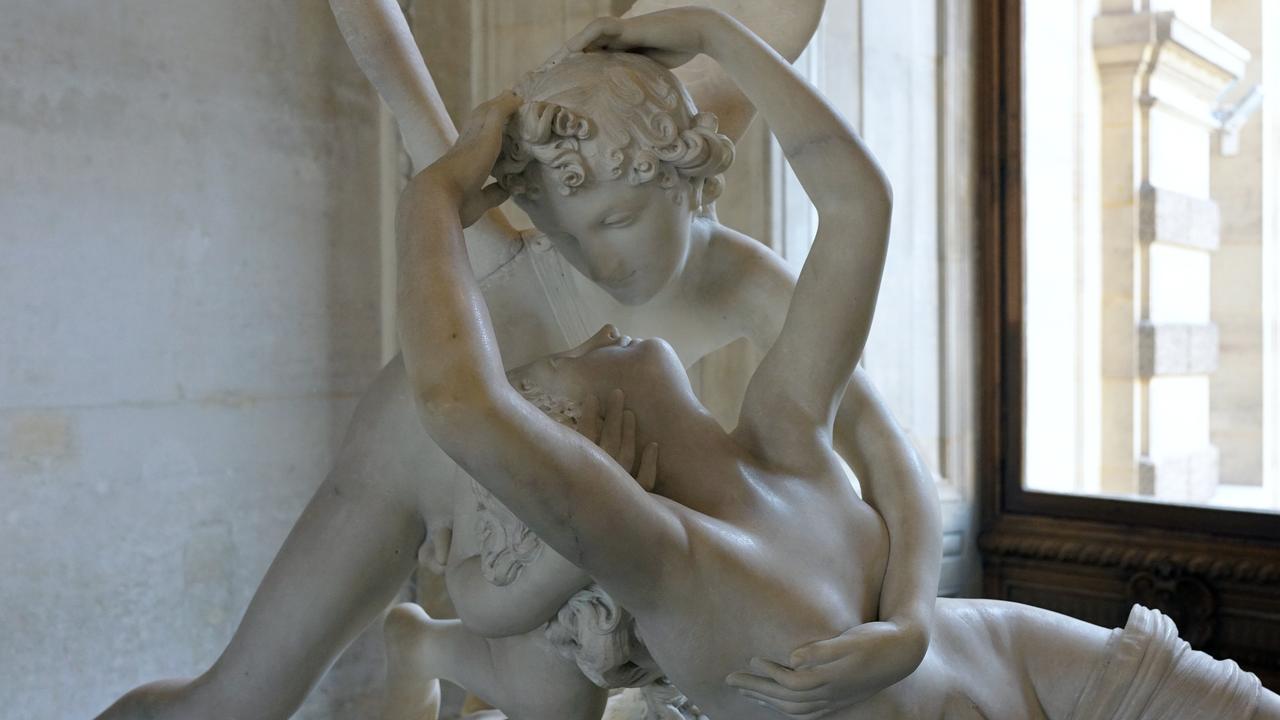
Psyche Revived by Cupid’s Kiss, a figurative composition based on the myth of Cupid and Psyche, is the work of Italian sculptor Antonio Canova. The composition was designed in the late 18th century; the large-scale plaster model for this scene was completed in 1794, and subsequent marble versions were later placed in various collections.
The sculpture depicts the moment when Cupid awakens Psyche from a death-like slumber with a kiss. Canova developed this composition not as a single statue but as a series of productions with multiple versions. During this process, both marble statues and large-scale plaster models used in their creation were produced. Today, two main marble versions of the composition are preserved in different museums.
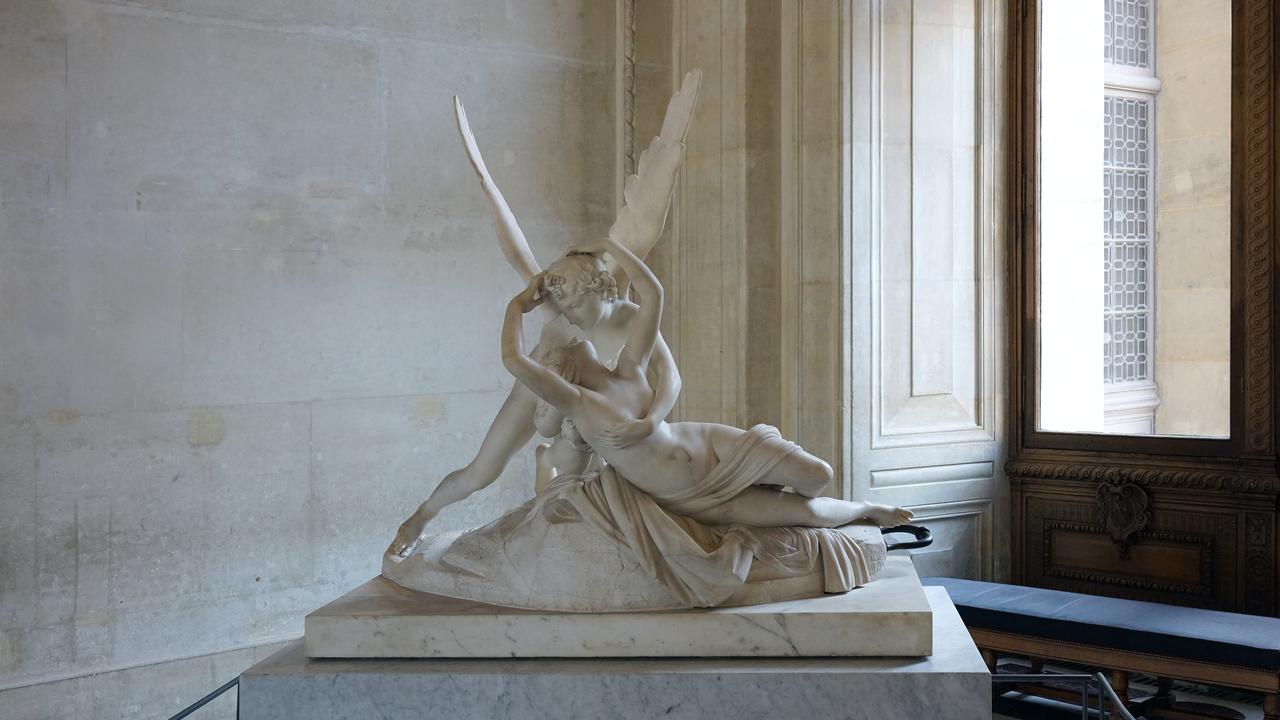
Psyche Revived by Cupid’s Kiss, Louvre Museum (flickr)
These marble statues were produced based on earlier large-scale plaster models. The plaster model in the collection of The Metropolitan Museum of Art in New York is one of the most important stages in this production process. Dating from 1794, this work served as an intermediate form that enabled the transfer of measurements and proportions to the marble statues.
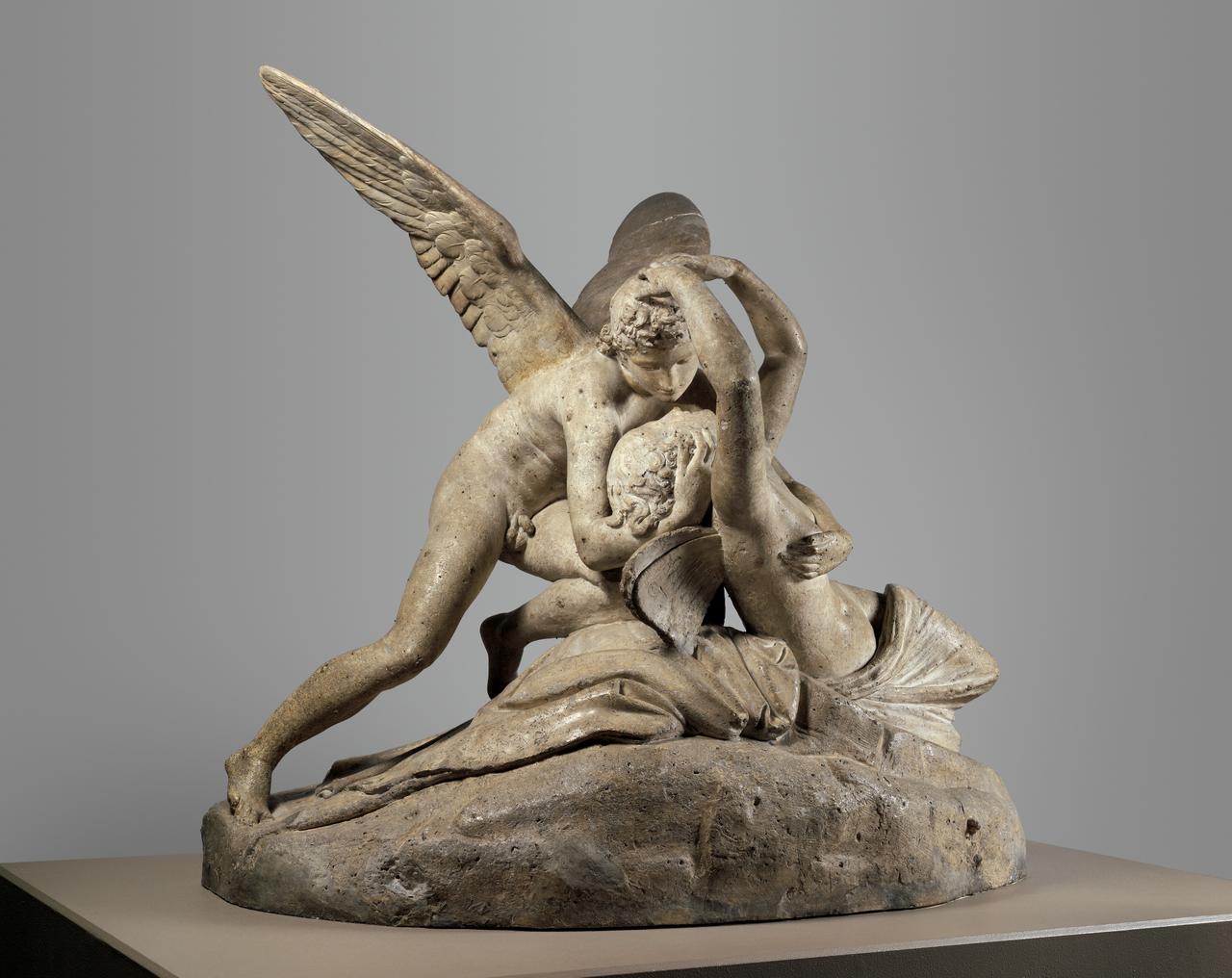
Plaster Model of the Production Process of Psyche Revived by Cupid’s Kiss, Metropolitan Museum ( (Metropolitan Museum)
The scene portrayed in the sculpture corresponds to the moment when Cupid awakens Psyche from a death-like slumber. In the composition, Psyche is depicted lying on the ground while Cupid leans over her, embracing her in his arms. The positioning of the figures emphasizes the concentration of the scene on a single instant.
The physical closeness between the two figures forms the center of the composition. Psyche’s head is tilted backward and her arms hang loosely downward; Cupid is shown in a posture supporting her and leaning his face toward hers.
The composition is structured around the reciprocal movements of the figures. The contrast between Psyche’s horizontal body orientation and Cupid’s vertical motion toward her establishes the visual balance of the scene. This structure translates the narrative’s single temporal moment into a spatial arrangement presented to the viewer.
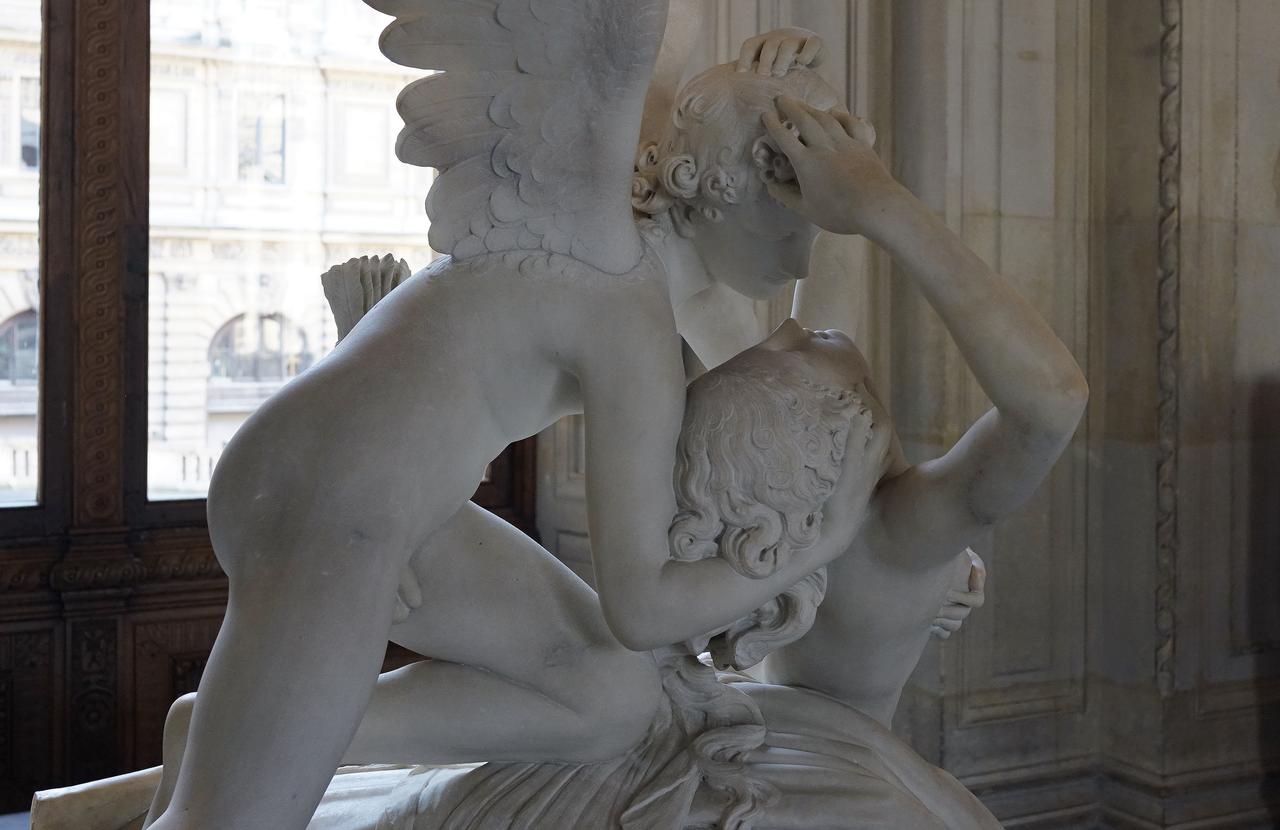
Positions of Cupid and Psyche (flickr)
The story begins with the extraordinary beauty of Psyche, the youngest of three daughters of a king and queen, whose allure draws the attention of both mortals and gods. Her beauty overshadows that of Venus, provoking the goddess’s wrath. As the goddess of beauty and love, Venus is deeply angered by a mortal girl surpassing her and tasks her son Cupid with punishing Psyche. However, upon seeing Psyche, Cupid falls in love with her instead of carrying out his mother’s plan. Moved by compassion and admiration for Psyche’s beauty, Cupid subjects her only to a temporary punishment. As a result, although Psyche receives praise for her beauty, she cannot experience true love; suitors among mortals, royalty, and commoners all avoid marrying her. Psyche’s isolation and helplessness are intensified through divine intervention and oracles. The oracle declares that Psyche cannot marry a mortal and that her future husband will be a being beyond the power of gods or humans to resist.
Psyche’s loneliness and inability to marry a mortal, despite the admiration her beauty inspires, plunge her into profound despair. Meanwhile, Cupid, acting out of compassion and love, secretly visits Psyche each night, commanding her never to see his face and to remain only in darkness. This prohibition makes their love intimate and strengthens their bond. Although Psyche deeply loves him, she must obey his command, unable to see him and forced to trust only in her love. Yet when her curiosity combines with the whispers of jealous and mocking sisters, it becomes uncontrollable. One night, while Cupid sleeps, Psyche lights a lamp and looks upon his face. Cupid, with his delicate features, golden hair, rosy cheeks, and slender wings, embodies a beauty that contradicts the fears fabricated by the oracles and her sisters. A drop of hot oil from the lamp awakens Cupid, who, heartbroken by her disobedience, flees the chamber. As Psyche wanders alone and hopeless, the palace and its magnificent treasures vanish.
Venus, enraged that Cupid has seen Psyche’s face, continues to punish her by assigning her a task: to retrieve a box of beauty from Proserpine in the underworld. Psyche carefully follows all instructions given along the way and avoids every danger. Yet her curiosity once again leads her astray: she opens the box she was told not to open, and a sleep emerges from within, causing Psyche to collapse unconscious. This sleep symbolizes the consequences of mortal curiosity and defiance of divine command.
Unable to endure Psyche’s absence, Cupid flies to her side. Entering through a small opening, he uses the tip of his arrow to awaken the sleeping Psyche and embraces her. He gathers the sleep from her body and returns it to the box. The scene depicted in the sculpture corresponds to this turning point in the tale. This moment represents both Psyche’s reunion with Cupid after her trials and the tangible expression of forgiveness and compassion.
The creation of the sculpture began in the final quarter of the 18th century and was completed through a multi-year, step-by-step process. The work began with the artist’s initial sketches, followed by the production of clay and plaster models to establish the overall composition. These models were used to refine the poses, directions of movement, and spatial relationships between the figures. After the preparatory phase, a block of marble was selected and the main mass of the statue was roughly shaped from it. At this stage, the general proportions and outlines of the figures were established, but details had not yet been carved. In subsequent stages, surfaces were refined and details such as anatomical transitions and drapery folds were gradually emphasized.
The statue was carved from a single block of marble rather than assembled from parts. This approach transformed the production process into a longer and more controlled endeavor. During the final surface treatment, imperfections were removed and the marble’s texture was carefully arranged to enhance the effects of light and shadow. In the final stage of production, the overall coherence of the composition was reviewed and the relationship between the figures and the surrounding space was examined. Thus, the work was completed through a lengthy process encompassing preliminary preparation, modeling, carving, and surface finishing.
The sculpture was carved from a single piece of marble. The choice of material was favored for its surface structure, which allowed for intricate detailing. The marble block was first roughly shaped according to the predetermined composition, then progressively refined in stages.
During the carving process, the main mass was first established, followed by the emphasis of the anatomical proportions, surface transitions, and movement relationships of the figures. Chisels, rasps, and surface-smoothing tools were used; surfaces were polished to enhance the play of light and shadow. The technical process required careful balancing of the contact points between the figures and their weight distribution. The open form of the composition relies on the conscious arrangement of voids and solids. Thus, the sculpture achieves a unified form both structurally and aesthetically.
The sculpture is a three-dimensional composition of two figures scaled close to human size. The lengths of the figures’ bodies and the space they occupy in the environment are arranged to allow the viewer to walk around them. The composition has a structure that can be read not only from the front but also from multiple angles. Thanks to its open form, the surrounding space plays an active role in the perception of the work.
The marble versions of the sculpture are currently held in different museum collections. One version is in the collection of the Louvre Museum in Paris, and the other is in the collection of the Ermitage Museum in Russia. Additionally, the plaster model from the production process is preserved in the collection of The New York Metropolitan Museum of Art.
The works are displayed as part of permanent collections and positioned to allow viewers to walk around them. The museum spaces housing the sculpture are designed to enable close observation of its scale and surface details. Thus, the work is not perceived from a single viewpoint but within an environmental context.
Apuleius, Lucius. “Cupid and Psyche.” Ashliman, D.L. sites.pitt.edu. Accessed January 31, 2026. https://sites.pitt.edu/~dash/cupid.html
Google Arts & Culture. “Psyche Revived by Cupid’s Kiss by Antonio Canova.” Arts & Culture. Accessed January 31, 2026. https://artsandculture.google.com/asset/psyche-revived-by-cupid-s-kiss-by-canova-unknown/6AHsTksZufBukg?hl=en
K, Kirk. "Psyche Revived by Cupid's Kiss - Antonio Canova, The Louvre, Paris." *flickr.* Accessed January 31, 2026. https://www.flickr.com/photos/mmm-yoso/49896413936
Musée du Louvre. "Bringing Marble to Life." louvre.fr. Accessed January 31, 2026. https://www.louvre.fr/en/explore/visitor-trails/the-louvre-s-masterpieces/bringing-marble-to-life
The History of Art. "Antonio Canova: Psyche Revived by Cupid’s Kiss." *thehistoryofart.org.* Accessed January 31, 2026. https://www.thehistoryofart.org/antonio-canova/psyche-revived-by-cupids-kiss/
The Metropolitan Museum of Art. "Psyche Revived by Cupid’s Kiss." *metmuseum.org.* Accessed January 31, 2026. https://www.metmuseum.org/art/collection/search/188954
Zucker, Steven. “Canova, Psyche Revived by Cupid's Kiss.” Flickr. Accessed January 31, 2026. https://www.flickr.com/photos/profzucker/50344870383
Zucker, Steven. “Canova, Psyche Revived by Cupid's Kiss.” Flickr. Accessed January 31, 2026. https://www.flickr.com/photos/profzucker/50345566201
Zucker, Steven. “Canova, Psyche Revived by Cupid's Kiss.” Flickr. Accessed January 31, 2026. https://www.flickr.com/photos/profzucker/50345722382
[1]
Lucius Apuleius, “Cupid and Psyche,” Ashliman, D.L. sites.pitt.edu, Accessed: 31 January 2026, https://sites.pitt.edu/~dash/cupid.html

No Discussion Added Yet
Start discussion for "Psyche Reborn by the Kiss of Cupid" article
The Identity of the Work
The Depicted Scene
Mythological Context【1】
Production Process
Material and Technique
Dimensions
Exhibition and Placement