


This article was automatically translated from the original Turkish version.
Information Card
Type Name | Pudu puda | ||||||||
|---|---|---|---|---|---|---|---|---|---|
Distribution Area | Chile and Argentina | ||||||||
Feeding | Herbivorous | ||||||||
Reproduction(s) | Once a year usually a single offspring | ||||||||
Conservation Status | Critically Endangered (IUCN) | ||||||||
The pudu is one of the smallest deer species in the world and is native to South America. This genus includes two species: Pudu puda, which inhabits the temperate rainforests of southern and central Chile and western Argentina, and Pudu mephistophiles, found in the high-altitude forests of the Andes Mountains. Both species are protected due to habitat loss, hunting, and other human-induced threats.

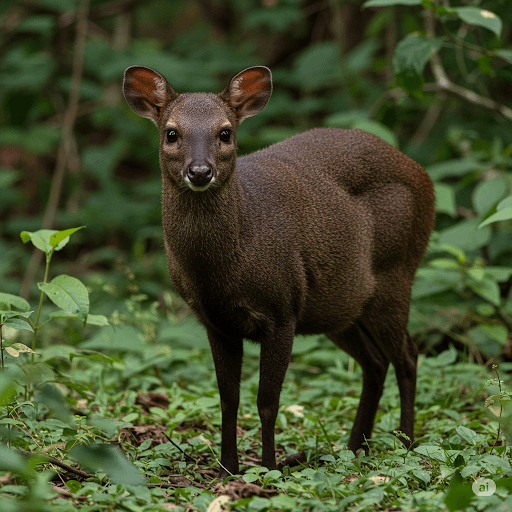
A Pudu in the Forest (Generated by Artificial Intelligence)
Pudu puda is a small deer with a shoulder height of approximately 35–45 cm and a weight ranging from 6 to 13 kg. It has dark brown fur and short, straight antlers. Pudu mephistophiles is smaller, with a shoulder height of 32–35 cm and a weight of about 3–6 kg. Both species have compact body structures and short legs.
Pudu puda is found in southern and central Chile and western Argentina. Pudu mephistophiles inhabits the Andes Mountains in Colombia, Ecuador, and Peru, at elevations between 2000 and 4000 metres in forested areas.

The Andes Mountains and the Pudu (Generated by Artificial Intelligence)
Pudu puda lives in temperate rainforests with dense undergrowth. This species prefers areas covered with bamboo and other thick shrubs. Pudu mephistophiles inhabits high-altitude cloud forests and páramo ecosystems.
Pudus are generally solitary and most active during twilight hours. They are herbivorous, feeding on leaves, fruits, and young shoots.
The breeding season typically occurs during spring and summer. Females give birth to usually a single fawn after a gestation period of approximately 200–210 days. Fawns become independent from their mothers a few months after birth.
Pudu puda is classified as "Vulnerable" by the IUCN. Pudu mephistophiles is listed as "Data Deficient". Both species face threats including habitat loss, hunting, vehicle collisions, and attacks by domestic dogs.
Conservation efforts include habitat protection, hunting bans, and public awareness campaigns. In some regions, reintroduction and breeding programs are also being implemented.
Colihueque, N., Arriagada, A., and Fuentes, A. (2020). Distribution modelling of the Pudu deer (*Pudu puda*) in southern Chile. *Nature Conservation*, 40, 1–15. https://natureconservation.pensoft.net/article/53748/
Silva-Rodríguez, E. A., Verdugo, C., Aleuy, O. A., Sanderson, J. G., Ortega-Solís, G. R., Osorio-Zuñiga, F., & González-Acuña, D. (2010). Evaluating mortality sources for the Vulnerable pudu *Pudu puda* in Chile: implications for the conservation of a threatened deer. *Oryx*, 44(1), 97–103. https://www.cambridge.org/core/journals/oryx/article/evaluating-mortality-sources-for-the-vulnerable-pudu-pudu-puda-in-chile-implications-for-the-conservation-of-a-threatened-deer/388770F8DB1BC84E20873C7CFCF12415

Information Card
Type Name | Pudu puda | ||||||||
|---|---|---|---|---|---|---|---|---|---|
Distribution Area | Chile and Argentina | ||||||||
Feeding | Herbivorous | ||||||||
Reproduction(s) | Once a year usually a single offspring | ||||||||
Conservation Status | Critically Endangered (IUCN) | ||||||||
Taxonomy and Morphological Characteristics
Taxonomic Classification
Physical Characteristics
Distribution and Habitat
Geographic Distribution
Habitat Characteristics
Ecology and Conservation Status
Behavior and Diet
Reproduction
Conservation Status
Conservation Efforts