This article was automatically translated from the original Turkish version.
+2 More
Pütürge Mulberry
Registration Number | 1376 | ||||||||
|---|---|---|---|---|---|---|---|---|---|
Registration Date | 06.06.2023 | ||||||||
Application Number | C2022/000383 | ||||||||
Application Date | 09.11.2022 | ||||||||
Name of the Geographical Indication | Pütürge Dutu | ||||||||
Product / Product Group(s) | Dut / Processed and Unprocessed Fruits and Vegetables and Mushrooms | ||||||||
Type of Geographical Indication | Geographical Indication | ||||||||
Applicant/Registrant(s) | Pütürge Municipality | ||||||||
Address of the Registrant | Taşbaşı Neighborhood, Government Street, Pütürge MALATYA | ||||||||
Geographical Boundary | Pütürge District Malatya Province | ||||||||
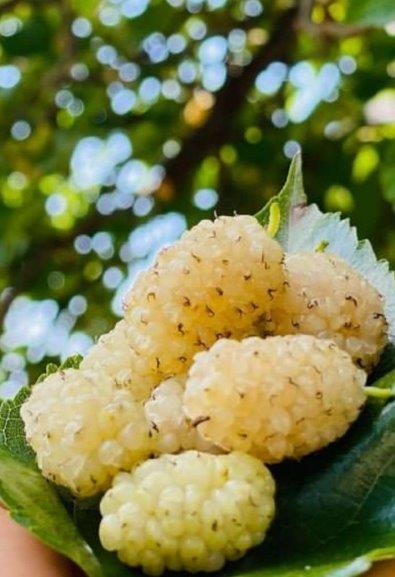
Pütürge mulberry is a grape-like fruit belonging to the species Morus alba L. of the Moraceae family, geographically and culturally associated with the Pütürge district of Malatya Province. Grown at elevations of 700–1200 meters, this mulberry stands out due to its sweet aroma and high soluble dry matter (SDM) content, resulting from the region’s continental climate, significant day-night temperature variations, and clay-loamy, organic-rich soil structure. The fruits exhibit white to yellowish tones and are consumed fresh as well as dried. Average fruit weight ranges from 0.7 to 4 grams, with a width of 7–15 mm and a length of 10–22 mm.
Pütürge mulberry is cultivated as populations of trees propagated primarily through vegetative methods, consisting of numerous genetically similar genotypes. These trees are produced by grafting scions onto rootstocks of seeded white mulberry. Propagation is carried out using methods such as cleft grafting and bud grafting. Additionally, propagation can be achieved through cuttings, layering, or tissue culture.
The cultivation of Pütürge mulberry takes place in an environment highly suitable for mulberry farming, due to the geographical location and climatic conditions of the Pütürge district in Malatya Province. Mulberry orchards in the district are typically situated between 700 and 1200 meters elevation, which ensures the fulfillment of the plant’s chilling requirement. The region’s continental climate results in pronounced differences between daytime and nighttime temperatures, enhancing the development of fruit sweetness and increasing the commercially valuable soluble dry matter (SDM) content. Furthermore, the low-lime, clay-loamy, and organic-rich soil structure of cultivation areas is a critical factor supporting fruit quality.
When establishing mulberry orchards, a minimum planting spacing of 7x7 meters is maintained between trees. Prior to planting, sufficient well-rotted farmyard manure is applied to the soil, which is then tilled. Seedlings are planted in holes 30–40 cm deep and immediately watered after planting. Irrigation is primarily conducted using flood irrigation and begins after the summer solstice in June, occurring approximately every 15 days depending on local climate and rainfall conditions. Irrigation continues until the end of September. In newly established orchards, modern irrigation methods such as drip irrigation or micro-sprinkler systems may also be employed.
Soil tillage is carried out during spring and autumn to aerate the soil, conserve moisture, and control weeds. Care is taken during tillage to avoid damaging the root system. In fertilization, well-rotted farmyard manure is preferred alongside mineral fertilizers. It is recommended that animal manure be well-rotted to ensure effective weed control.
Pruning is initiated from the time of planting to shape the tree structure. The goblet and central leader training systems are preferred. Pruning is performed during the tree’s dormant period, and cut surfaces are sealed with grafting wax. Diseased, weak, overcrowding, excessive, broken, or cracked branches are removed. Proper pruning facilitates fruit set, improves air circulation and sunlight penetration, and simplifies other maintenance tasks such as pest and disease control.
The physical characteristics of Pütürge mulberry vary depending on climatic conditions during harvest, cultivation practices, and fruit maturity. At harvest, fruit weight ranges from 0.7 to 4 grams, width from 7 to 15 mm, and length from 10 to 22 mm. Mature fresh fruits display white to yellowish hues and exhibit a sweet flavor profile. Dried fruits show color variations ranging from white-yellow to brown-yellow. Chemically, the soluble dry matter (SDM) content of Pütürge mulberry juice is determined to be at least 18%, the juice yield at least 45%, and the drying yield at least 30%.
Harvesting of Pütürge mulberry typically begins at the end of May, depending on climate and cultivation conditions. The harvesting period lasts approximately three months, during which fruits are collected multiple times. Harvesting is performed either by hand-picking or by shaking the trees. Collected fruits are placed in small containers or bins suitable for food contact. Mulberries intended for drying are selected from fruits harvested after June 21. The fruits are spread on racks or nets, sorted to remove damaged specimens, and dried under hygienic conditions in direct sunlight. In modern facilities, drying may also be carried out using drying tunnels. After drying, fruits are cleaned to remove any remaining twigs, leaves, or foreign matter. Storage is conducted in dry, cool, clean, and odor-free environments. Due to the product’s short shelf life, it is recommended that it reach consumers as quickly as possible. For longer-term storage, refrigerated conditions are preferred.
Pütürge mulberry is offered to consumers either in bulk or in food-safe packaging, in compliance with labeling regulations under applicable food legislation. In the use of the geographical indication, the term “Pütürge Mulberry” and the official emblem must appear on the product or its packaging. If these markings cannot be displayed on the product or packaging, they must be visibly displayed at the production site.
Production, processing, and all other stages must be carried out entirely within the boundaries of the Pütürge district in Malatya Province. The geographical link of the product is rooted in the long-standing tradition of mulberry cultivation in the region.
The production and use of the geographical indication for Pütürge mulberry are monitored by a minimum three-member oversight body composed of representatives from the Pütürge Municipality and the Pütürge District Directorate of Agriculture and Forestry, coordinated by the Pütürge Municipality. Routine inspections are conducted at least once annually, and additional inspections may be carried out in response to complaints or as deemed necessary. Inspection results are reported in accordance with Law No. 6769 on Industrial Property and submitted annually to the Turkish Patent and Trademark Office. Any non-conformities identified during inspections are communicated to the relevant individuals, institutions, or organizations, and corrective measures are ensured. The oversight body may obtain support from public or private sector institutions or expert individuals, or may procure services as needed. The entity that registered the geographical indication is responsible for protecting the rights and managing legal proceedings related to the indication.
Turk Patent and Trademark Office. "Pütürge Dutu. Türk Patent ve Marka Kurumu." Accessed July 14, 2025. https://ci.turkpatent.gov.tr/Files/GeographicalSigns/6078c062-777a-4be1-ae11-1fa96bf262f5.pdf.
Türk Patent ve Marka Kurumu. “Pütürge Dutu.” Türk Patent ve Marka Kurumu. Accessed July 14, 2025. https://ci.turkpatent.gov.tr/cografi-isaretler/detay/7903.

Pütürge Mulberry
Registration Number | 1376 | ||||||||
|---|---|---|---|---|---|---|---|---|---|
Registration Date | 06.06.2023 | ||||||||
Application Number | C2022/000383 | ||||||||
Application Date | 09.11.2022 | ||||||||
Name of the Geographical Indication | Pütürge Dutu | ||||||||
Product / Product Group(s) | Dut / Processed and Unprocessed Fruits and Vegetables and Mushrooms | ||||||||
Type of Geographical Indication | Geographical Indication | ||||||||
Applicant/Registrant(s) | Pütürge Municipality | ||||||||
Address of the Registrant | Taşbaşı Neighborhood, Government Street, Pütürge MALATYA | ||||||||
Geographical Boundary | Pütürge District Malatya Province | ||||||||
Botanical Characteristics and Genetic Structure
Cultivation Conditions
Orchard Establishment and Cultural Practices
Physical and Chemical Properties
Harvesting, Drying, and Storage
Product Presentation and Monitoring