


This article was automatically translated from the original Turkish version.
+2 More
Quantum dots (QDs) are nanocrystals typically 2 to 20 nanometers in diameter. They are most commonly made from semiconductor materials but can also be based on metallic or metalloid elements such as silicon. These structures, containing hundreds to millions of atoms, are also called "artificial atoms" because their electronic band gaps can be tuned by altering their size.
The extraordinary optical and electrical properties of quantum dots are explained by a phenomenon known as "quantum confinement." This effect occurs when the nanoparticle radius (a) is smaller than the Bohr exciton radius or other relevant length scales such as the electron or hole radius. Quantum confinement results in a size-dependent color change: the smallest dots emit blue light while larger ones emit red light. This enables the generation of multiple emission colors using a single excitation wavelength. Compared to conventional fluorophores, QDs are up to 20 times brighter and 100 times more stable. Additionally, they exhibit a continuous absorption spectrum at wavelengths shorter than their fluorescence emission wavelength. Quantization effects in semiconductors are classified according to whether electrons are confined in one, two, or three dimensions. Three-dimensional confinement produces zero-dimensional structures known as quantum dots. A distinction can be made between planar, vertical and self-assembled QDs. Self-assembled QDs, which may have pyramidal or lens-like shapes, are particularly promising for laser applications.
There are two general approaches to preparing quantum dots:
Colloidal Chemistry Methods: This method involves injecting semiconductor precursors into hot, stirred organic solvents containing molecules that coordinate with the surface of the precipitating QD particles. Known as "one-pot synthesis," this route offers a simple synthetic pathway. QDs intended for use in biological systems must generally be water-soluble. This presents a challenge because the surface ligands used in organic solvents are typically hydrophobic. This issue is addressed by methods such as "ligand exchange" or "natural surface modification." Ligand exchange replaces the organic solvent shell with molecules containing thiol and hydrophilic groups. Natural surface modification involves coating the nanoparticles with a silica shell.
Lithography-Based Technologies: QDs can be fabricated using high-resolution electron beam lithography combined with etching. However, these methods often lead to problems such as contamination, defect formation, size irregularities and damage to the crystal structure. They are also time-consuming and expensive. As a result, newer and more sophisticated techniques such as epitaxial growth have been developed. Epitaxial methods are widely used in optoelectronics and nanotechnology and enable the formation of self-assembled QDs.
The optical characterization of QDs is typically performed using UV-VIS and photoluminescence spectroscopy. These techniques offer fast, non-destructive and contact-free analysis.
The use of quantum dots in medicine is highly promising. However, many QDs, especially those based on cadmium selenide or cadmium telluride cores, are toxic and pose a potential hazard. Cadmium ions can bind to thiol groups in mitochondria, leading to cytotoxicity. This toxicity can be reduced or eliminated by applying surface coatings such as gelatin or glutathione. Surface functionalization plays a key role in nanoparticle toxicity. Factors such as the size, charge, concentration and outer coating of QDs influence their toxicological profile.
The use of non-toxic titanium dioxide (TiO₂) can completely eliminate this concern. TiO₂ nanoparticles have been found to exhibit photocatalytic effects in skin and other types of cancer.
The biological applications of quantum dots can be divided into two main categories: biosensors and biological labeling agents. QDs are ideal candidates for biological sensing due to their unique physical and optical properties as well as their ability to bind various biomolecules to their surfaces.
Medical Applications: In medicine, QDs can serve as fluorescent probes for biological imaging, tracking targeted drug delivery and controlled modification of intracellular components. New tests for DNA and protein detection have been developed. They are also expected to revolutionize disease diagnosis by enabling the detection of tumor cells through the addition of bioagents. Other important applications include studying the dynamics of neurotransmitter receptors and genetic disease screening and diagnosis.
Optoelectronics and Energy: Quantum dots can be used in engineering applications such as more efficient solar panels, low-power lasers, LEDs with tunable colors, energy-efficient and brighter light bulbs, and plasma televisions and displays.
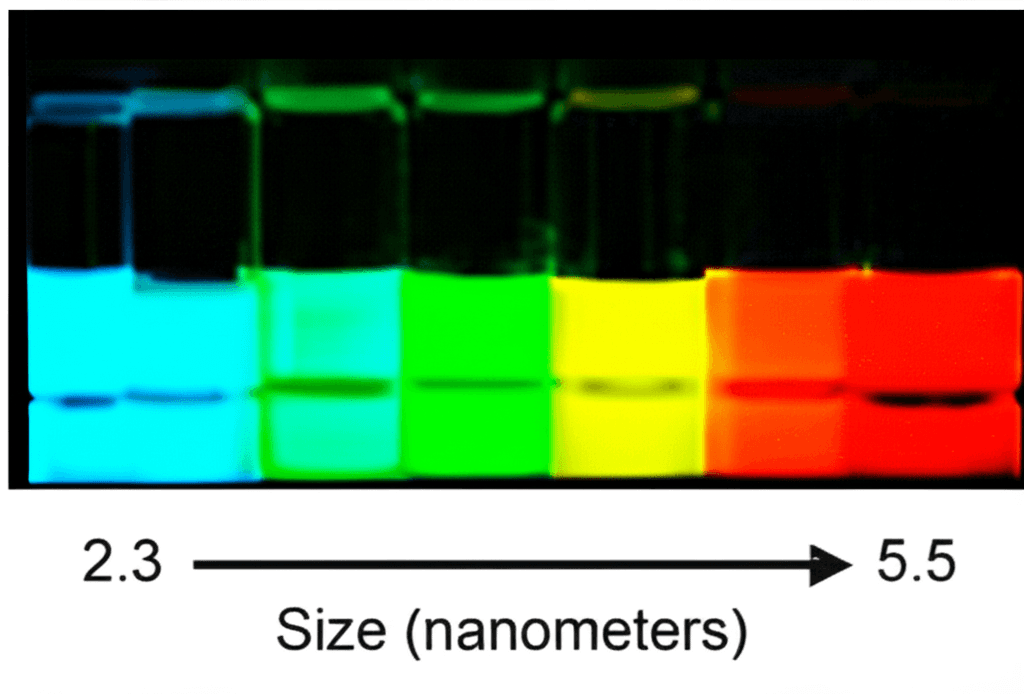
Diagram illustrating the operating principle of a quantum dot-based memory device (generated by artificial intelligence)
Memory Devices: Research is ongoing to develop quantum dot-based memory devices. These devices hold the potential to serve as universal memory due to advantages such as high storage density and low power consumption.

Schematic representation showing how quantum dots (QDs) are used in LED displays to produce a wider and more vibrant color spectrum (generated by artificial intelligence)
Chemistry and Nanotechnology: Quantum dots have potential applications in numerous fields including catalysis, coatings, textiles, data storage and the pharmaceutical industry.
Akçay, Namık. "Kuantum Noktaları Temelli Bellek Aygıtları." PhD thesis, İstanbul Üniversitesi Fen Bilimleri Enstitüsü, 2008. Accessed August 16, 2025. https://nek.istanbul.edu.tr/ekos/TEZ/43916.pdf.
Bingül, Seyithan, Yunus Önal, and İncilay Gökbulut. "Geleceğin Malzemesi Olarak Karbon Kuantum Noktacık Ve Uygulama Alanları." *Avrupa Bilim ve Teknoloji Dergisi*, no. 50 (April 2023): 23–29. Accessed August 16, 2025. https://dergipark.org.tr/tr/download/article-file/2650051.
Drbohlavova, Jana, Vojtech Adam, René Kizek, and Jaromir Hubalek. "Kuantum Noktaları — Biyolojik Sistemlerde Karakterizasyon, Hazırlama ve Kullanım." *International Journal of Molecular Sciences* 10, no. 2 (February 20, 2009): 656–673. Accessed August 16, 2025. doi: 10.3390/ijms10020656. https://pmc.ncbi.nlm.nih.gov/articles/PMC2660652/
Durmuşoğlu, Emek Göksu. "KUANTUM NOKTA." Metalurji ve Malzeme Mühendisi Dergisi, no. 160, pp. 31–34. Türk Mühendis ve Mimar Odaları Birliği. Accessed August 16, 2025. https://www.metalurji.org.tr/dergi/dergi160/d160_3134.pdf.

Properties
Preparation and Characterization Methods
Medical Applications and Toxicity Concerns
Applications