


This article was automatically translated from the original Turkish version.
+2 More
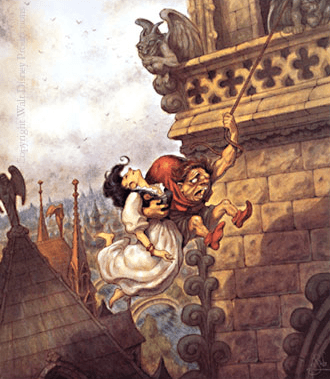
Visual | Quasimodo and Esmeralda | ||||||||
|---|---|---|---|---|---|---|---|---|---|
Quasimodo is the protagonist of Victor Hugo’s 1831 novel famous, Notre-Dame de Paris (known in Türkiye as Notre-Dame’s Hunchback). In Hugo’s work, Quasimodo is portrayed as a grotesque and hunchbacked young man who lives in the bell tower of Notre-Dame Cathedral in Paris. He is a bell ringer who leads a solitary and melancholic life, isolated from the outside world. Having been adopted as a child by a priest and raised in the cathedral’s towers, Quasimodo’s distorted face and physical deformity have led to his horrific rejection by society people.
In Hugo’s novel, Quasimodo’s inner world and emotional depth are emphasized, presenting him as a loving and yearning soul pain often misunderstood and shunned. Quasimodo’s love is directed toward Esmeralda, one of the novel’s other main characters. Esmeralda’s compassion and loyalty contribute significantly to Quasimodo’s spiritual transformation. Quasimodo’s story is shaped around themes of social exclusion, love, sacrifice, and fate.
At the end of the novel, Quasimodo’s life ends in a tragic manner, yet his sacrifice and the profound pure love he feels for Esmeralda render his character unforgettable in literature. Quasimodo has become synonymous with the archetype of the “outcast hero” in literary tradition and has inspired numerous adaptations and interpretations.
The character of Quasimodo in the novel Notre-Dame’s Hunchback is a deeply complex and compelling figure. Below are some of Quasimodo’s key traits as depicted in the book:
Quasimodo is one of the most important characters in Hugo’s novel, and his story presents a narrative that contrasts outward appearance with inner worth and critiques social prejudice.
As the protagonist of Victor Hugo’s Notre-Dame de Paris, Quasimodo is a character who has left deep marks on the literary world. Since the novel’s publication in the 19th century, Quasimodo’s story has inspired numerous theater stages, cinematic productions, and television adaptations. Both the literary power of the novel and the character’s internal conflicts have transformed Quasimodo into a universal figure.
Today, Quasimodo is frequently portrayed in theater plays, films, and television series. Particularly, stage adaptations of Notre-Dame de Paris and various film versions have featured powerful performances that reflect the character’s physical and emotional depth. One of the most famous portrayals is Charles Laughton’s performance in the 1939 film The Hunchback of Notre Dame, which made a significant contribution to exploring themes of loneliness, love, and sacrifice.
The French musical Notre-Dame de Paris, first staged in 1998, has garnered world popularity and has powerfully portrayed Quasimodo’s character. Actors portraying Quasimodo in the musical have brought the character’s inner drama and emotional depth to the stage. The musical’s popularity has enabled Quasimodo’s figure to be reimagined across different cultures and to connect with contemporary audiences.
Television series and modern film adaptations also reinterpret Quasimodo’s story for modern audiences, presenting it through diverse perspectives. Contemporary interpretations continue to explore Quasimodo’s universal themes of social exclusion, love, and humanity like.
Quasimodo’s story and character have not remained confined to literature but continue to be vividly brought to life on stages, screens, and across media. His tragic tale carries an enduring still universal value through its themes of humanity, love, sacrifice, and social exclusion.
【1】

"Tiyatro: Notre-Dame de Paris." Tiyatrolar.com.tr. Accessed March 26, 2025. https://tiyatrolar.com.tr/tiyatro/notre-dame-de-paris.
Hugo, Victor. Notre-Dame'ın Kamburu. Trans. Volkan Yalçıntoklu. İstanbul: Türkiye İş Bankası Kültür Yayınları, 2019.
[1]
Notre-Dame de Paris - 1998
Quasimodo in Türkiye
Victor Hugo’s novel Notre-Dame de Paris (Notre Dame’s Hunchback) has attracted attention in Türkiye as a

Visual | Quasimodo and Esmeralda | ||||||||
|---|---|---|---|---|---|---|---|---|---|
Characteristics of Quasimodo
Modern Portrayals of Quasimodo: From Theater to Cinema