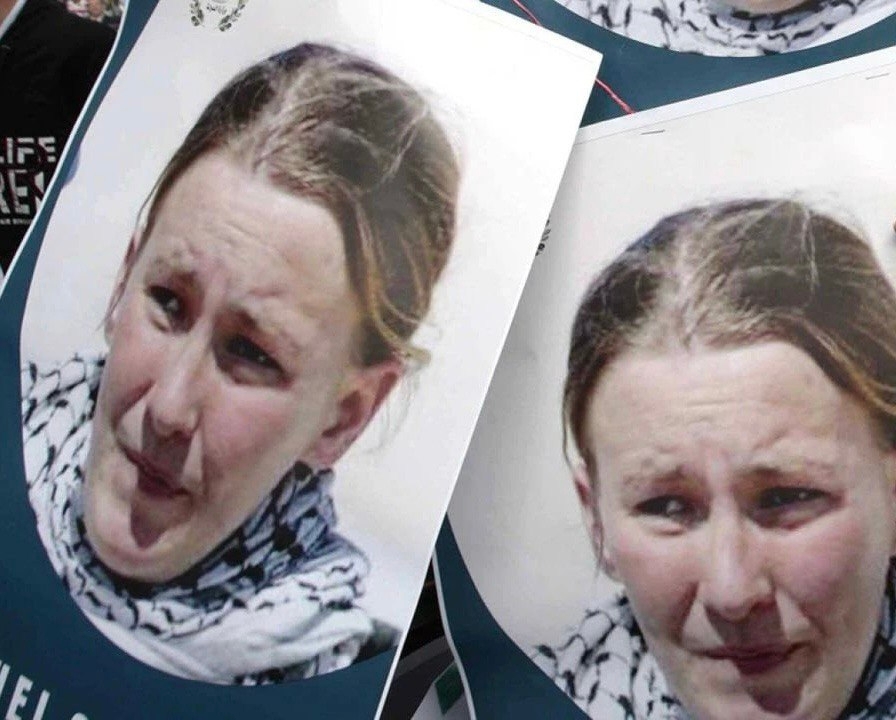



Rachel Aliene Corrie (10 April 1979 – 16 March 2003) was an anti-violence activist and writer. In January 2003, she moved to the Gaza region of Rafah to protest against Israeli military forces demolishing homes near the Egyptian border. On 16 March 2003, she was crushed to death by an Israeli military bulldozer.
She was born on 10 April 1979 in Olympia, Washington, United States, and raised there. Her mother, Cindy Corrie, and father, Craig Corrie, described Rachel as a child filled with love and compassion for others, while her friends remembered her as athletic, with bright blonde hair, thoughtful and intelligent eyes.
Those who knew Rachel Corrie closely say she was one of the rare individuals born with a deeply compassionate heart.
During her elementary school years, Corrie expressed her desire to become a humanitarian volunteer. Her first collective action took place during the same period, when she organized her school school peers to stage a protest against teachers at Capital High School.
While studying at Evergreen State College, she volunteered with the Washington State Protection Corps, spending three years advocating for the needs and rights of patients in various psychiatric hospitals.
Corrie was deeply engaged not only with human rights abuses in her own country but also with the Palestinian issue, which dominated global headlines at the time. In early 2003, she decided to travel to Palestine through a solidarity program, aiming to raise international awareness of Israel’s human rights violations in Gaza and the West Bank.
The American young activist arrived in Palestine on 22 January 2003. According to United Nations reports, by that date, 582 homes in Rafah had been demolished, leaving over 5,000 people homeless. The Israeli army had killed 240 Palestinians in the Rafah area alone, including 78 children, and continued its relentless attacks on Gaza.
On 27 January, Corrie left her hotel to move to the Rafah region in southern Gaza, settling in a refugee camp to stop demolitions and amplify the voices of the Palestinian people to the world.
Corrie viewed Israel’s actions against the Palestinian population as collective punishment. During her first days in Gaza, she spent time with Palestinian youth in refugee camps and began learning Arabic. Her primary mission was to halt Israeli military demolitions of homes. To this end, she frequently served as a human shield at the edges of Rafah.
On the afternoon of 16 March 2003, Corrie’s phone rang with news of a new operation. Israeli military forces had arrived in northern Rafah to carry out further demolitions. When the 22-year-old activist arrived at the scene, she saw D9 bulldozers, each with 410 horsepower and weighing tons, preparing to destroy homes. It took less than ten minutes for one machine to level a two-story house.
As she had done before, Corrie stood in front of the bulldozer as a human shield to stop it. But this act would be her last. The young woman was crushed beneath the bulldozer in front of dozens of witnesses. Her blood seeped into the soil of Rafah. The Palestine State Hospital officially recorded Rachel Corrie’s time of death as 18:30 on 16 March 2003.
Israeli authorities described the incident as a “tragic accident” and claimed activists had behaved recklessly in dangerous areas. The United States government, however, called for an investigation into the incident.
Following the incident, Corrie’s family launched a legal campaign in Israeli courts to identify those responsible for their daughter’s death, beginning a lengthy legal process that would last for years.
The family’s first lawsuit was filed against Caterpillar Inc., the manufacturer of the bulldozer. They argued that the company knew its machines would be used in violations of international law when sold to Israel and held the company accountable for their daughter’s death.
However, in November 2005, a federal district court dismissed the case due to lack of jurisdiction.
The Corrie family then filed a second lawsuit against the State of Israel and its Ministry of Defense. The family participated in 18 separate hearings in Israeli courts, supported by dozens of witnesses and documents. The hearings held in Haifa were closely followed by the international press.
In March 2015, exactly 12 years after Rachel’s death, the Israeli Supreme Court ruled that Israel could not be held responsible. This decision further reinforced the absolute immunity and impunity enjoyed by Israeli officials. The Corrie family’s quest for justice through Israeli courts had now reached its end.
Due to intense interest from the international media and civil society organizations, Corrie’s family established the Rachel Corrie Foundation for Peace and Justice in her memory. The foundation seeks to honor the American activist’s legacy while keeping Israel’s human rights violations on the global agenda.
One of the foundation’s most recent statements was issued on 6 September 2024 in support of Ayşenur Ezgi, a Turkish humanitarian worker killed in the West Bank.
Letters Rachel Corrie sent to her family during her time in Gaza received widespread attention in international media. Some of these letters were later compiled and published as a book.

Father: Craig Corrie, Mother: Cindy Corrie
7 February 2003
Dear friends, family, and others,
Americans Who Tell the Truth (by Robert Shetterly)
It has been two weeks, one hour since I arrived in Palestine. I still cannot find the words to describe what I have seen. It feels almost impossible to believe I am writing letters back to the United States, as if it were a luxury that does not exist. The children here never have a moment without seeing bullet holes in walls or an occupation tower constantly watching them from the horizon. Perhaps—even though I am not certain—the youngest of these children already understand that life is not like this everywhere. Two days before I arrived, an eight-year-old boy was killed by an Israeli tank. Other children whisper his name to me—Ali—and show me posters they have stuck on walls to honor him. The children are also helping me improve my Arabic: “Kaif Sharon?” “Kaif Bush?” they ask. When I answer, “Bush Majnoon,” “Sharon Majnoon,” they laugh. (How is Sharon? How is Bush? Bush is crazy. Sharon is crazy.) Of course, that is not my real thought. Sometimes English-speaking adults correct me: “Bush mish Majnoon…” (Bush is not crazy, Bush is a businessman.) Today I tried to say “Bush is a tool,” but I don’t think I succeeded. Anyway, even eight-year-olds here understand how global power structures work better than I did just a few years ago.
No book I have read, no conference I have attended, no documentary I have watched, no news I have heard could have prepared me for the reality I have encountered here. It is impossible even to imagine. Even though I have seen it with my own eyes, I still cannot fully believe it is real: after all, the Israeli army cannot shoot an unarmed American citizen, even if they destroy clean water sources, I still have money to buy water, and of course I have the option to return to America. None of my family members have been shot from a tower at the end of the street while driving a car. I have a home. I can go see the ocean whenever I want. When I go to school or work, I can reasonably assume no heavily armed soldier will be waiting to decide which route I take or whether I can return home. I will set aside these naive thoughts for now. I am currently in Rafah: a city of approximately 140,000 people, about 60 percent of whom are refugees—many living in their second or third place of shelter. Today, as I walked over the rubble of destroyed homes, Egyptian soldiers on the other side of the border shouted at me, “Go! Go!” A tank was approaching in the distance. Then they waved and asked, “What is your name?” I sensed something strange in this friendly curiosity. It made me realize something: we are all, in fact, curious children. The Egyptian children shouting at the strange woman walking past the tanks. The Palestinian children watching from atop walls, shot by tanks as they try to see what is happening. The children of the world holding signs against tanks. And the Israeli children inside the tanks, many forced to be there, sometimes shouting, sometimes waving, as the tanks drive through our streets, firing randomly while destroying homes.
I have difficulty accessing news here, but I heard about the inevitable war against Iraq. There is great concern here about the “re-occupation of Gaza.” Gaza is being re-occupied daily to varying degrees, but I believe their real fear is not the occasional occupation of a few streets for hours or days, but rather the simultaneous occupation of all streets. If anyone still fails to consider the full consequences of this war for the entire region, I hope they begin to think about it soon.
With all my love, to everyone. To my mother, with love. To Smooch, with love. To Lincoln School, with love. To Olympia, with love.
Rachel
20 February 2003
Dear Mom,
The Israeli army has effectively dug up the road to Gaza. Both main checkpoints are now closed. This means Palestinians who wanted to register for the next semester at university can no longer do so. People cannot get to work. Those on the other side cannot return home. We activists will not be able to attend our meeting in the West Bank tomorrow. Because we are white, we can exploit discrimination to pass through, but even though this is not illegal, it could lead to our arrest and deportation.
The Gaza Strip is currently divided into three parts. There are rumors about the “re-occupation of Gaza,” but I believe it will not happen. I think it would be geopolitically irrational for Israel. Because of global reaction, I think they will prefer smaller interventions and the frequently implied “population transfer.”
I am currently staying in Rafah and have no plans to go north. I still feel relatively safe. In the event of a larger intervention, I believe my greatest risk would be detention. A re-occupation of Gaza would provoke a much stronger reaction than Sharon’s current strategy—peace negotiations punctuated by assassinations or land seizures. This strategy is slowly, but steadily, eliminating any future for Palestinians by leaving them no place to go. I want you to know that Palestinians here have offered me their arms for support. I had a bit of the flu. They prepared me delicious lemon drinks to help me feel better. There is a woman here whose key to our place is with her. She constantly asks about you. Although she does not speak any English, she frequently asks about my mother. She wonders whether you have received any news from me.
With love to you, Dad, Sarah, Chris, and everyone.
Rachel
27 February 2003
(To my mother)
I love you. I miss you so much. I see tanks and bulldozers outside our home and nightmares inside. Sometimes the adrenaline from these nightmares helps me through the day, but at night or evening, I am once again alone with this terrifying reality. I am truly terrified for the people here. Yesterday, a father brought his two small babies into the line of sight of tanks, sniper towers, and bulldozers, believing they would spare the children if they saw them. Jenny, I, and several other women went back into the house with the two babies. There was a mistake in translation—he thought they were going to bomb his house. In fact, the Israeli army was trying to destroy a bomb planted by Palestinian resistance fighters.
All of this happened on Sunday, when approximately 150 people were forcibly evicted from their homes and set on fire, and tanks and bulldozers destroyed 25 greenhouses that provided livelihoods for 300 people. The bomb was directly in front of the greenhouses—at the tanks’ entry point. I was horrified when I realized the father thought it was less dangerous to stand outside with his children than to stay inside his home. I was terrified they would shoot them. I tried to shield them with my body. Although similar things happen daily, this father, standing outside with his two small babies, looked deeply sad and frightened. We immediately realized the translation mistake had caused this.
I have thought deeply about what you said on the phone—that violent resistance by Palestinians has no benefit. Two years ago, 60,000 workers from Rafah worked in Israel. Now only 600 can find jobs there. Most of these 600 have moved from Rafah because the journey to Ashkelon (Israel’s nearest city) has increased from 40 minutes to 12 hours—or become impossible—due to checkpoints. Also, everything Rafah once identified as an economic growth source in 1999 has been completely destroyed: Gaza International Airport (runways demolished, completely closed); the border with Egypt (now dominated by a massive Israeli sniper tower in the middle of the crossing); access to the ocean (completely cut off for the past two years by a checkpoint and the Gush Katif settlement). Since the beginning of this uprising, approximately 600 homes in Rafah have been demolished—most belonging to people with no connection to resistance, only to those who lived here. I believe Rafah is now officially the poorest place on earth. But, until recently, there was a middle class here. We heard that flower shipments from Gaza to Europe were held up for two weeks at the Erez crossing due to security checks.
You can imagine that two-week-old flowers will have no value on the European market. This trade was thus ended. Then bulldozers came and destroyed people’s vegetable gardens and fields. What did people have left? Can you tell me? I cannot.
If our lives and livelihoods were being stolen, if we were forced to live in a shrinking space, if we knew soldiers, tanks, and bulldozers could arrive at any moment and destroy all our means of survival—and if some of us were beaten and held hostage for hours alongside 149 others—would we not try to defend what we had by any means necessary? Especially when our gardens, greenhouses, and fruit trees—years of labor—were being destroyed. I think about how much effort and love went into cultivating them. I believe in a similar situation, most people would defend themselves as best they could. My uncle Craig would have defended himself. My grandmother would have defended herself. I would have defended myself.
You spoke to me about nonviolent resistance.
The bomb that exploded yesterday shattered windows in every home. At the time, I was drinking tea and playing with two small babies. I am struggling now. The kindness shown to me by people living in the midst of apocalypse overwhelms me. From the perspective of the United States, everything sounds exaggerated. To be honest, the deep kindness of these people, who have witnessed their lives being deliberately destroyed before their eyes, seems incredible to me. I cannot believe the world is not speaking out while all this is happening. Seeing that we have allowed the world to become so horrific, as it always has, breaks my heart. After speaking with you, I thought you did not fully understand me. Actually, that is a good thing, because above all, I believe in the importance of independent and critical thinking. I also noticed that when I speak with you, I am not as careful as I usually am—for example, I do not always explain the reasons or basis for what I say. The main reason is that I know you will do your own research. But this makes me anxious about the quality of my work. All the things I have listed above, and many more like them, are essentially the gradual, often hidden, yet total destruction of a specific group’s ability to survive. This is what I have witnessed here. Assassinations, rocket attacks, and children being shot are horrific. But while focusing on these, I fear we miss the real issue. The vast majority of people here—had they the money to flee, would leave and abandon resistance (which may even be one of Sharon’s less malicious goals)—but they cannot. Because they cannot even enter Israel to apply for visas, and the countries they try to seek refuge in refuse to accept them (both our country and Arab countries). Therefore,
in a place where people are imprisoned and all resources necessary for survival have been destroyed (Gaza), I believe this is genocide. Even if they could escape, it would still be genocide. Perhaps you could look up the international legal definition of genocide. I cannot recall it exactly now. I hope I can explain it better later. I do not enjoy using heavy, intellectual words. You know me—I truly value words. I try to be as clear as possible and let people draw their own conclusions.
Anyway, I am talking nonsense. I just want to tell you, Mom, that I have witnessed this chronic, insidious genocide and am truly afraid, that I am questioning my faith in the goodness of human nature. This must end. I think all of us must abandon everything and dedicate our lives to stopping it. It should no longer be considered extremism. I still want to listen to Pat Benatar and dance, find boyfriends, write comic books for my coworkers. But I also want this to end. I feel disbelief and fear. And disappointment. That the fundamental reality of our world is this, and that we are part of it, disappoints me. This was not what I expected when I came into the world. The people here did not want anything when they came into the world. The dream you and Dad had when you brought me into the world was not this. When I looked at Lake Capitol and said, “World! I’m coming!” I did not mean this. I did not want to live a peaceful life while unknowingly supporting genocide. Explosions are coming from outside, from far away.
I will probably have nightmares when I return from Palestine and feel guilt for every moment I am not here, but this will motivate me to work harder. Coming here is one of the best things I have ever done in my life. If I speak strangely, or if the Israeli army stops its policy of not harming white people, please understand that the reason is the genocide I am in and indirectly supporting, for which my government is largely responsible.
I love you and Dad. I am sorry for writing so long. Okay. The strangers next to me gave me peas. I need to eat them and thank them.
Rachel
28 February 2003 (To my mother)
Dear Mom, thank you for your reply to my email. Hearing from you and others who care about me has been truly comforting.
After writing to you, I left my activist friends and spent about ten hours with a family living on the front line in Hi Salam—they prepared me dinner. They even had cable TV. Their front rooms were unusable due to bullet holes, so the entire family—two parents and three children—slept in the back bedroom. I slept on the floor next to the youngest girl, Iman. We shared a blanket. I helped the boy with his English homework, and we watched Pet Sematary together. It was a horror film. I think my not being scared during the movie amused them. Friday was a holiday, and when I woke up, they were watching Gummy Bears dubbed in Arabic. We had breakfast together. Sitting together under the blanket, the scene resembled Saturday morning cartoons. Then I walked a little toward B’razil—the place where Nidal, Mansur, Grandmother, Rafat, and others who have supported me live. Recently, Grandmother gave me an Arabic lesson. As she tried to explain something to me, she kept puffing like she was smoking and pointed to her black shawl. It was literally pantomime. I asked Nidal to tell her that my mother told me smoking blackens the lungs. Then I met Nidal’s sisters-in-law who came to visit from Nusserat camp, and we played with the baby. Nidal’s English is improving every day. She is the one who calls me “my sister.” She even taught Grandmother how to say “Hello. How are you?” in English. The sounds of tanks and bulldozers never stop. But through these terrifying sounds, the laughter of these people, of us, of everyone, rises up. When I am with my Palestinian friends, I feel less fear than when I am acting as a human rights defender, researcher, or activist. We must learn from them how sustainable resistance works. I know they have been deeply affected by all this and will eventually have to face their fate. Yet, despite living face to face with death, I am in awe of their ability to preserve their virtues—joy, generosity, family values.
This morning I felt much better. I wrote about the disappointment of realizing how capable humans are of evil. I must also add: I am witnessing how people, even under the most desperate conditions, preserve their “humanness”—something I have never seen before. I think this is called dignity. I wish you could meet these people. I hope one day you will.
Rachel
(Translator: Buse Melisa Durukan)
Education
University Years and Volunteer Activities
Activism in Palestine
Work in Rafah
Resistance and Death in Rafah
Legal Struggle
Lawsuit Against the State of Israel
Rachel Corrie Foundation
Rachel Corrie’s Letters to Her Family