


This article was automatically translated from the original Turkish version.
+1 More
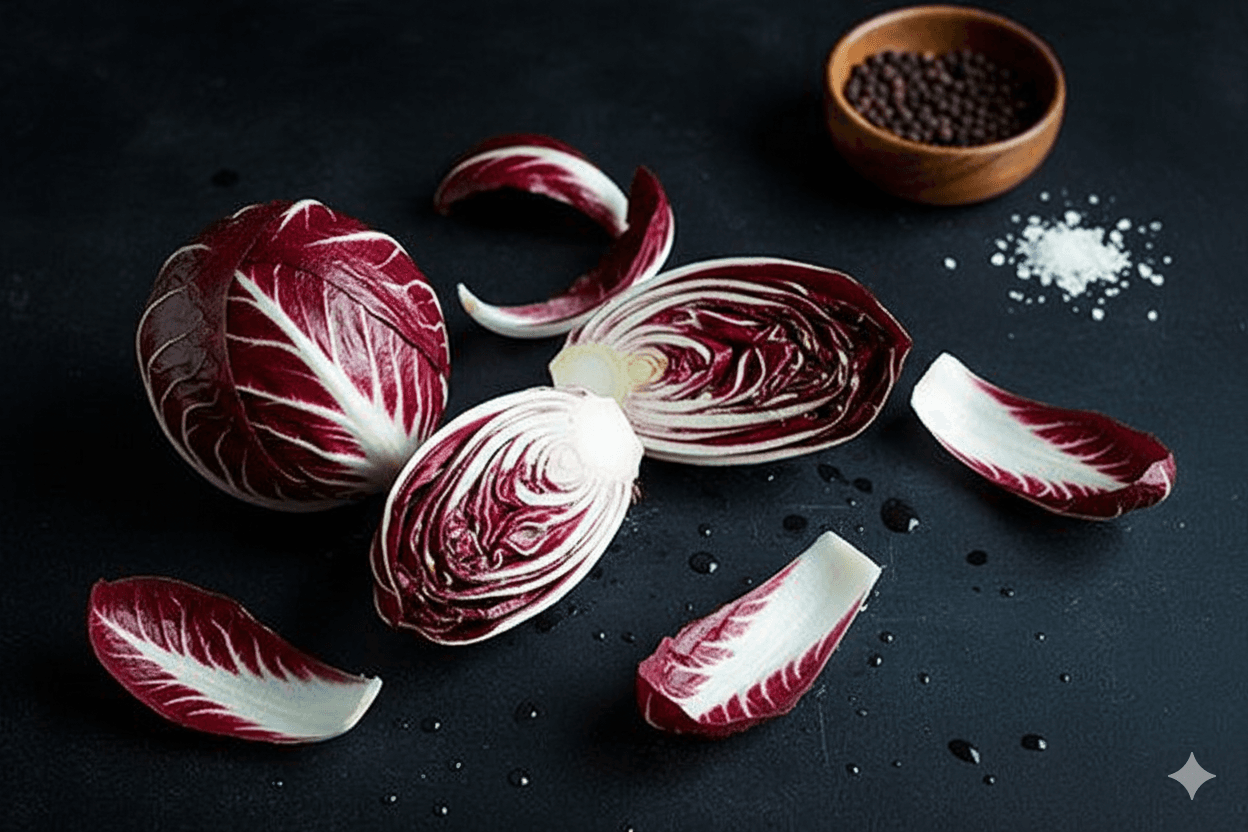
Radicchio Rosso di Treviso (Generated by Artificial Intelligence)
Type(s) | Protected Geographical Indication (PGI) | ||||||||
|---|---|---|---|---|---|---|---|---|---|
Product Type | Food | ||||||||
Combined Nomenclature Code | 07, 08, 10, 11, 20 | ||||||||
Country | Italy | ||||||||
Status | Registered | ||||||||
File Number | PGI-IT-1514 | ||||||||
Registration Date | 02/07/1996 | ||||||||
Producer Group | Consorzio Per La Tutela E La Valorizzazione Del Radicchio Rosso Di Treviso IGP E Del Radicchio Variegato Di Castelfranco IGP | ||||||||
Radicchio Rosso di Treviso PGI is a protected geographical indication (PGI) vegetable developed through careful selective breeding, innovative production methods, and artisanal craftsmanship of wild chicory grown in Italy. The product is characterized by its bright red color and mild bitter flavor.
The complete history of Radicchio Rosso di Treviso is shrouded in mythological accounts. One narrative claims that the first chicory seeds fell onto the roof of a church and were carefully tended by monks affiliated with a local monastery.
However, the most widely accepted account attributes the introduction of the plant to the region to Francesco Van de Borrem, a Belgian horticulturalist. It is believed that Van de Borrem applied his country’s chicory cultivation techniques to the Italian variety. By 1900, Radicchio Rosso di Treviso had become a local specialty, featured in dedicated exhibitions designed to showcase its distinctive qualities.
Radicchio Rosso di Treviso PGI is cultivated exclusively within a geographically limited area in northeastern Italy. This region encompasses specific municipalities surrounding the cities of Treviso, Padova (Padua), and Venezia (Venice). The area benefits from numerous natural spring sources, which are critical to the later stages of the production process.
Two varieties of the product are grown, differing slightly in taste and texture: an early variety and a late variety. Both varieties undergo similar processes to achieve the final product.
Plants are sown before the end of July and left in the fields throughout autumn. The early variety may be harvested at any point after 1 September. The late variety, however, must experience the first frosts before it can be harvested from the fields.
After harvest, the chicories are cleaned and their outer leaves removed. Heads are gathered into bunches or placed in nets or crates. At this stage, they are carefully stored to prevent any damage.
At this stage, the chicories undergo the “bleaching and forcing” process, which imparts their characteristic color, distinctive flavor, and crisp texture.
During this process, the plants are placed in dark tanks. Their stems are submerged in local spring water drawn from the region and maintained at a constant temperature. A critical rule of this procedure is that the leaves must never come into contact with the water.
This method is designed to awaken the plants from winter dormancy and stimulate new growth. The darkness of the tank prevents chlorophyll production, resulting in the whitening of the stems and creating the signature red-and-white contrast.
A final preparation step is required before the product can be sold as Radicchio Rosso di Treviso PGI. This step is performed exclusively by hand and demands a high degree of skill and finesse.
During this process, the outer leaves are carefully removed and the stem is delicately carved. This meticulous removal of the outer segments gives Radicchio Rosso di Treviso its distinctive final appearance. After this step, the product is ready for sale.
European Commission. "EUGI00000013392 (Radicchio Rosso di Treviso (PGI)) Record." *E-Ambrosia Geographical Indications Register.* Accessed October 24, 2025. https://ec.europa.eu/agriculture/eambrosia/geographical-indications-register/details/EUGI00000013392.
European Commission. "Radicchio Rosso di Treviso." Accessed October 24, 2025. https://agriculture.ec.europa.eu/farming/geographical-indications-and-quality-schemes/geographical-indications-food-and-drink/radicchio-rosso-di-treviso_en.

Radicchio Rosso di Treviso (Generated by Artificial Intelligence)
Type(s) | Protected Geographical Indication (PGI) | ||||||||
|---|---|---|---|---|---|---|---|---|---|
Product Type | Food | ||||||||
Combined Nomenclature Code | 07, 08, 10, 11, 20 | ||||||||
Country | Italy | ||||||||
Status | Registered | ||||||||
File Number | PGI-IT-1514 | ||||||||
Registration Date | 02/07/1996 | ||||||||
Producer Group | Consorzio Per La Tutela E La Valorizzazione Del Radicchio Rosso Di Treviso IGP E Del Radicchio Variegato Di Castelfranco IGP | ||||||||
No Discussion Added Yet
Start discussion for "Radicchio Rosso di Treviso" article
Historical Origins
Production Area and Geographical Conditions
Cultivation and Harvest
Bleaching and Forcing Process
Final Preparation and Shaping