


This article was automatically translated from the original Turkish version.
+1 More
Rahvan riding is a traditional equestrian style based on the rahvan gait, a smooth and rhythmic movement in which the horse moves both legs on the same side simultaneously. This gait provides comfort to the rider and enables the horse to cover long distances with less energy expenditure. In Turkish culture, rahvan riding has persisted for centuries across Anatolia as a means of transportation, sport, and recreation.
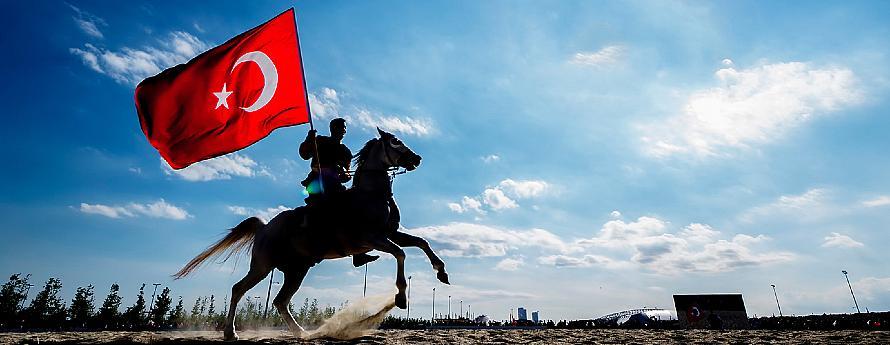
A visual representing rahvan riding. (Marmara Ata Sports Federation)
The rahvan gait involves the simultaneous movement of the front and hind legs on the same side of the horse. This gait differs from natural gaits such as the walk, trot, and canter. Horses capable of naturally performing the rahvan gait are rare, and this ability is largely determined by genetic predisposition. A horse must possess at least 50 percent rahvan genetic traits to be born with the capacity to perform this gait.
The rahvan gait is energy-efficient and comfortable for both rider and animal. During this gait, the rider experiences almost no jolting. For this reason, rahvan horses are ideal for cargo transport and long-distance travel. At the same time, the steps of a rahvan horse are short but extremely rapid; in a well-trained rahvan horse, the foot movements during motion can be too fast to follow visually.
Rahvan horses possess a specialized anatomical structure suited to this gait. Their wrists are short and flexible. Their joints are large and robust. Their chests are deep, their shoulders are sloping and supple. Their respiratory and circulatory systems are well developed. Their hooves are hard and high. Their backs are short. In addition, they have strong metabolisms, noble temperaments, and are loyal and docile toward humans.
The main horse breeds in Türkiye with the rahvan gait are:
The regions where rahvan riding is most commonly practiced are:
The origins of rahvan riding lie in the Turkic cultural environment of Central Asia. With Turkic migrations, rahvan horses were brought to Anatolia and retained their importance during the Seljuk and Ottoman periods. The earliest written record appears in the Şine-Usu text of the Orkhon Inscriptions, erected in 745 CE, where it is referred to as "Yorga Yarış." This is recognized as the oldest documented example of rahvan riding.
During the Ottoman period, rahvan horses were especially preferred. In Anatolia, where extensive pastures were scarce, rahvan horses—requiring little feed, causing minimal fatigue to riders, and capable of covering long distances quickly—were widely used for transportation and communication.
Today, the breeding and riding of rahvan horses continue in various regions of Türkiye. This traditional equestrian discipline is preserved and promoted under the umbrella of the Türkiye Geleneksel Spor Dalları Federasyonu. Rahvan races form an important part of local festivals and fairs, during which it is customary to play the Köroğlu rhythm accompanied by davul-zurna.
Rahvan riding is not merely an equestrian technique; it is also an integral part of Turkish culture. Throughout history, rahvan horses and rahvan riding have held a significant place in military, transportation, and traditional sports contexts. Today, they remain vital elements of traditional life and cultural continuity.
MarmaraAta Sporları Federation. "Rahvan Binicilik." Accessed May 13, 2025. https://www.atasporlari.org.tr/egitimler/binicilik/rahvan-binicilik.
Turkish Ministry of Culture and Tourism, "Rahvan At Races,"Muğla İl Directorate of Culture and Tourism, Accessed May 13, 2025. https://mugla.ktb.gov.tr/TR-73672/rahvan-at-yarislari.html.
Türkiye Geleneksel Equestrian Sports Federations. "Rahvan Binicilik." TGASDF, Accessed May 13, 2025. https://www.tgasdf.gov.tr/rahvan-binicilik/.

Characteristics of the Rahvan Gait
Physical Characteristics of Rahvan Horses
Breeds and Prevalence
History of Rahvan Riding
Rahvan Riding Today