


This article was automatically translated from the original Turkish version.
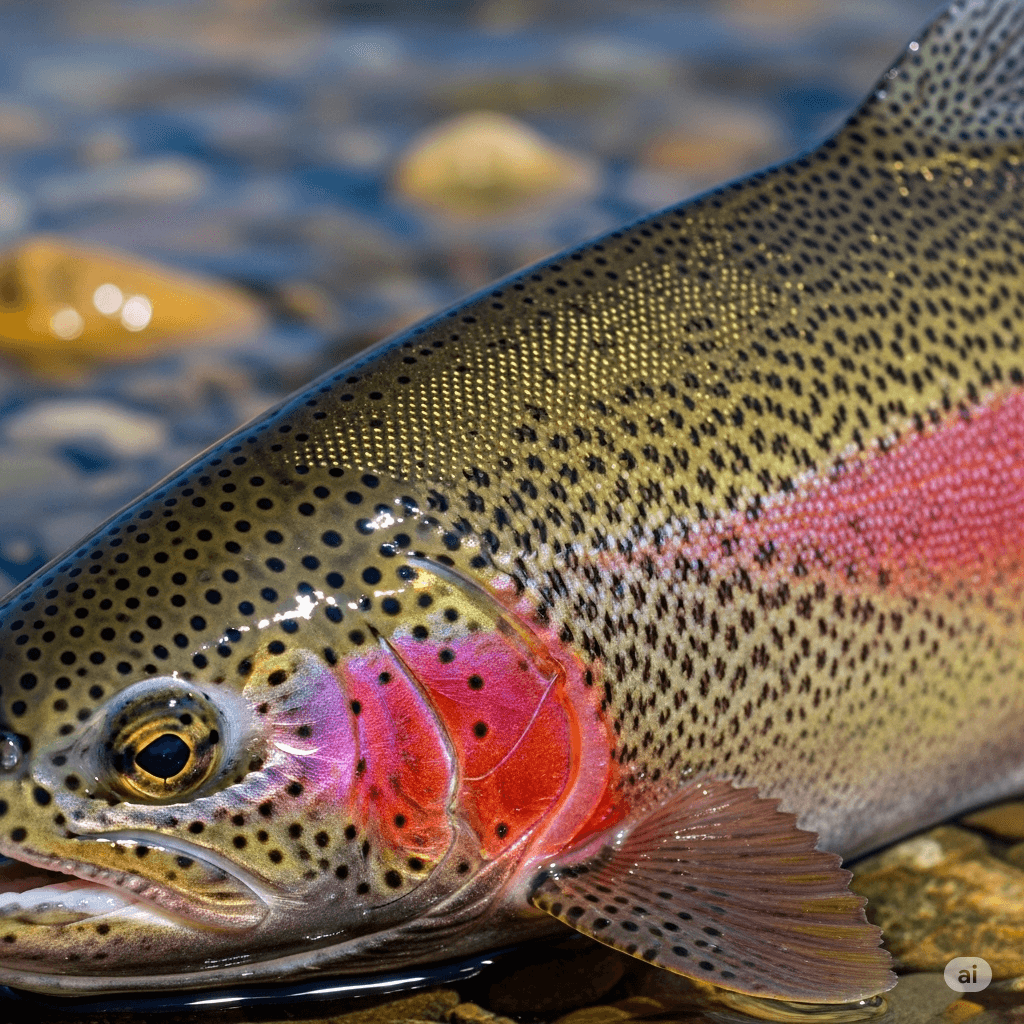
Rainbow Trout
Scientific Name(s) | Oncorhynchus mykiss | ||||||||
|---|---|---|---|---|---|---|---|---|---|
Family | Salmonidae | ||||||||
Natural Origin | Pacific coasts of North America and Asia | ||||||||
Appearance | Prominent pink-red stripe along the side | ||||||||
Habitat | Prefers clean and oxygen-rich waters cool | ||||||||
Reproduction(s) | Spawns in spring months in the wild | ||||||||
Rainbow trout (Oncorhynchus mykiss) is a freshwater fish species belonging to the Salmonidae family. Native to rivers and lakes draining into the Pacific Ocean in North America and Asia, this species has been widely introduced globally for food and sport fishing purposes.

Rainbow Trout (Pexels)
The rainbow trout is classified within the Salmonidae family, characterized by the presence of an adipose fin. It belongs to the genus Oncorhynchus, which also includes Pacific salmon. Until 1989, it was classified within the genus Salmo due to similarities in life cycle, habitat, diet, and appearance with the brown trout (Salmo trutta). However, morphological and genetic studies revealed that salmon and trout native to the Pacific basin constitute a distinct genus, subsequently named Oncorhynchus. Today, the genus Salmo includes only species native to Europe and northern Africa, such as the Atlantic salmon (S. salar) and the brown trout (S. trutta). The rainbow trout is not closely related to species in the genus Salvelinus, such as the brook trout (S. fontinalis) or lake trout (S. namaycush), which are biologically classified as “charr”.
The rainbow trout derives its name from the prominent reddish or pink stripe along its lateral side. Consequently, it is sometimes referred to as the “redband trout”. The color of spots can aid in distinguishing between different genera:
Although color variants such as “golden” or “blue” rainbow trout exist, these are merely different morphological forms of the same species. The chemical composition of fresh rainbow trout fillet averages 72.31% water, 20.15% protein, 4.61% fat, and 1.29% ash.
Wild Rainbow Trout, United Kingdom (CHASING SCALES)
The native range of the species extends along the western coast of North America from Mexico to Alaska, encompassing rivers and lakes that drain into the Pacific Ocean. They are also found along the Pacific coast of Russia, particularly on the Kamchatka Peninsula.
The rainbow trout has been introduced by humans to many countries, including the United Kingdom. It is now present on every continent except Antarctica. This widespread distribution is due to its high adaptability and favorable traits for aquaculture.
Rainbow trout prefer clear, clean, cool, and oxygen-rich waters. However, they are more tolerant of higher water temperatures than brown trout. Key water quality parameters considered ideal for aquaculture include:
Rainbow trout exhibit both resident (freshwater-only) and anadromous (migrating to the sea for part of their life cycle) forms. The anadromous form is known as “steelhead”. Unlike brown trout, which spawn in autumn or winter, rainbow trout spawn in spring. Spawning timing varies with water temperature, occurring as early as January in warmer regions such as California and as late as June in colder areas. Spawning typically coincides with rising water temperatures. Steelhead spend approximately two years in freshwater before migrating to the sea. Unlike some Pacific salmon species, both rainbow trout and steelhead can spawn multiple times in their lifetime (iteroparous).
Generally, they feed on aquatic and terrestrial invertebrates found at or near the surface or bottom of rivers and lakes. This primary diet is supplemented by terrestrial insects or other fish.
Rainbow trout share habitats and spawning times with the closely related cutthroat trout, leading to frequent hybridization between the two species. The widespread introduction of rainbow trout beyond its native range has threatened unique cutthroat trout populations in rivers of western North America. Similarly, their introduction into originally fishless lakes in California’s Sierra Nevada region has caused significant declines in the Sierra Nevada yellow-legged frog population. In introduced regions, rainbow trout can negatively impact native wildlife; for example, in New Zealand, competition and disease transmission by rainbow trout are believed to have contributed to the extinction of the native grayling, a now-extinct fish species.
Rainbow trout are widely farmed for both food and recreational fishing, and are regularly stocked in lakes and rivers. Commercial aquaculture of the species began in the 1880s at hatcheries along the McLeod River and in San Leandro, California. Today, the majority of rainbow trout produced globally trace their origin to these two hatcheries.
In 2020, approximately 1.02 million metric tons of rainbow trout were produced worldwide across 77 countries. Türkiye ranked second globally in production that year with 144,283 metric tons, following Iran. Rainbow trout farming in Türkiye began in the 1970s and accounted for 35% of the country’s total aquatic product production in 2021, which reached 471,686 metric tons. Production occurs in 68 provinces, with Elazığ (26,500 tons) and Muğla (22,000 tons) recording the highest yields. Rainbow trout grown in sea cages in the Black Sea region, reaching over one kilogram in weight, are marketed commercially as “Turkish Salmon”.
Rainbow trout is a highly nutritious food source. It is consumed fresh and also processed by methods such as smoking. Hot smoking reduces the fish’s water content, thereby increasing the relative proportions of protein, fat, and ash. One study found that the chemical composition of hot-smoked fillets averaged 59.26% water, 28.05% protein, 9.51% fat, and 2.02% ash.
Aydın, Fikri. *Alabalık Biyolojisi ve Yetiştirme Teknikleri*. Ankara Üniversitesi Ziraat Fakültesi Su Ürünleri Bölümü, 2009. Accessed June 5, 2025. https://www.tarimorman.gov.tr/BSGM/Belgeler/Icerikler/Su%20%C3%9Cr%C3%BCnleri%20Yeti%C5%9Ftiricili%C4%9Fi/1-%20Alabal%C4%B1k%20Biyolojisi%20ve%20Yeti%C5%9Ftirme%20Teknikleri.pdf.
CHASING SCALES. *Wild Rainbow Trout, UK*. YouTube, 4:59. 2020. https://www.youtube.com/watch?v=BpF03e0jMvw&t=98s. Accessed June 5, 2025.
Oğuzhan, Pınar, Simay Angiş, H. İbrahim Haliloğlu, and Muhammed Atamanalp. “Gökkuşağı Alabalığı (Oncorhynchus mykiss) Filetolarında Sıcak Tütsüleme Sonrası Kimyasal Kompozisyon Değişimleri.” *Ege Journal of Fisheries and Aquatic Sciences* 23, no. 3 (2006). Accessed June 5, 2025. http://www.egejfas.org/en/download/article-file/57761.
Yıldırım, Önder, and İsmail Berat Çantaş. “Türkiye’de Gökkuşağı Alabalığı Yetiştiriciliğinin Üretim ve Ekonomik Göstergelerinin İncelenmesi.” *Acta Aquatica Turcica* 18, no. 4 (2022): 461–474. Accessed June 5, 2025. https://doi.org/10.22392/actaquatr.1101098.
Özkan, Yaşar. *Alabalık Biyolojisi ve Yetiştirme Teknikleri*. Accessed June 5, 2025. https://antalya.tarimorman.gov.tr/Belgeler/Yetiştirici%20Bilgileri/Alabalık%20Yetiştiriciliği.pdf.
“Rainbow Trout.” Wild Trout Trust. Accessed June 5, 2025.

Rainbow Trout
Scientific Name(s) | Oncorhynchus mykiss | ||||||||
|---|---|---|---|---|---|---|---|---|---|
Family | Salmonidae | ||||||||
Natural Origin | Pacific coasts of North America and Asia | ||||||||
Appearance | Prominent pink-red stripe along the side | ||||||||
Habitat | Prefers clean and oxygen-rich waters cool | ||||||||
Reproduction(s) | Spawns in spring months in the wild | ||||||||
No Discussion Added Yet
Start discussion for "Rainbow Trout (Oncorhynchus mykiss)" article
Taxonomy and Classification
Description
Distribution and Habitat
Natural Habitat
Introduced Regions
Habitat Requirements
Biology and Ecology
Life Cycle and Reproduction
Diet
Ecological Interactions and Impacts
Relationship with Humans
Aquaculture
Use as Food